

Description
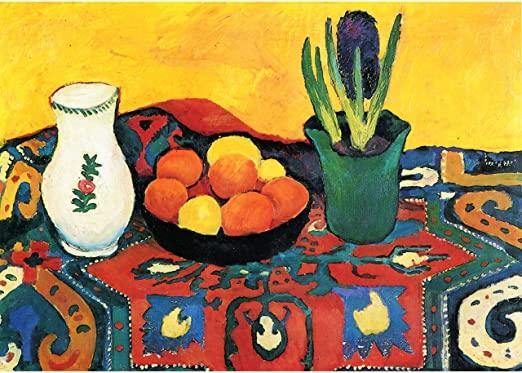
The painting depicts a still life by August Macke, composed around 3 balanced visual focal points: a white jug on the left, a dark bowl of fruit in the center, and a greenish-blue pot of hyacinths on the right. The jug, with its broad body and narrow neck, has a wavy rim and a red-and-green floral motif that makes it an ornamental focal point. The fruit, grouped in shades of orange, red and yellow, concentrates color at the center of the scene, while the plant raises its long leaves and dark upright bud. Everything rests on a multicolored carpet or fabric, against an orange-yellow background with visible brushstrokes.
As a still life, the work does not depict an action or feature any figures: it focuses attention on everyday objects coexisting in a domestic space transformed by color. The decorated jug, grouped fruit and flowering plant link the painting to the still-life tradition, which is based on the careful arrangement of shapes, visual weight and contrasts. Here, however, the elements are not subordinated to a naturalistic depiction. The carpet plays a decisive role, extending the pictorial interest from the objects to the surface that supports them and turning the composition into an ornamental arrangement.
Each object is part of a network of visual relationships. The floral decoration on the jug enters into a dialogue with the hyacinths and the patterns on the rug. The fruit introduces the traditional motif of abundance, though its presence is perceived above all as a cluster of rounded forms set against the geometry and vertical lines of the plant. The hyacinths add height and a vegetal counterpoint to the jug’s and bowl’s broad forms. Covered in flowers, arabesques and geometric figures, the textile extends the still life into an almost textile conception of space: the objects emerge from a continuous decorative field rather than being isolated against a neutral surface.
The horizontal composition is organized through a rhythm of masses and directions. The jug’s compact volume guides the eye toward the central bowl, while the plant’s leaves extend the movement toward the upper right. The yellow background contrasts sharply with the ceramic white, greens, reds and blues in the foreground. The visible brushwork and simplified forms reduce conventional depth and deliberately make the textile’s motifs compete with the main objects. Even so, the overlapping jug, bowl and flowerpot retain a clear sense of space. The result is vibrant, warm and densely patterned, with a surface to be appreciated both for its objects and for its chromatic rhythm.
The work is consistent with August Macke’s tendency to use intense colors, simplified forms, and a decorative arrangement of space—features associated with his Expressionist painting and his interest in chromatic synthesis. In Still Life with Carpet and Hyacinths, the domestic scene is transformed into an architecture of color: the pitcher introduces an ornamental accent, the fruit concentrates the chromatic energy, the plant establishes the verticality, and the carpet unites all the elements through its expansive pattern. The eye moves from one motif to another without leaving the decorated surface; this is where the painting’s strength lies, in making a group of simple objects function as a complete, dynamic, and visually exuberant composition.
Have questions about our oil painting reproductions? See our frequently asked questions.