

Description
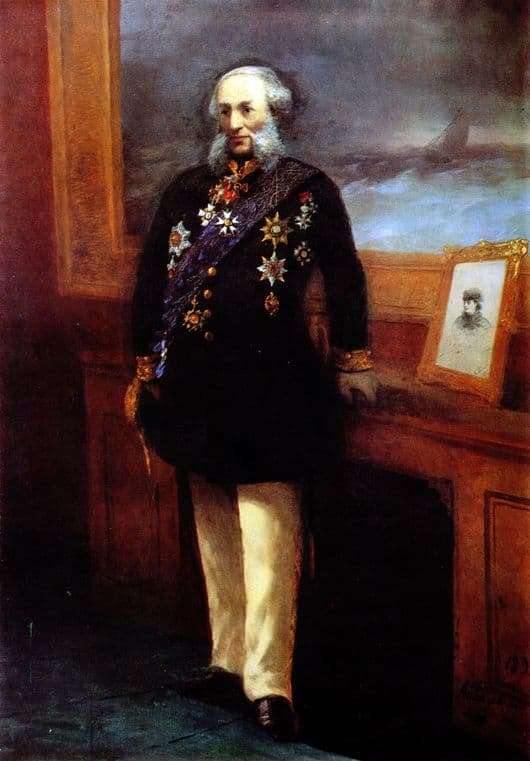
The painting shows Ivan Aivazovsky at full length, standing upright in the center of a wood-paneled interior. The artist appears as an older man with white hair, a beard, and a mustache, his gaze turned slightly to the left. He wears a long, dark garment covered with medals, stars, crosses, and sashes, along with light-colored trousers and dark footwear. To his right, a wooden piece of furniture holds a small portrait in a gilded frame; in the background, a luminous opening reveals a bluish expanse of sky and landscape. The scene thus brings together the sitter’s physical presence, signs of public recognition, and a domestic setting steeped in memory.
As a self-portrait, the work belongs to a genre in which the painter makes their own figure the subject of art. It presents not merely an individual, but a mature and distinguished personality, conscious of their position in public life. The frontal pose and the monumental scale of the figure reinforce this assertion of identity. Ivan Aivazovsky’s name also provides the context of an artist widely recognized for his seascapes and his sensitivity to light, atmosphere, and the changing effects of the landscape. That tradition appears here in a secondary role, concentrated in the luminous, open area in the background, while the core of the composition remains devoted to the honorific portrait.
The numerous decorations serve as visual signs of honor, rank, and recognition. Their accumulation transforms the chest into an almost heraldic surface, where each glint breaks up the darkness of the clothing and turns the figure into a public image. The small portrait placed on the piece of furniture adds a dimension of memory and self-representation: it establishes a relationship between the main figure and another human presence, smaller and more distant. The clear view of the background introduces a meaningful counterpoint to the enclosed interior. It can be read as an opening onto space and the imagination of landscape, but also as a visual pause that prevents the figure’s solemnity from becoming completely rigid.
The vertical composition draws attention to the artist’s body, which serves as a stable axis between the dark panels on the left and the piece of furniture balancing the right side. The lighting is reserved especially for the face, the decorations, and the ivory trousers, creating a sequence of bright accents against a foundation of blacks, reddish browns, and golden ochres. The bluish background adds depth and a distinct chromatic breath, while the moldings, frames, and lines of the furniture organize the space with measured geometry. The relationship between the dominant figure and the small portrait further emphasizes the hierarchical scale: the artist’s monumental present contrasts with a secondary, intimate, and silent image.
In this Self-Portrait, Ivan Aivazovsky conveys the sitter’s authority with a sensitivity to light and landscape, qualities that connect the portrait to the breadth of his artistic practice without displacing its human center. The work turns maturity into a visual declaration: the face, clothing, and decorations speak of a firmly established identity, while the piece of furniture and the luminous opening situate that identity between private memory and public presence. It is worth observing how each glint of the medals leads the eye back to the face, and how the landscape in the background lightens the composition’s gravity without disrupting it. The result is an image of an artist in which prestige, memory, and contemplation are brought together in a single scene.
Have questions about our oil painting reproductions? See our frequently asked questions.