

Description
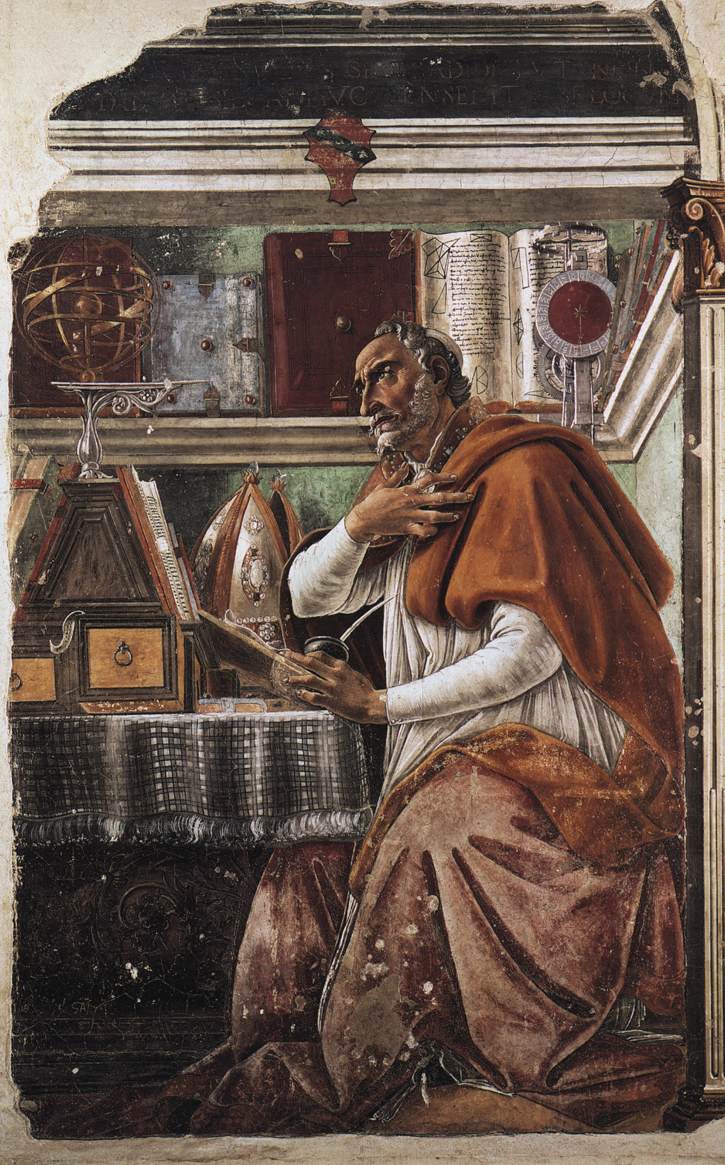
The painting shows Saint Augustine seated inside a study, leaning over an open volume that draws the attention of his hands and gaze. His bearded figure occupies the center-right of the composition, distinguished by a light tunic, a voluminous reddish cloak and a brown garment falling in folds over his legs. A landscape of knowledge unfolds around him: open and closed books, pages covered with writing and diagrams, an armillary sphere, a circular instrument and small objects gathered on work surfaces. On the left, a wooden cabinet with drawers supports part of this scholarly world; a column frames the right side, and an architectural band runs across the top.
Saint Augustine is one of the great saints and Fathers of the Christian Church, as well as a bishop and a seminal author in the Western Christian tradition. The scene depicts him in his study, where reading and writing take on a spiritual dimension. The saint is not shown apart from the culture of his time: he is surrounded by instruments, manuscripts and books that make intellectual reflection the visible core of his identity. In this way, the work brings together two forms of authority that tradition has associated with him: that of the thinker devoted to understanding the faith and that of the religious man devoted to contemplation.
The books and carefully arranged pages serve as attributes of theology, writing, and reasoning, while the armillary sphere and circular instruments broaden the study to encompass observation of the order of the world. The gesture of the hand raised toward the chest introduces an expressive pause: it may be understood as meditation, explanation, or intellectual affirmation. The abundance of objects does not distract from the scene but creates an environment in which every element reinforces the relationship between knowledge, contemplation, and faith. The interior thus takes on the character of a place of retreat, not because it is empty, but because all its energy is concentrated in the figure reading and thinking.
The vertical composition guides the eye along a diagonal descending from Saint Augustine’s face toward the book and hands. The earthy red of his robe serves as a chromatic focal point against the browns, ochres, muted greens, and blacks of the furnishings and background. The horizontal surfaces of the table and shelves balance the figure, while the column on the right provides an architectural boundary that organizes the space. The clearly defined outlines and meticulous accumulation of objects create a sense of precision; at the same time, the warm light on the face, hands, and pages sets the intellectual core apart from the aged, shadowy surroundings.
In keeping with traits widely associated with Sandro Botticelli and the Florentine Renaissance, the work combines linear drawing, elegant contours, refined color, and a religious narrative open to the humanist interest in culture. The figure is not reduced to a saint identified by external attributes: his holiness is conveyed through his concentrated posture, the ordered study, and the relationship between his body and the book. It is worth observing how the architecture frames this act of reading, and how the instruments visually extend thought beyond the pages. In this dialogue between devotion, knowledge, and form, Saint Augustine emerges as a spiritual presence whose authority also springs from his intellect.
Have questions about our oil painting reproductions? See our frequently asked questions.