

Description
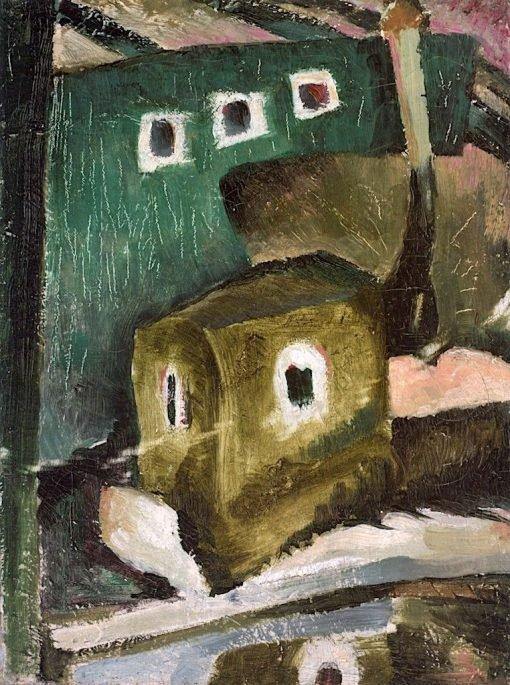
The painting presents Boats on the Harlem River as a concentration of compact, angular volumes, dominated by a large dark green mass at the top and a smaller form in olive and brown tones below. Small light openings are scattered across these structures, adding points of light within the dense colors. A vertical black band cuts through the composition, creating a stark division between the planes, while white, beige, and pink surfaces surround the main forms. The riverside landscape is condensed into a scene of overlapping masses, where boats and their surroundings are perceived through fragments of color, texture, and movement.
The title places the work on the Harlem River, a tidal strait in New York City that separates Manhattan from the Bronx. Rather than offering a topographical description, Arthur Dove transforms this urban setting into a concentrated visual experience: the boats, riverside structures, and water merge into a single field of forms. The geographical reference provides a specific setting, but the painting moves away from the panoramic view and narrative detail. The space appears compressed, filled with dense bodies, fractured reflections, and rhythms of movement that turn the landscape into an intensely material pictorial construction.
The luminous openings serve as points of orientation within the green and dark masses. Their repetition introduces an almost architectural cadence and connects the volumes with windows, cabins, or structural details, without fully separating boat, building, and reflection. Below, the grayish planes and diagonal bands evoke a fragmented water surface, crossed by movement. The contrast between the light areas and earthy tones heightens the sense of a compressed landscape, in which the water is not a passive backdrop but a force that divides, reflects, and rearranges the structures.
The composition is built from large vertical and diagonal masses that occupy almost the entire picture field. The upper green form establishes the dominant focus; below it, the olive volume balances its weight and extends the visual descent toward the lower band. The dense, vertical brushstrokes reveal the energy of the surface, especially in the greens, where texture gives the color a physical presence. Dark edges outline and interweave the planes, while small white areas interrupt the chromatic density like flashes of light. Depth depends not on conventional perspective, but on layering, tonal contrast, and the rhythmic force of the diagonal lines.
In Arthur Dove’s work, lyrical modernism transforms nature and landscape into expressive relationships of color, form, texture, and rhythm, without relying on literal representation. This work reflects that sensibility by turning a river scene recognizable from its title into an almost abstract construction of greens, blacks, pinks, and grays. Attention is drawn to the way each light opening alters the weight of the forms around it, and to how the lower bands preserve the idea of water without depicting it directly. The result is a landscape in which boats, architecture, and reflection merge into a single, dense and dynamic pictorial substance.
Have questions about our oil painting reproductions? See our frequently asked questions.