

Description
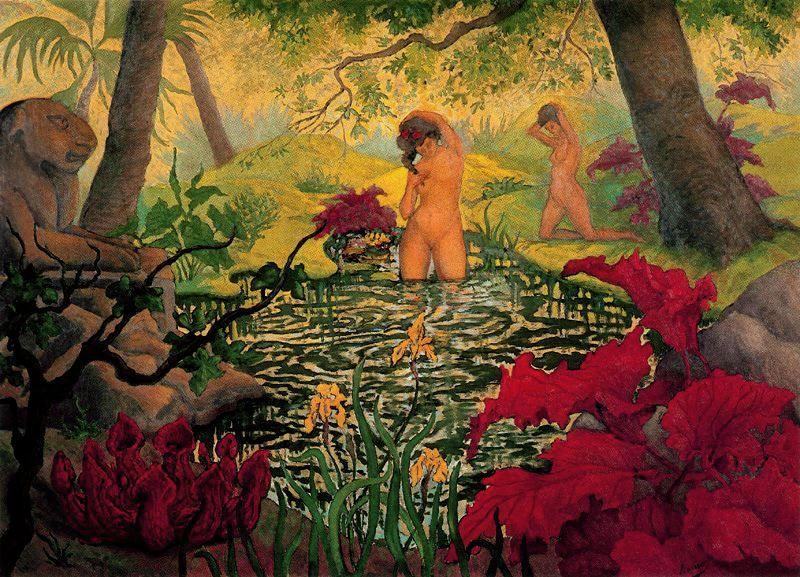
The painting depicts a bathing scene in a tropical garden, arranged around a shallow, clear pond. At the center, a nude figure stands in the water, face turned toward a small cluster of dark flowers held close to the face. In the background, among the trunks and leaves, another figure echoes the human presence in a more side-on pose, with one arm raised toward the head. On the left, a large brown-furred feline rests, partly concealed among roots and trees. Red, yellow and orange flowers, together with vines and twisted branches, transform the setting into a dense, enveloping and sensual space.
The Bathing Place does not depict a specific historical, religious or mythological episode, but rather an intimate moment spent beside the water. The scene brings human bodies and lush nature into close relationship: the figures do not dominate the landscape, but seem to blend into it. The pond serves as a place of rest and encounter, while the feline’s presence introduces an element of wild life into this fantastical garden. The distance between the central figure and the one in the background creates a brief visual narrative, as though the viewer were witnessing a shared pause, isolated from the outside world.
The water and its ripples evoke a sense of calm and sensory connection with the surroundings. The profusion of flowers heightens the composition’s ornamental, exotic character, especially through the contrast between the red petals in the foreground and the yellow and orange hues bordering the pond. The feline, positioned among roots and trunks, introduces an untamed presence that balances the figures’ nudity with a more powerful and mysterious nature. Set in different planes, the two figures make bathing a contemplative experience: their bodies provide points of human interest within a scene dominated by vegetation.
The horizontal composition opens like a stage enclosed by the large trunks at the sides and the branches forming an arch overhead. This leafy frame draws the eye toward the water and the central figure, which serves as the narrative and chromatic focal point. The red flowers in the foreground form an ascending diagonal from the lower-right corner toward the center, while the ripples in the pond introduce a gentler, more repetitive rhythm. Golden light, filtered through the foliage, unifies the bluish greens, browns, and warm hues of the flowers. Depth is created through the overlapping roots, water, bodies, and trees, without disrupting the sense of a decorative surface.
In Paul Ranson’s work, this sensitivity to stylized forms, ornamental contours, and the integration of figures, landscape, and botanical motifs takes on a particularly immersive quality here. Associated with the Nabis group, the artist transforms the tropical garden into an almost fantastical composition in which every element contributes to a unified visual fabric. It is worth noting how the pond is not merely the setting for the action: it also organizes the work’s color, depth, and rhythm. Among the flowers, the feline, and the nude figures, The Bathing Place turns a simple scene into an intimate, dreamlike, ornamental vision of nature.
Have questions about our oil painting reproductions? See our frequently asked questions.