

Description
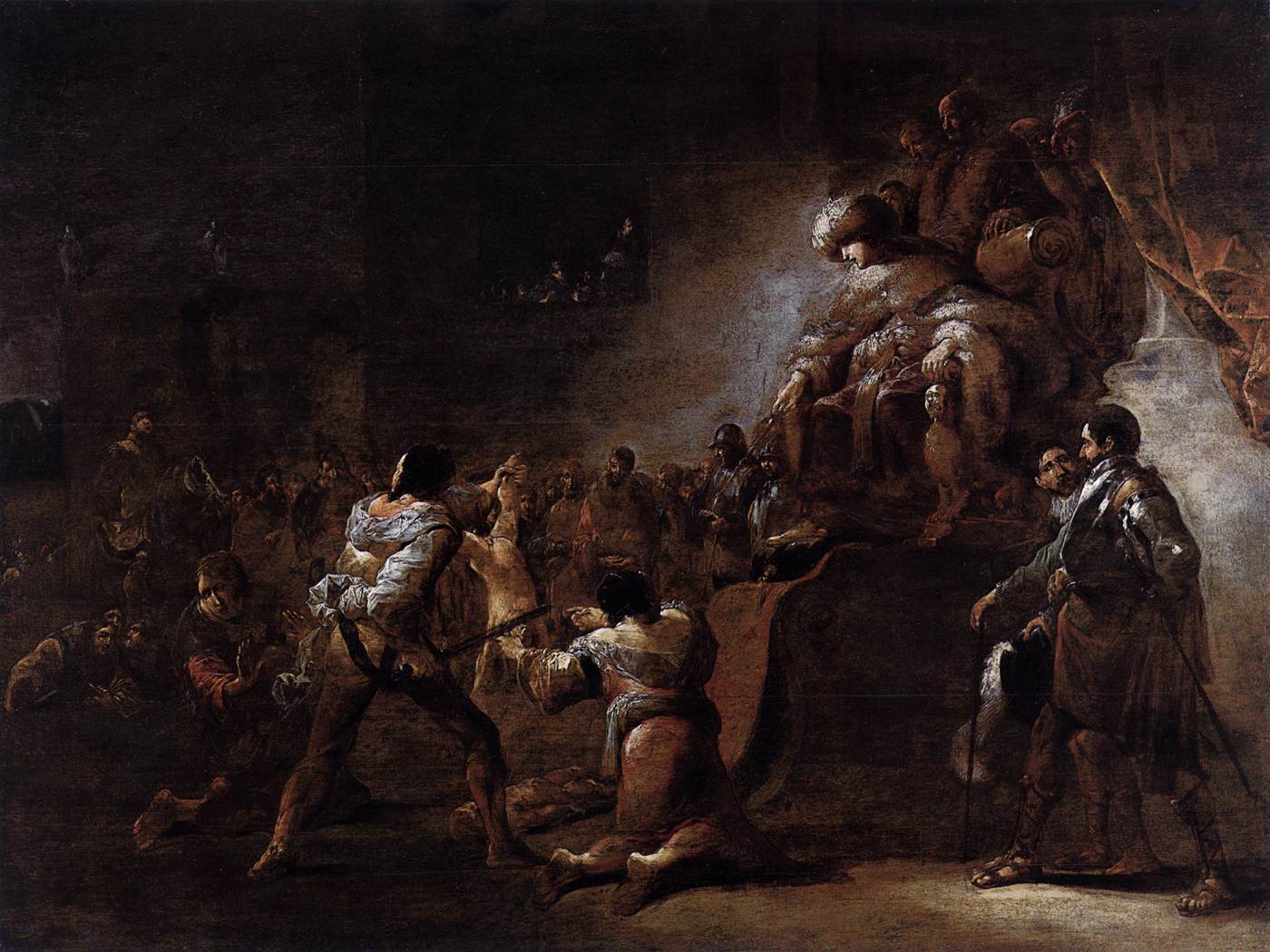
The painting depicts The Judgment of Solomon as a crowded, tense, and deeply theatrical audience. At center-right, a regal figure sits in an elevated position, dressed in dark and reddish tones, visually presiding over those gathered before him. Attendants and petitioners cluster around him: some stand, others bow or kneel, and several figures occupy the foreground floor. An illuminated staircase rises at the far right, beside two standing figures, while helmets, staffs, or long weapons emphasize the presence of a guarded, ceremonial court. The interior architecture, formed by walls and vertical structures shrouded in shadow, encloses the scene and focuses all attention on the act of judgment.
The episode comes from the biblical account that made Solomon a model of wisdom and discernment. Two women appear before the king, each claiming the same child. To uncover the truth, Solomon proposes dividing the child; the true mother would rather give him up than let him be harmed, and this act of compassion reveals her identity. The painting translates this moral conflict into an image of public authority: rather than presenting a domestic scene, it depicts a royal decision witnessed by a crowd. The hierarchical arrangement of the figures makes visible the distance between the person charged with resolving the dilemma and those who wait, plead, or await the outcome.
The iconography relies especially on gestures and differences in height. Solomon stands apart from the level of those appearing before him, as a figure of judgment whose authority is expressed both by his position and by the light falling on him. The kneeling and bowing figures introduce a body language of supplication and submission, while the gathering of onlookers turns the case into a solemn event. The staircase forms an ascending diagonal and reinforces the idea of access to a higher authority. Elements evoking guards or court attendants add tension and vigilance to the scene, without shifting the center of gravity away from moral discernment.
The horizontal composition is organized around a large dark mass advancing from the left toward the illuminated focal point in the center-right. The bowed bodies in the foreground create successive diagonals that guide the eye toward the seated figure; the staircase extends this movement upward. The earthy palette—blacks, browns, ochres, muted reds, and grayish whites—unifies the crowd and makes the lighter accents stand out like signals in the gloom. Depth is created through overlapping figures, shifts in lighting, and architectural fragments, while the group’s density produces an almost theatrical rhythm. The light does not fall evenly: it picks out the authority figure, certain gestures, and particular areas of drapery, transforming darkness into an active part of the narrative.
In Leonaert Bramer’s work, this combination of biblical themes, nocturnal lighting, earthy colors, and theatrical staging is associated with the Caravaggesque direction of Dutch painting. The drama here arises from the union of a crowded court and a monumental space that seems to extend beyond the areas visible to us. It is worth noting how each pose establishes a relationship with Solomon: the elevated figure focuses the decision, while the bodies in the foreground turn the wait into a physical, collective experience. Thus, the painting does more than depict a celebrated judgment; it constructs before the viewer the moment when truth must make its way through the crowd, authority, and gloom.
Have questions about our oil painting reproductions? See our frequently asked questions.