

Description
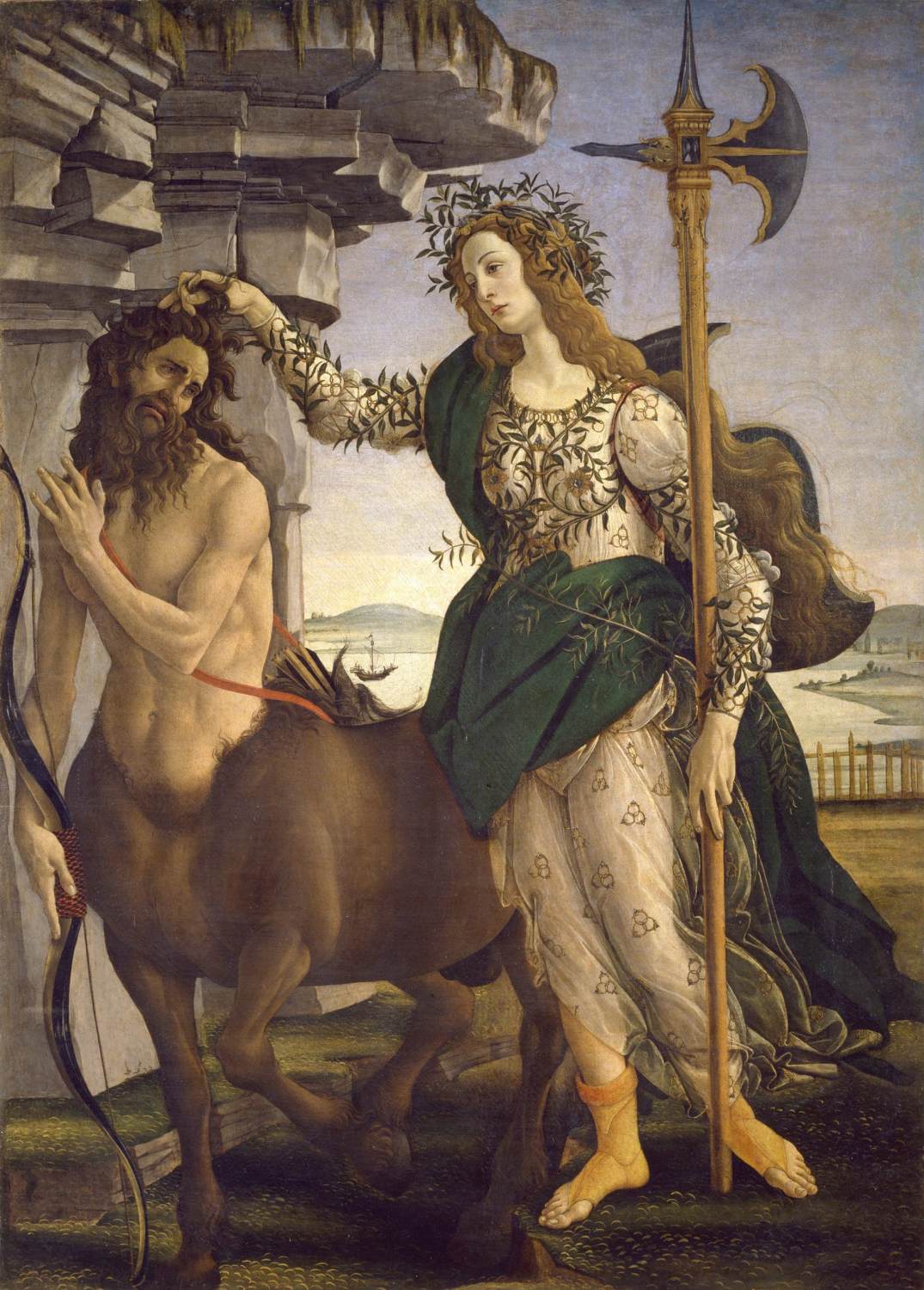
The painting depicts Pallas alongside a centaur in a coastal landscape with a fantastical atmosphere. The female figure occupies the right side of the central axis: she wears a light-colored tunic covered by a green mantle, a crown of leaves, and is surrounded by branches that extend across her clothing. She holds a vertical staff topped with a curved ornament and rests her hand on the head of the hybrid creature. Facing her, the bearded centaur bends his human torso while his equine body stretches to the left, beside a bow and several arrows. In the background, rocky formations, water, a small boat, low hills, and a fence extending the scene toward the horizon can be made out.
In classical mythology, Pallas is a name associated with Athena, goddess of wisdom, strategy, and just warfare. The centaur, a creature formed from a human torso and a horse’s body, introduces a physical, hybrid presence into the composition, one associated with instinctive force. The relationship between the two figures structures the scene without the need for a complex narrative episode: Pallas remains upright and composed, while the centaur adopts a bent posture beneath her restraining gesture. The contrast between verticality and torsion turns their encounter into an image of authority, balance, and order.
The attributes reinforce this interpretation. The staff makes Pallas a protective and martial presence, while the leafy crown and branches entwining her dress lend her a natural, peaceful quality. Beside her, the bow and arrows evoke the possibility of hunting, violence, or the untamed energy associated with the centaur. The vegetation thus serves as an organic counterpoint to the weapons, connecting the martial dimension with an idea of harmony. The coastal landscape broadens the allegory: the tiny boat, water, and hills place the mythical encounter in a habitable, peaceful world governed by measure.
The composition guides the eye through a precise interplay of lines and postures. The shaft establishes a firm vertical axis, set against the curve of the equine body, the centaur’s twist, and the sinuous contours of the branches. The woman occupies a visually dominant position, while the hybrid figure directs the movement to the left and lends depth to the foreground. Dark greens, ochres, browns, and grayish blues unify the figures with the terrain and the horizon. The soft light does not sharply separate the planes, but instead articulates the forms as parts of a single theatrical scene, suspended between nature, myth, and stone architecture.
These features connect the work with qualities widely associated with Sandro Botticelli: elegant linear drawing, stylized figures, flowing contours, and a poetic interpretation of classical mythology. The power of Pallas and the Centaur comes from turning the relationship between two beings into a visual structure of tensions: verticality versus torsion, reason versus impulse, weapon versus vegetation, and bodily proximity versus the breadth of the landscape. It is worth paying particular attention to Pallas’s hand on the centaur’s head, then following the path of the shaft, the branches, and the horizon; along this route, the image conveys a serene order that contains instinctive energy without erasing its presence.
Have questions about our oil painting reproductions? See our frequently asked questions.