

Description
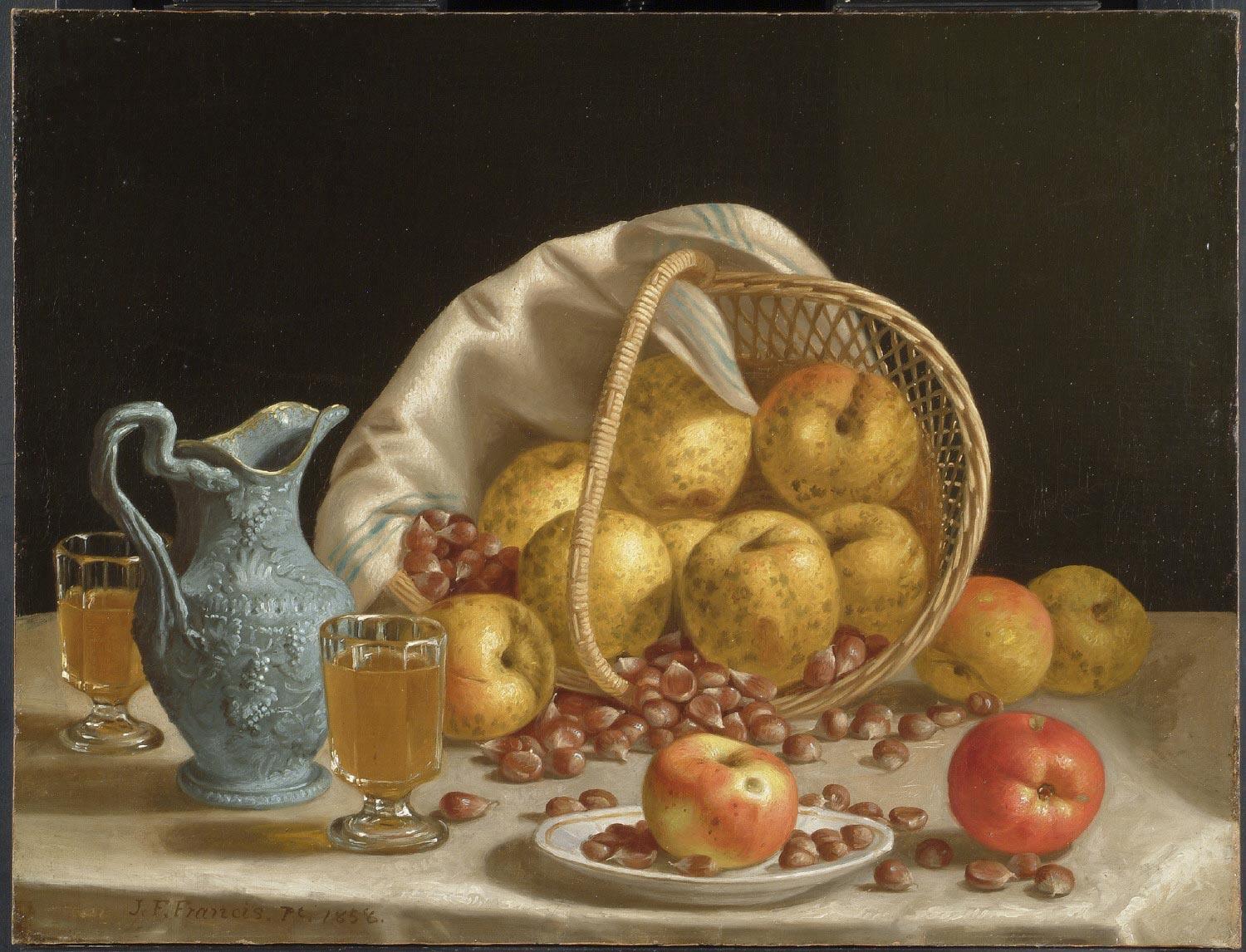
The painting depicts a still life of fruit and vessels arranged on a light-toned table. A wicker basket, tilted to the right and filled with pears, draws the eye to the center of the composition. Red and golden apples, bunches of grapes, and loose grapes are arranged around it, while an oval plate holds another piece of fruit in the foreground. On the left, a grayish-blue pitcher and two glasses of amber liquid balance the visual weight of the basket. A white or cream cloth falls behind the objects and stretches across the tabletop, set against an almost-black background.
As a genre, still life turns everyday objects into a subject for contemplation in their own right. There is no historical or religious narrative to decipher here: the focus is on the physical presence of the fruit, vessels, glass, pottery, and fabric. The abundance gathered on the table belongs to a pictorial tradition attentive to the richness of domestic life and the variety of natural forms. Within the tradition of 19th-century fruit still lifes associated with John F. Francis, the scene relies on a realistic treatment and focused lighting that make each object a visual experience.
The accumulation of pears, apples, and grapes evokes abundance, variety, and sensory richness without needing rigid symbolism to sustain its impact. The glasses and pitcher deepen this impression of domestic plenty and bring together different surfaces: the transparency of glass, the solidity of pottery, the roughness of the basket, and the soft folds of the cloth. The tilted basket introduces a slight tension into the overall stillness, as if its contents were about to spill onto the table. The spread of fruit invites the viewer to take in the arrangement slowly, moving from the larger objects to the small touches of color.
The visual structure is organized around a balance of masses and diagonals. The basket forms the main focal point at center right, while the pitcher and glasses counterbalance its volume on the left. The grapes trace an irregular line toward the foreground and draw the eye to the apples, which serve as points of chromatic emphasis. Golden yellows and orangey reds stand out against the browns and blacks of the background; the pitcher’s grayish blue introduces a cool pause in the warm palette. Concentrated light shapes the volumes, catches reflections in the glass, and precisely separates the objects from the darkness behind them.
This combination of abundant composition, realistic observation, and luminous contrast connects the painting with the fruit still lifes for which John F. Francis is known. Its richness depends not only on the number of elements, but also on how each material contributes to the rhythm of the scene: the weave of the basket, the taut surfaces of the fruit, the liquid gleam of the glasses, and the folds of the cloth. When viewing it, follow the diagonal from the grapes in the foreground to the tilted basket, then return to the blue pitcher: along this path, we can see how the artist transforms an everyday table into a composition of intense material presence, color, and light.
Have questions about our oil painting reproductions? See our frequently asked questions.