

Description
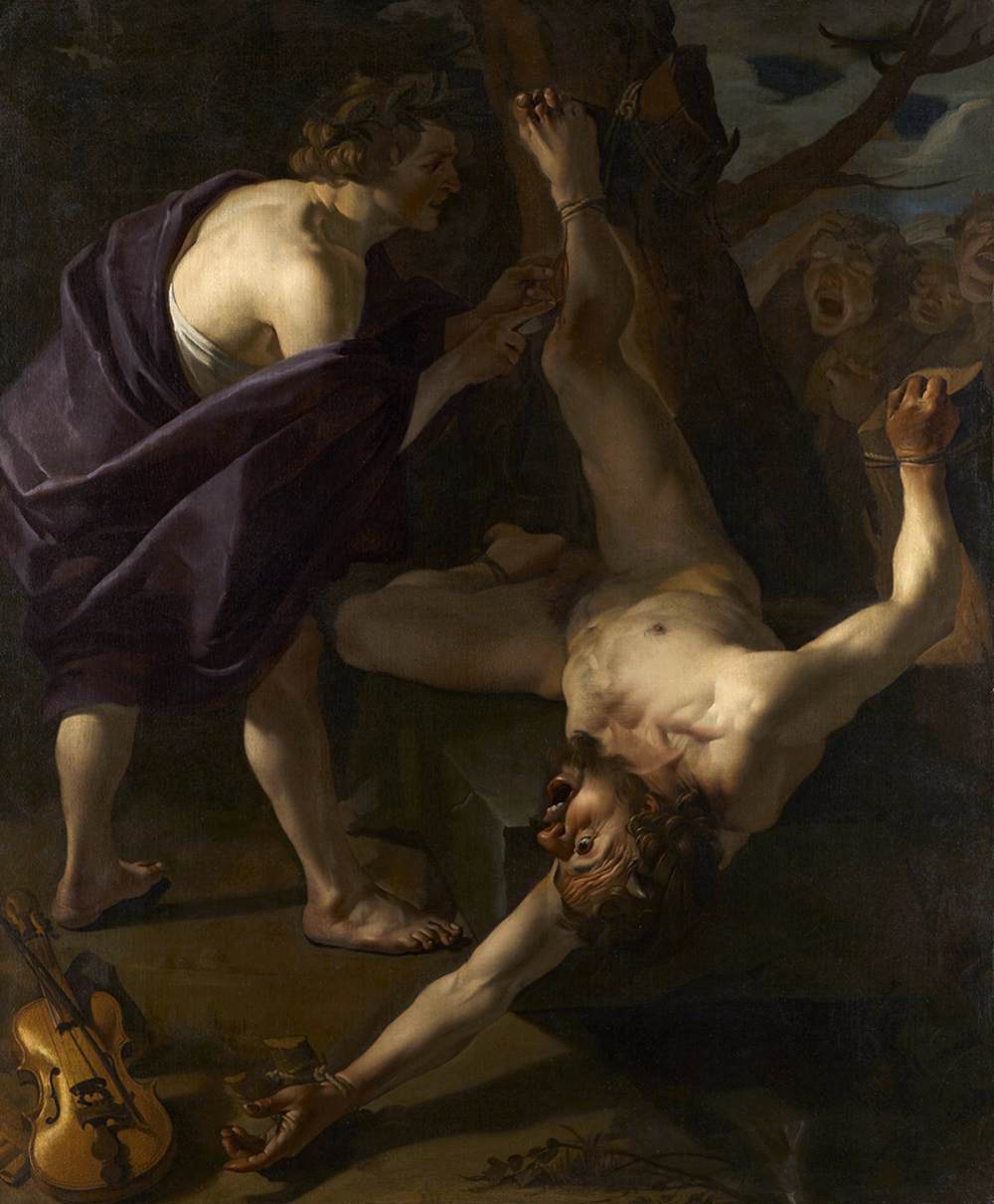
The painting shows Apollo flaying Marsyas in a dark, rugged landscape. On the left, a figure wrapped in a flowing purple cloth bends over the naked body of the musician, suspended upside down at the center of the composition. A narrow blade approaches his side, making this gesture the focal point of the action. In the background, among rocks, branches, and shadows, several human figures are partially visible, like onlookers witnessing or accompanying the episode. In the lower-left corner, a stringed musical instrument provides an essential clue to understanding the scene.
The story belongs to Greek mythology. Marsyas, a satyr and musician, challenged Apollo to a musical contest; after defeating him, the god punished him by flaying him. The work focuses on the cruellest moment in that story and contrasts two forms of power: the challenger’s musical skill and the absolute authority of the divine. The instrument near the lower edge recalls the origin of the dispute, while Marsyas’s inverted body makes the extreme consequence of his challenge visible. The myth thus brings competition, pride, music, and punishment together in a single scene of ritual violence.
The elements of the composition function as signs that extend the narrative. The stringed instrument alludes to the musical contest and establishes a link between the beauty of art and the brutality of the outcome. Marsyas’s inverted pose heightens his helplessness: his body is exposed, unsupported, and subjected to the movements of the figure punishing him. The figures in the background, partially concealed in the gloom, reinforce the public and theatrical nature of the episode. More than a mere setting, the landscape of branches, stones, and greyish sky confines the figures in a harsh space, far removed from any shelter.
The vertical composition is structured around taut diagonals. The clothed figure descends from the left toward the center, while Marsyas’s body cuts across the space in the opposite direction, drawing the eye toward the raised legs and the head near the lower edge. The contrast between the warmly toned, intensely illuminated skin and the deep browns, blacks, and purples of the surroundings focuses attention on the punished body and Apollo’s gesture. The branches above and the instrument below act as visual boundaries, framing the action. Depth is built up in layers of shadow: the foreground has a stronger physical presence, while the background breaks up into faces, rocks, and patches of light.
In Apollo Flaying Marsyas, Dirck Van Baburen draws on the Caravaggesque style through forceful chiaroscuro, figures with an intense physical presence, and theatrical staging. The light does not soften the narrative: it picks out fragments of the body and the action, while the darkness turns the surroundings into a sounding board for drama. The result sets music, associated with the instrument, against the stark power of punishment. Notice how the diagonal of the inverted body and the concentrated light transform a mythological episode into an immediate physical experience: the myth is understood through its attributes as much as through the tension shaping every glance and gesture.
Have questions about our oil painting reproductions? See our frequently asked questions.