

Description
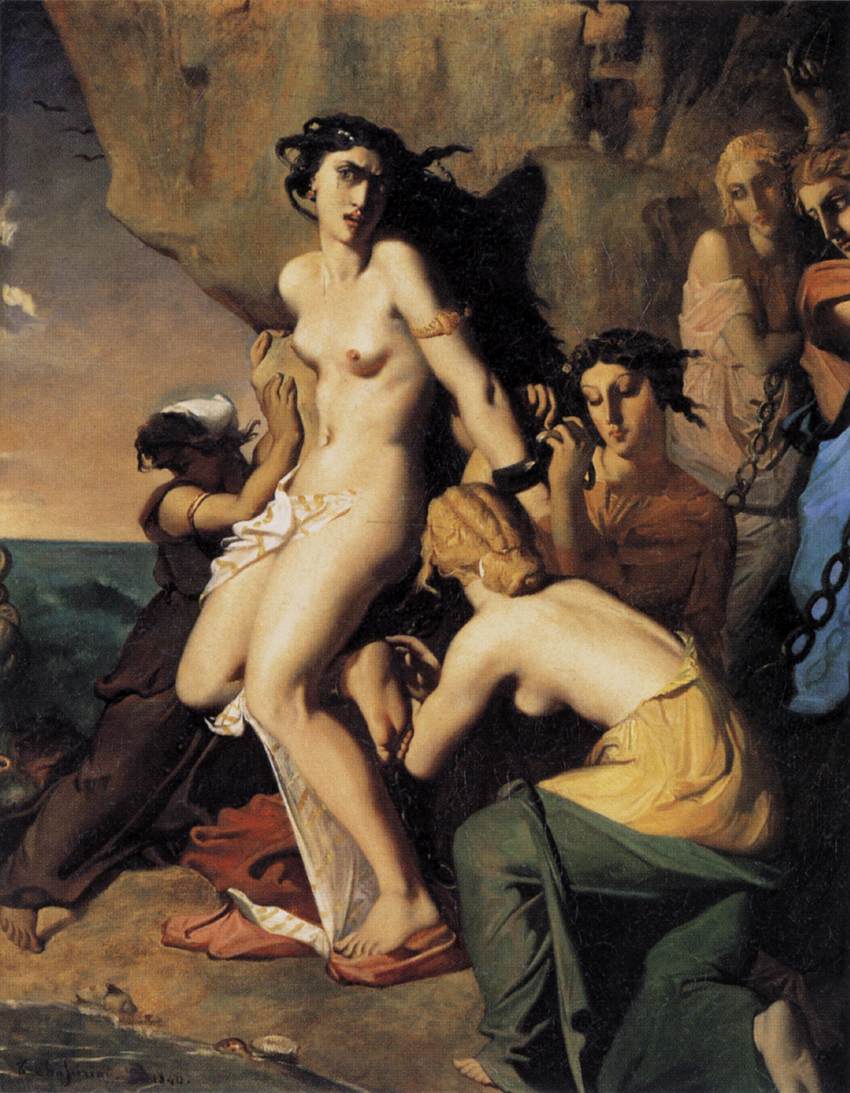
The painting shows Andromeda at the center of a tense, theatrical coastal scene. The female figure, nude and with very long black hair, stands on a white cloth that partly wraps around her legs, while several figures gather around her. Some hands reach toward her hair and body; others handle the fabrics spread across the ground. On the right, a chain of large links descends beside partially cropped figures. Behind them, a rocky wall rises like a natural stage, while the sea opens out to the left beneath a sky where small birds are flying.
The scene refers to the Greek myth of Andromeda, daughter of Cepheus and Cassiopeia. Condemned to be exposed and chained to a rock as a sacrifice in the face of a threat from the sea, the princess is caught between the vulnerability of the body and the violence of fate. The figures surrounding her are the Nereids, sea nymphs associated with Nereus, and their presence places the episode in a legendary aquatic world. The story belongs to the mythological cycle associated with Perseus, although here the focus is on the moment of exposure, surrounded by human and marine presences.
The chain serves as the clearest sign of captivity and makes the central body the focus of physical and moral tension. The vertical rocks reinforce the sense of isolation, but the group of Nereids introduces an enveloping movement that prevents the scene from being read as a solitary figure. Their arms, hair, and garments create a web of gestures around Andromeda, poised between agitation and ritual. The white cloth emphasizes the protagonist’s vulnerability, while the reddish, ochre, and dark fabrics on the ground add dramatic weight to the episode.
The vertical composition guides the eye from Andromeda’s head and hair down to the chain and the fabrics gathered at the base. Her illuminated body establishes a clear axis against the rockier, darker-toned background, and the contrast focuses attention on the exposed figure. The diagonals formed by the arms, chain, and folds break the rigidity of the central axis and create an upward and downward rhythm. On the left, the sea horizon and birds open up a spatial pause; on the right, the clustering of bodies and objects compresses the field of vision. The landscape is therefore more than a simple backdrop: it heightens the sense of danger and confinement.
In Andromeda Chained to the Rock by the Nereids we recognize Théodore Chassériau’s Romantic sensibility: idealized figures, emphatic drawing, and dramatic intensity, with illuminated bodies emerging from dark backgrounds. The work transforms myth into a portrayal of sensual tension and collective movement, in which every element contributes to the theatricality of the whole. It is worth observing how the luminosity of the skin guides the eye toward the chain and, from there, toward the figures surrounding the protagonist. Along this path, narrative, symbol, and pictorial construction come together: Andromeda appears trapped between the rock, the sea, and the human circle that makes her fate visible.
Have questions about our oil painting reproductions? See our frequently asked questions.