

Description
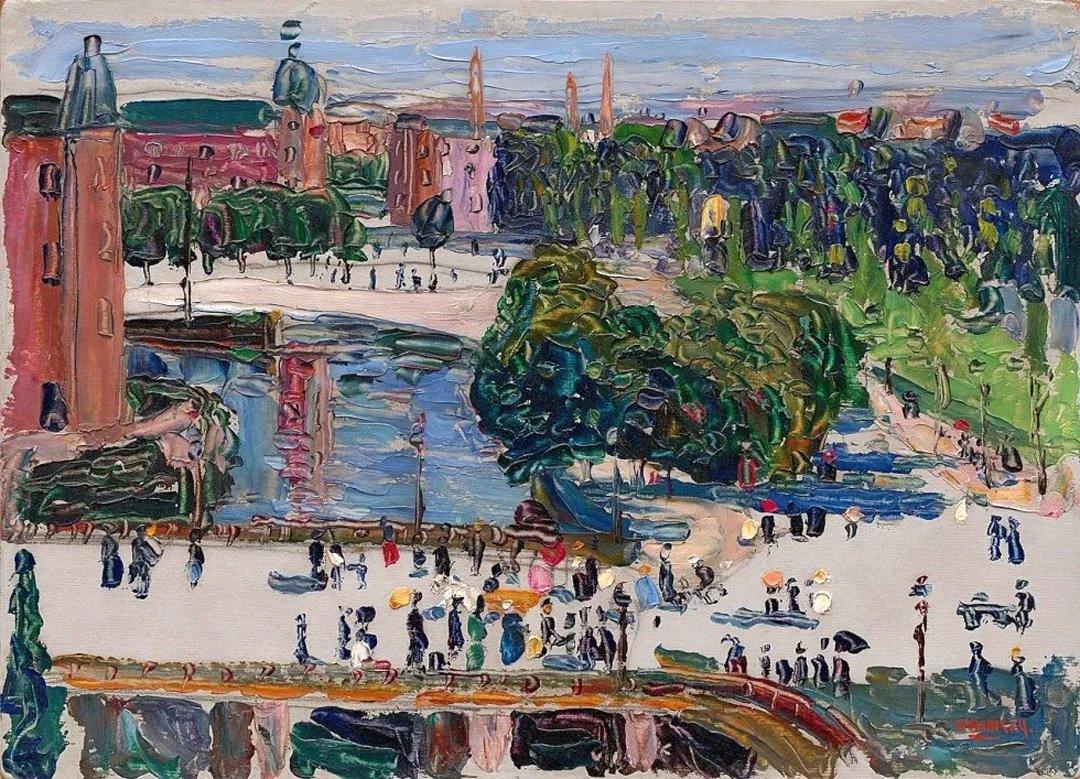
The painting Amsterdam, View from the Window presents a sweeping cityscape beside the water, unfolding in bands of color and activity. Narrow buildings in reddish, pink and ochre tones rise on the left; above them, two larger figures occupy an elevated structure. A dense grove stretches out in front of the architecture, with areas of lawn and paths leading the eye toward groups of people out for a stroll. The water fills much of the lower area, while a horizontal walkway or bridge brings together numerous human figures, some walking, sitting or gathered in groups. The city thus appears as a lived-in space, traversed and shared.
The work belongs to the tradition of the Amsterdam city view, depicting a city historically shaped by canals and other waterways. In this type of landscape, architecture, vegetation and pedestrian traffic coexist within the same field of vision. The water is more than just a background: it organizes the relationship between the buildings, the park and the crowd, turning the panorama into a scene of everyday observation. The reference to the window can be understood as a panoramic viewpoint over the city, a way of framing urban movement without separating it from its surroundings.
The grayish-blue surface acts as a compositional axis and visually extends the masses of buildings, trees and figures through reflections and dark bands. The concentration of people suggests strolling, meeting and socializing; their small scale makes collective life feel like a continuous rhythm rather than a sequence of individual portraits. The grove serves as an organic counterpoint to the vertical density on the left, while the reddish and pink tones of the architecture lend intensity to the horizon. The contrast between the strip of greenery, the water and the walkway brings nature, city and movement together in a single spatial experience.
The panoramic composition is clearly structured: the buildings form a vertical boundary in the upper left, the park occupies the center, and the horizontal structure in the foreground establishes a dynamic base. This combination of vertical and horizontal lines and irregular masses of foliage creates balance without stillness. The eye can travel from the two large figures toward the grove, descend along the paths, and end at the crowd gathered by the water. The visible, fragmented brushwork intensifies this journey; the greens, blues, ochres, and reds do more than describe surfaces—they turn each area into a chromatic vibration. The figures arranged at varying depths heighten the sense of scale and movement.
In this work, Wassily Kandinsky draws on his early figurative style, in which expressive color, energetic brushwork, and the dynamic construction of the landscape transform a recognizable scene into a rhythmic composition. The city is not viewed as a static prospect, but as a web of relationships between architecture, water, vegetation, and human presence. The figures act as a bridge between the viewer and the depicted space: they establish scale, animate the paths, and restore a collective dimension to the landscape. The painting’s strength lies in this union of urban panorama and everyday movement, with each band of color contributing to the feeling of a living city.
Have questions about our oil painting reproductions? See our frequently asked questions.