

Description
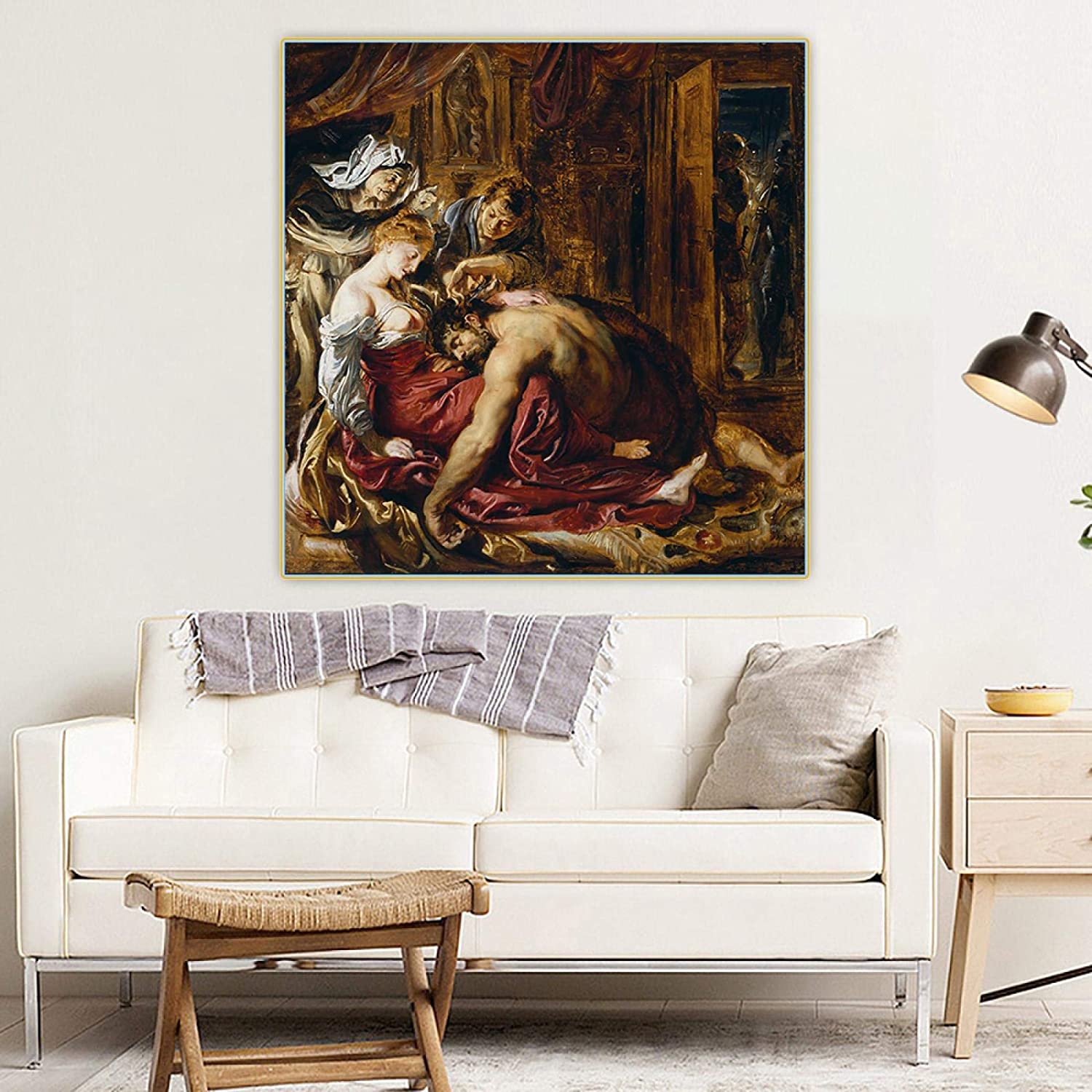
The painting shows Samson and Delilah inside a palatial room, conceived as a setting of tension and danger. In the lower center, a bare-chested man leans toward the foreground, partly wrapped in red and white fabrics. Beside him, a woman with light-colored hair and white, gray and red garments draws the group’s attention. Several figures crowd behind them, while others remain in the shadows beside an open doorway. The columns, heavy draperies and fabrics spread across the floor turn the space into a theatrical, intimate and threatening scene.
The episode comes from the biblical story of Samson, whose strength is traditionally linked to his hair. Delilah discovers the hero’s secret and betrays him by handing him over to his enemies. As Samson lies vulnerable, the Philistines prepare to seize him after cutting off his hair. The composition focuses on this moment of lost control: the protagonist occupies the foreground, physically exposed, while the woman’s presence and the figures concealed in the background introduce the threat of imminent capture.
Samson’s bent posture shapes an image of vulnerability and broken power. Opposite him, Delilah is integrated into the heart of the action, surrounded by fabrics and figures that emphasize her role in the betrayal. The open doorway into darkness serves as a narrative threshold: behind it lies the danger that has not yet fully entered the room. The vivid reds of the garments and draperies lend the scene sensuality and a sense of alarm, while the illuminated whites make the protagonists’ physical closeness more apparent. The scene’s intimacy is thus pierced by the threat of violence.
Rubens organizes the composition around a powerful diagonal that begins with Samson’s naked body and leads the eye toward the woman and the figures in the background. The bodies overlap, lean and intertwine in a crowded rhythm, leaving no room for the eye to rest. Light is concentrated on the skin and pale fabrics, then shifts from there to the reds, golds and ochres of the decoration. By contrast, the doorway and the areas at the sides recede into deep browns and blacks. This interplay of light and shadow creates depth and transforms the architecture into a stage set in which every figure plays a part in an imminent ambush.
The work is consistent with qualities widely associated with Peter Paul Rubens: dynamic composition, bodies with a powerful physical presence, intense color and dramatic lighting that orchestrates the action. The abundance of fabrics, gestures and diagonals makes the biblical story feel like a drama of dangerous intimacy, closer to a living scene than a static representation. Samson’s exposed body, Delilah’s central position and the darkness of the doorway form a single visual progression: seduction, betrayal and capture are brought together in the same space, suspended in the instant before the outcome.
Have questions about our oil painting reproductions? See our frequently asked questions.