

Description
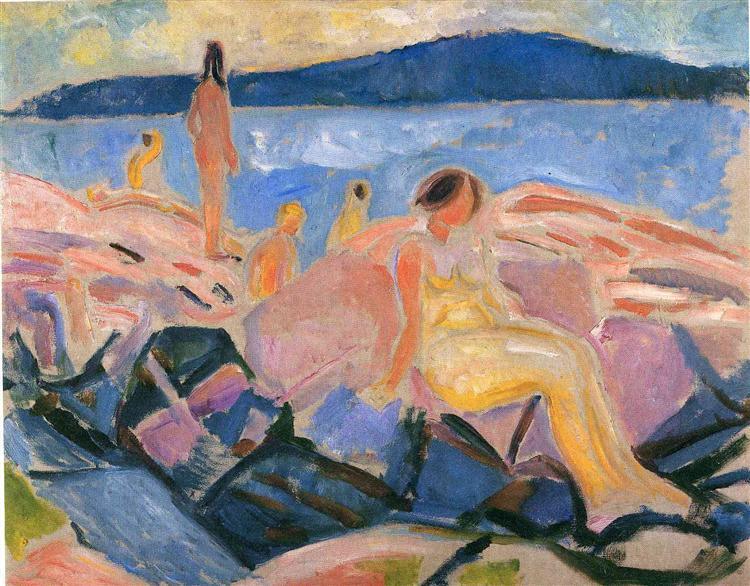
The painting depicts a summery lakeside landscape in which several human figures share the shore among rocks, vegetation and areas of intense color. A tall, upright figure stands by the water on the left, while smaller presences are scattered toward the center. In the foreground, a dark‑haired figure in pink and yellow clothing appears seated or reclining on the rocky ground and becomes the composition’s main human anchor. Behind them stretches a blue body of water bounded by a dark mountain range, beneath a pale sky streaked with yellow, gray and blue brushstrokes.
As an inhabited landscape, Summer High II does not develop a concrete historical, religious or mythological narrative. Its subject is the experience of summer by the water: a moment of companionship, repose and spatial openness. The figures do not enact a defined action but establish a human scale within an environment that blends nature and feeling. Edvard Munch’s presence is evident here in a conception of landscape that privileges color intensity and expressive simplification over meticulous topographical description. The lake, the mountain and the shore function as a common stage but also as an enveloping sensory experience.
The reclining figure in the foreground brings the landscape into intimate proximity with the body and provides a point of identification for the viewer. Her relaxed posture contrasts with the verticality of the figure at the left and creates a rhythm of gestures between repose and attentive presence. The group gathered by the shore suggests an outdoor social scene, while the rocks and dark masses of vegetation introduce a note of density and depth. The blue of the water and the horizon opens the composition toward the distance; the pinks, corals, yellows and oranges return the gaze to the near surface, as if the landscape were constructed from chromatic memories rather than from fixed boundaries.
The visual structure is organized into stepped bands: sky, mountain, water, shore and rocky foreground. The large angular lower forms create diagonals that lead the eye toward the seated figure and then back toward the smaller figures and the lake. The mountainous horizon provides stability, but the loose brushwork unsettles that stillness with horizontal strokes in the water and vibrant contours in the rocks. The palette of dark and light blues establishes depth, while violets, greens, pinks and yellows break naturalistic continuity and infuse the scene with energy. The luminous breadth of the sky is thus balanced by the visual weight of the foreground.
In relation to the language associated with Edvard Munch, the work transforms a recognisable landscape into an experience of chromatic tension and emotional resonance. The simplification of figures and natural forms does not eliminate their presence; on the contrary, it allows each silhouette to take part in an overall rhythm of colour, distance and proximity. The interest of Summer Evening II lies in that coexistence of summer repose and pictorial vibration: note how the rocks lead the eye toward the reclining figure, how the figures link the shore with the water, and how the lake turns an everyday scene into an open, intense and sensory image.
Do you have questions about our oil-painting reproductions? Check our frequently asked questions.