

Description
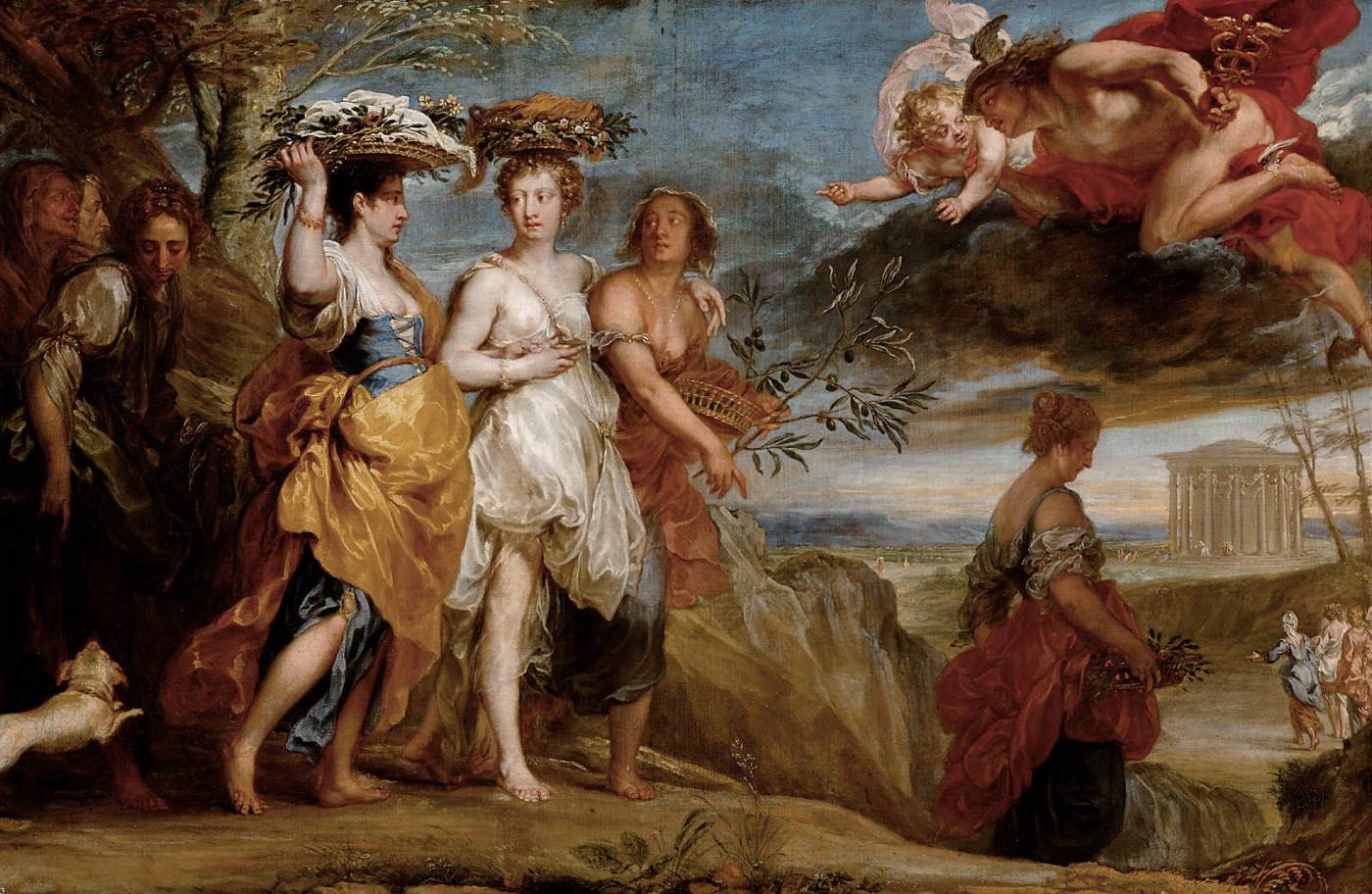
The painting depicts Mercury and Herse in an expansive classical landscape, arranged around a group of women in the foreground beneath the shade of a large tree. Three figures stand out in their light-colored dresses, leafy crowns, and the baskets or branches they carry, as participants in a ceremonial procession. At the upper right, Mercury reclines on a rocky rise, partly draped in red fabric, beside nude or semi-nude figures. A seated or kneeling woman, holding branches, extends the visual movement toward the lower edge. In the distance, the landscape’s blue band, low mountains, vegetation, and columned building expand the scene to panoramic scale.
The episode is drawn from the Metamorphoses by Ovid. Herse, daughter of Cecrops and sister of Aglauros and Pandrosus, is taking part in a procession when Mercury sees her and falls in love with her. The god tries to approach her, but Aglauros intervenes to prevent their meeting. Her opposition sets the story’s tragic ending in motion: Mercury turns Aglauros to stone. The composition focuses on the moment before the conflict, when the distance between the god and the young women is charged with anticipation, desire, and resistance.
The leafy crowns, baskets, and branches place the women in a ceremonial setting and reinforce the scene’s communal dimension. By contrast, Mercury’s elevated figure creates an individual focal point: his reclining pose and the intensity of the red drapery set him apart visually from the group of women. The dark tree serves as a natural frame and a place of concealment, while the colonnade in the background evokes an idealized ancient world. The waterscape and open horizon turn the setting into a stage for an encounter and a frustrated approach, with nature accompanying the narrative tension.
The horizontal composition is structured around a visual path from left to right. The tree trunk and branches form a shadowy screen that contrasts with the sky and the blue strip in the background; from there, the branches held by the women lead the eye toward the group above. The ivory whites of the dresses and the ochres of the ground stand out against the deep greens and browns, while the crimson fabrics serve as a striking chromatic accent. The layering of figures, rocks, foliage and architecture creates depth without sacrificing the episode’s theatrical clarity.
This work by Jan Van Boeckhorst displays general characteristics of the Flemish Baroque tradition: numerous figures, expressive gestures, chromatic contrasts and a dynamic relationship between landscape and mythological narrative. The artist turns a literary moment into a scene of restrained movement, in which the ceremonial group and Mercury’s elevated figure are bound together by a visual tension of desire and impediment. The branches connect the different planes, while the red fabrics concentrate the dramatic intensity; in this way, the painting transforms an episode from Ovid into an image of Baroque theatricality, frozen just before the conflict.
Have questions about our oil painting reproductions? See our frequently asked questions.