

Description
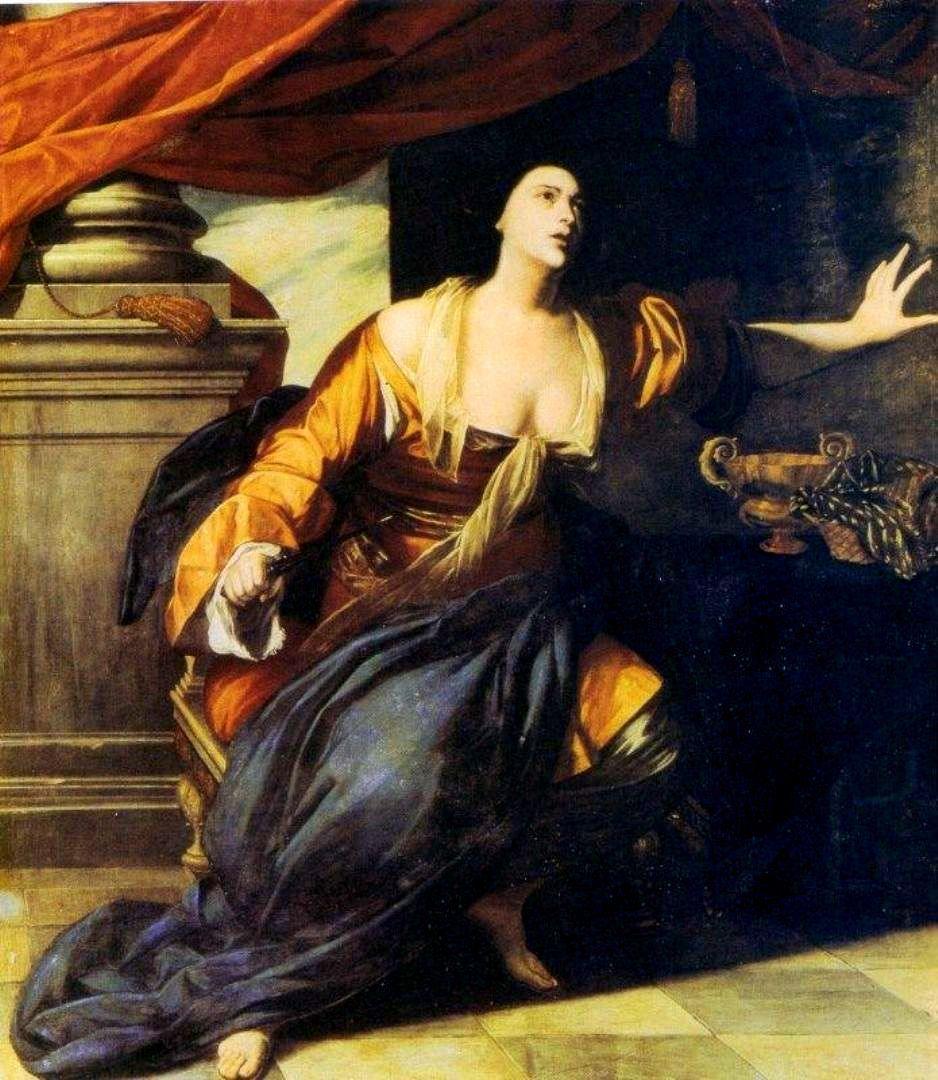
The painting presents Lucretia as a monumental female figure, seated or kneeling at the center of an interior with a palatial appearance. Her dress combines gold sleeves, a dark bodice, and a full blackish-blue skirt, while a white cloth stands out beside her left hand. Her right arm reaches toward a horizontal, ornamented object on the opposite side, creating an immediate tension between the protagonist’s body and that point in the scene. On the left, a stone structure with moldings and steps supports a rounded volume; above it, a large red and orange curtain falls in deep folds. The light-colored tiled floor, arranged in a geometric pattern, provides an orderly foundation beneath the drama of the composition.
Lucretia belongs to the historical and legendary tradition of ancient Rome, where she is associated with virtue, family honor, and a moral crisis with collective consequences. According to the Roman account, she was assaulted by Sextus Tarquinius, son of Tarquinius Superbus. After telling her family what had happened, she took her own life; her death sparked the revolt that expelled the Tarquins and became associated with the transition from monarchy to Republic. The composition concentrates this background into a suspended moment: rather than narrating a complete sequence of events, it presents the protagonist on the brink of an irreversible decision, isolated within a solemn space.
The gesture extended toward the right side focuses the iconographic reading. The object positioned there becomes part of the episode’s tragic tension and turns the direction of the arm into a line of decision, while the white cloth provides a counterpoint of vulnerability against the dense tones of the dress and background. The richly attired figure is not reduced to a distant emblem: she occupies the space with physical presence, dignity, and solemnity. The red drapery heightens the scene’s theatrical quality, while the stone architecture serves as a frame of permanence and historical weight. Set against the surrounding darkness, the bright white of the fabric directs attention to the hands and the face turned to the right.
The formal construction depends on carefully calculated contrasts. The central figure receives the greatest concentration of light and color, while the dark background visually separates her from the architectural space. The diagonals of the arm, the folds of the skirt, and the drapery lead the eye from the upper left toward the decisive gesture and then down to the lower paving. The stone structure balances the movement of the body with a stable mass, and the object at the side extends the composition horizontally. Warm reds and golds engage in a dialogue with the blue-black dress, creating an intense palette in which each illuminated area takes on expressive weight. Depth is organized in layers: a geometric foreground, a dominant protagonist, and a shadowy opening in the background.
In this work, Artemisia Gentileschi brings together narrative drama, high-contrast lighting, and the monumental prominence of a female figure—features widely recognized as characteristic of her artistic language. The sumptuous fabrics are not merely decorative: they heighten the emotional scale of Lucretia and make her dignity visible in an extreme situation. The scene thus takes on theatrical force without losing its psychological focus. The eye travels from the drapery to the face, from the face to the arm, and from the arm to the object at the side; along this path, color, architecture, and gesture transform a story of violence and honor into an image of tragic resolve, physical presence, and political memory.
Have questions about our oil painting reproductions? See our frequently asked questions.