

Description
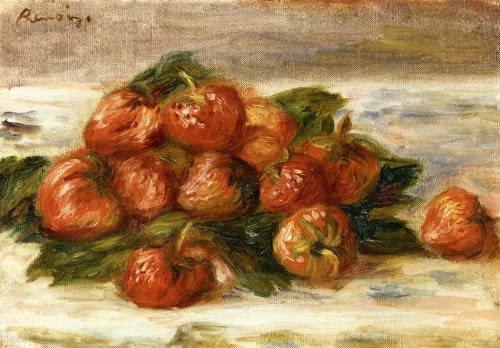
The painting shows a still life of tomatoes arranged on a light surface. A compact group of red fruit occupies the center and extends into the lower area, with large, flattened, rounded specimens overlapping one another. Green leaves and stems intertwine around the pile, providing an organic, dark base. On the right, an isolated tomato creates a pause within the central cluster and extends the composition into the space at the side. Behind the objects, the background is arranged in horizontal bands of gray, cream, beige and ochre, while diffuse light models the forms without hardening their contours.
As a still life, the work presents no specific narrative: its appeal lies in contemplating everyday objects transformed into a painted scene. The tomatoes are gathered together, set apart and partially concealed, so that each retains an individual presence within the group. This arrangement makes it possible to appreciate variations in size, shape, volume and color while maintaining a sense of domestic abundance. The scene is set in a simple space, with no accessories to distract the eye, and focuses the experience of the still life on the direct relationship between the fruit, the leaves, the surface and the background.
The red tomatoes serve as a visual celebration of materiality and the vitality of color. Their luminous surfaces contrast with the deep greens of the leaves, which establish an immediate connection with the plant world and suggest freshness. The tomato set apart on the right serves mainly as a formal counterpoint, but also provides a moment of pause in contrast with the dense cluster. The interplay of abundance and isolation offers a simple reading of plenty and singularity: each fruit contributes to the overall structure without entirely losing its own distinct character.
The horizontal composition is held together by a balance between concentration and expansion. The main group serves as the visual focal point through its density, overlapping forms, and the intensity of its reds; the solitary tomato offsets that weight and prevents the scene from becoming too enclosed at the center. The bands of the background and the surface establish tranquil lines that reinforce the stability of the whole, while the leaves introduce irregular rhythms and gentle diagonals. The seemingly free brushwork allows for supple transitions between light and shadow, especially in the bright highlights on the tomatoes and their orange-toned areas. Depth thus arises more from overlapping forms and chromatic contrast than from an elaborate spatial construction.
In general, the work can be linked to Pierre-Auguste Renoir’s interest in luminous color, loose brushwork, and the sensory perception of objects, applied here to a domestic still-life composition. The painting transforms an everyday arrangement into a vibrant chromatic structure: the reds draw the eye, the greens articulate the cluster, and the muted tones of the background allow the fruit to breathe visually. It is worth noting how the solitary tomato alters the rhythm of the central group and how the horizontal bands keep the energy of the brushwork contained. The strength of Still Life with Tomatoes.
Have questions about our oil painting reproductions? See our frequently asked questions.