


Description
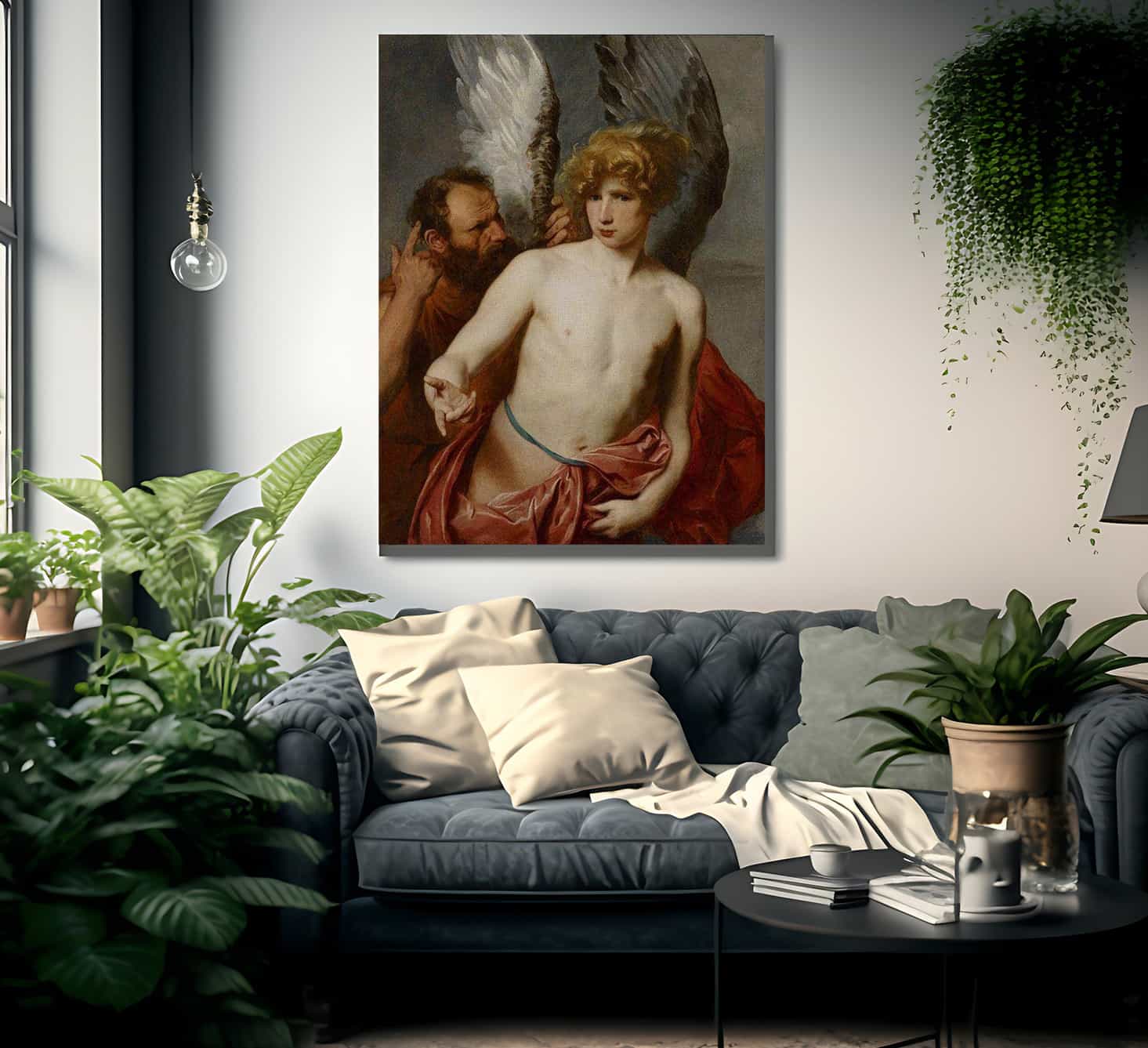
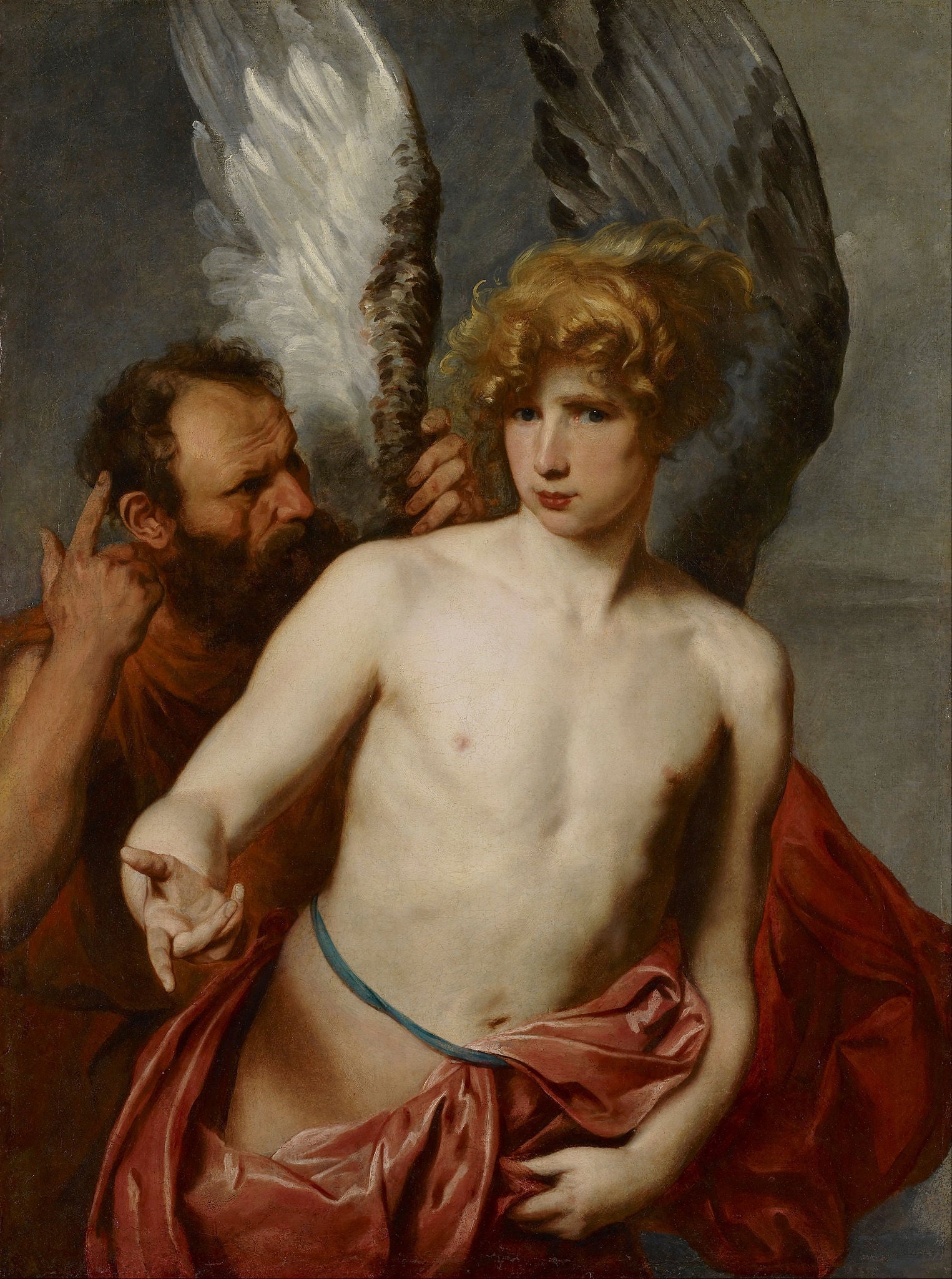
The painting presents Daedalus and Icarus in a vertical composition that is intimate and intensely theatrical. In the foreground, Icarus occupies the center with a bare torso, golden hair and a serene expression, partially wrapped in a wide red and pink drapery. A blue-green ribbon crosses his waist, providing a cool accent to the work’s warm palette. Behind him stands Daedalus, bearded and dressed in brownish tones, partially obscured by the young body. His raised hand and outstretched finger beside Icarus’s face introduce a direct communication between them. Two large wings rise behind them: one pale, with white and grayish feathers, and the other dark, in coal, brown and black tones. The background, with no visible landscape or architecture, concentrates all attention on the bodies, the hands and the wings.
The scene alludes to the Greek myth of Daedalus and Icarus. Daedalus, the renowned craftsman and inventor, fashions wings of feathers and wax to escape with his son. Before the flight he warns him to keep a prudent height and not to fly too close to the sun. Icarus ignores the warning and ascends higher than advised; the heat melts the wax that binds his wings and the youth falls into the sea. The painting gathers the essential signs of that story in a moment of preparation and warning: the adult figure instructs, the young figure occupies the center of the action, and the wings dominate the upper space as a promise of elevation and a harbinger of danger.
The wings articulate a double symbolic dimension. They represent Daedalus’s technical ingenuity and the desire to exceed human limits, but they also recall the risk of excess. The raised finger concentrates the tension between knowledge and desire: beside Icarus’s vulnerable body, it visually formulates a rule that the flight will test. The youth and nudity of the central figure accentuate his exposure to the forces around him, while the red cloth contributes energy, movement and emotional intensity. The contrast between the light wing and the dark one broadens the episode’s dual reading — between freedom and threat, ascent and fall, paternal protection and longing for independence.
The formal construction directs the gaze from the red drapery in the lower area toward the luminous torso and, following the hand’s gesture, to the face and the wings. The diagonals of the drapery break the frontal stillness of the young figure and extend its upward rhythm into the feathers. Daedalus, placed behind and to the left, establishes depth without losing physical proximity: his face and hands keep the relationship between the two figures active. The warm tones of the skin, the red and brown, stand out against the charcoal gray, while the light feathers balance the dark mass and visually expand the upper part. The chiaroscuro turns the bodily illumination into the center of a sustained dramatic tension.
The work belongs to a Flemish Baroque idiom associated with Sir Anthony van Dyck: elegant, sculptural figures, expressive gestures, rich coloration and focused lighting. The emphasis falls on the bodies and the silent communication between father and son rather than on an extensive narrative setting. The myth thus becomes an immediate experience: counsel is transformed into gesture, flight into an architecture of wings and diagonals, and the beauty of the illuminated body is pierced by the threat of excess. Note how the raised hand, the red drapery and the ascent of the feathers together organize a single visual tension between care and risk.
Do you have questions about our handmade oil-painting reproductions? See our frequently asked questions.