

Description
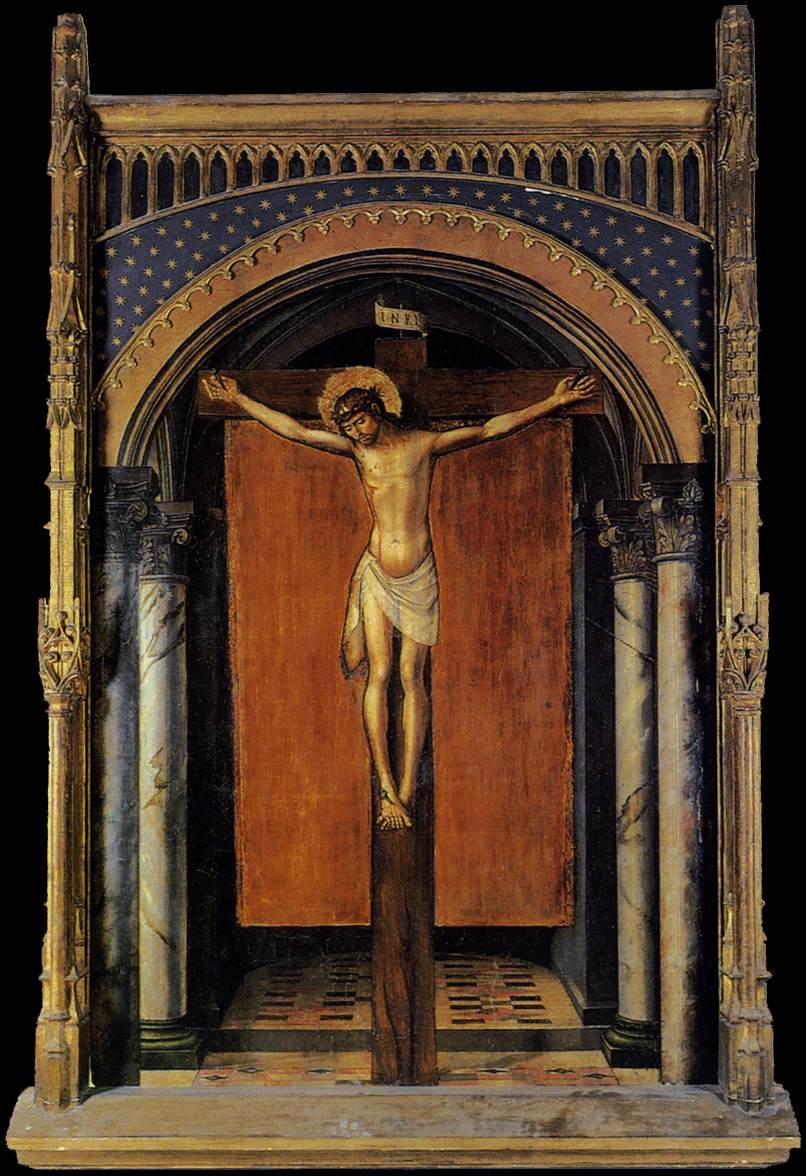
The painting shows Christ crucified at the very center of the composition. His body, with its bare torso and waist covered by a light-colored cloth, stretches across a reddish wooden cross; his outstretched arms and bowed head focus the viewer’s gaze on an image of surrender and suffering. Above him, a small plaque accompanies the traditional identification of the scene, while a golden disk surrounds his head. The figure is set within a pointed arch of several mouldings, flanked by pale columns and an outer structure of reliefs, pinnacles, and vertical ornamentation.
The work depicts the Crucifixion of Christ, a central episode in the Christian Passion and one of the fundamental subjects of Western religious painting. Here, the cross functions not merely as a physical support, but also as the attribute that makes visible the story of redemptive death and devotional contemplation. The plaque above the head refers to the traditional formula identifying Jesus as the King of the Jews. The entire ensemble is presented as a sacred vision, arranged within an architectural space evocative of a ceremonial interior.
The golden halo reinforces the figure’s sacred nature and creates a luminous focal point around his bowed face. By contrast, the dark blue field of the tympanum is strewn with golden stars, creating a celestial atmosphere that lifts the scene beyond a purely corporeal representation. The columns, tracery, and pinnacles make the Gothic frame an active part of the meaning: they do not simply surround the image, but present it as an object of veneration. The flagstone floor, visible in the lower area, extends the scene into the viewer’s space and connects the sacred image with tangible architecture.
The vertical, symmetrical structure guides the eye from the upper arch to the cross, whose central upright forms a firm, almost motionless axis. Christ’s outstretched arms balance this upward movement and create the painting’s principal intersection of lines. The brown and reddish tones of the wood and body stand out clearly against the deep blues, blacks, and golds of the background. The alternation of columns, moldings, and narrow arches creates an orderly rhythm around the figure, while the floor lends the scene a subtle sense of perspective. The light concentrated on the body and halo heightens the contrast between human presence and sacred space.
In the context of Pedro Berruguete’s work, the painting is associated with religious art from the transition between the Late Gothic and the Renaissance, attentive to drawing, rich color, and the ornamental splendor of sacred spaces. Here, these qualities come together in an image of great devotional clarity: Christ’s body remains isolated on the cross, yet gains greater force from the architectural frame surrounding it. The stars, tracery, and floor do not compete with the figure, but instead create a ceremonial experience around it, uniting suffering, holiness, and geometry. The eye ultimately returns to the bowed face and golden halo, the silent core of the entire composition.
Have questions about our oil painting reproductions? See our frequently asked questions.