

Description
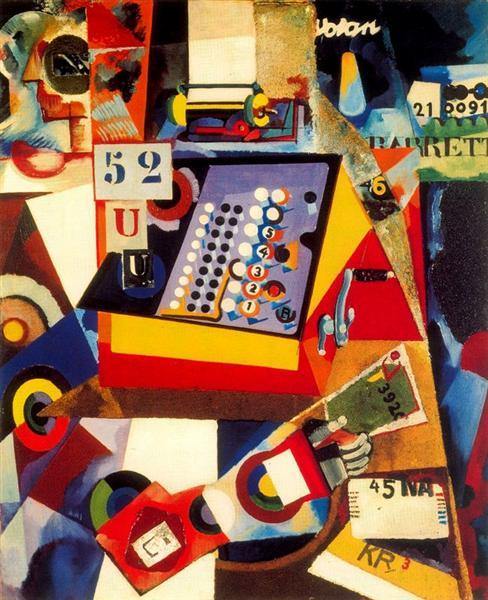
The painting Cash Register presents a vertical, vibrant assemblage in which an inclined rectangular board occupies the centre of the composition. On its surface are arranged small circles and coloured tokens, some marked with numbers, as if they were part of a calculating or recording mechanism. Around it pile cards, labels, rings, geometric blocks and typographic fragments. A small yellow-and-blue object rests on the upper band, while elongated forms, overlapping papers and diagonal planes complete the edges. There are no human figures or a natural setting: the entire surface functions as a compact field of objects, signs and elements in tension.
The title places this construction in the everyday realm of commerce, classification and exchange. The cash register appears here not as an isolated device rendered naturalistically, but as the core of a material culture made of numerals, labels, cards and operations. The work transforms a functional object into a modern scene of circulation: the signs seem to shift, accumulate and reorganize like goods or documents within a visual system in motion. Thus the commercial experience is turned into an abstract composition where the practical and the pictorial meet.
The central board acts as a visual anchor, and its grid of circles suggests calculation, order and repetition. The numbered tokens introduce a counting logic that contrasts with the freer arrangement of peripheral elements. The cards and fragmented letters evoke the printed language of receipts, labels and signs, but by appearing partially covered they cease to be complete messages and become graphic material. The circles and rings provide rhythm, while the scattered symbols retain the reference to exchange without imposing a literal narrative. Reading therefore progresses between identifying the object and its dissolution into a system of forms.
The composition is constructed with dense, diagonal layers that prevent static contemplation. The tilted board first concentrates the gaze, but the intense reds, yellows and blues then lead it toward the sides, where new labels, discs and triangular planes appear. Black and white function as visual cuts that separate and articulate the colors, while orange, green and gray introduce variations within the structure. The superimposition flattens space and, at the same time, creates depth by accumulation: each fragment seems to rest upon another. The result is a staccato, almost mechanical rhythm that turns the surface into a pictorial machine.
In this work by Amadeo de Souza-Cardoso one can identify traits linked to early-20th-century Portuguese modernism: formal fragmentation, intense color, and the coexistence of objects, letters and signs within a dynamic composition. Its visual language gathers echoes of Cubism and Futurism without being reduced to a single depiction of the machine. Note how the title directs the reading toward the cash register, while the painting expands it to encompass an entire environment of numbers, circulation and printed culture. The interest of the work lies precisely in that transformation: an everyday object becomes a structure of rhythm, color and modern language.
Do you have questions about our oil-painting reproductions? See our frequently asked questions.