

Description
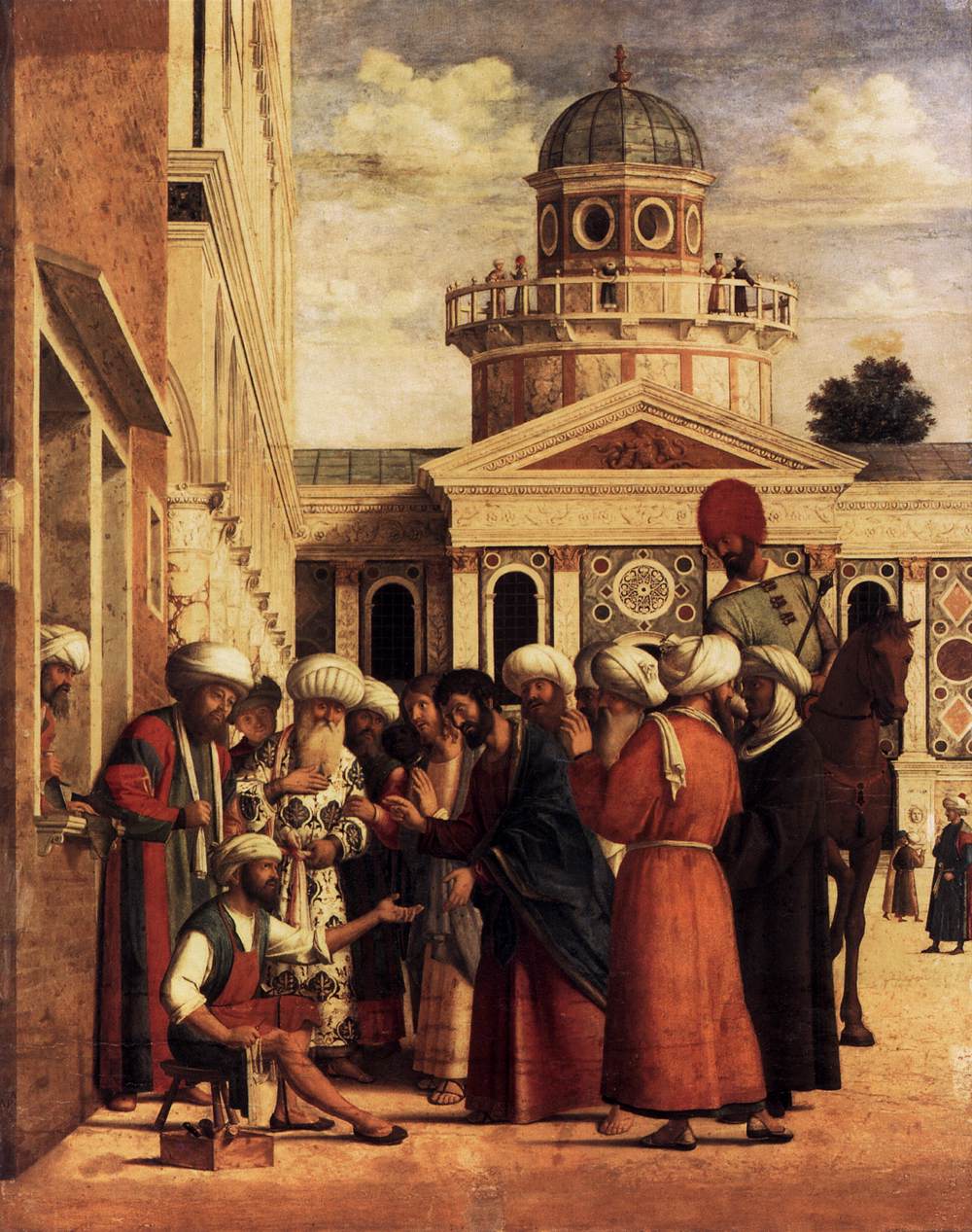
The painting depicts Saint Mark healing Anianus as a public episode, set in a square before monumental architecture. In the foreground, a seated artisan is beside an open box, tools and work implements; his apron and low position distinguish him from the group gathered around him. Nearby, several figures in turbans, tunics and cloaks watch the action. A dark-clothed male figure extends his hand to the left, while others turn toward the gesture. In the background rises a pale building articulated with arches, columns, mosaics, a triangular pediment and a circular structure topped by a dome. The scene opens beneath a cloudy sky, with a dark tree silhouetted against the architecture on the right.
The episode belongs to the Christian tradition associated with Alexandria. Anianus, presented as a shoemaker, suffered an accidental wound while working; Saint Mark healed him and, according to tradition, Anianus converted to Christianity. He was later recognized as the first bishop of Alexandria. The painting does not reduce this story to a private encounter: it places the artisan among witnesses, urban figures and residents gathered before a solemn building. The miracle thus becomes a shared event, observed by a community participating through its presence, gazes and gestures.
The box and tools anchor the narrative in the tangible world of the trade. Set against the lofty scale of the dome and buildings, these humble objects remind us that spiritual transformation begins in an everyday situation. Saint Mark’s outstretched gesture serves as the focal axis of the scene: it directs the viewer’s gaze toward Anianus and connects the foreground figures. The crowd acts as a visual witness, while the architecture lends the scene a ceremonial, urban dimension. The turbans, tunics, and geometric ornament evoke the Alexandrian setting of the story without turning the scene into a precise topographical reconstruction. The relationship between the artisan’s wound, the healing intervention, and the attentive crowd gives the composition its religious meaning.
The vertical composition is structured around a powerful relationship between groups of people and architectural forms. The figures fill the lower portion in an irregular rhythm of heads, folds, arms, and profiles; above them, the columns, arches, and circular tower establish a more stable geometry. The dome’s axis draws the eye toward the center, but the outstretched hand and seated figure bring attention back to the heart of the narrative. Ochres, beiges, and terracotta tones unify the ground and garments, while blacks and dark greens create depth among the figures. The warm light on the façade contrasts with the blue-gray sky, making the building seem to rise solemnly above the square. The diagonals formed by the gestures link the intimate act of assistance with the breadth of the public space.
In Cima da Conegliano’s work, this painting reflects a recognizable Venetian Renaissance sensibility, marked by clear drawing, luminous color, and a balanced arrangement of architectural and landscape settings. Here, the precision of the ornamental details does not compete with the story; it expands its scale and turns the healing into a collective memory. The shoemaker’s small box and Saint Mark’s gesture form an upward dialogue with the dome; between these two extremes, the crowd transforms a moment of aid into a scene of religious and public significance. The eye can travel through it from the tools in the foreground to the elevated architecture, following the same movement that turns an individual experience into communal testimony.
Have questions about our oil painting reproductions? See our frequently asked questions.