



Description
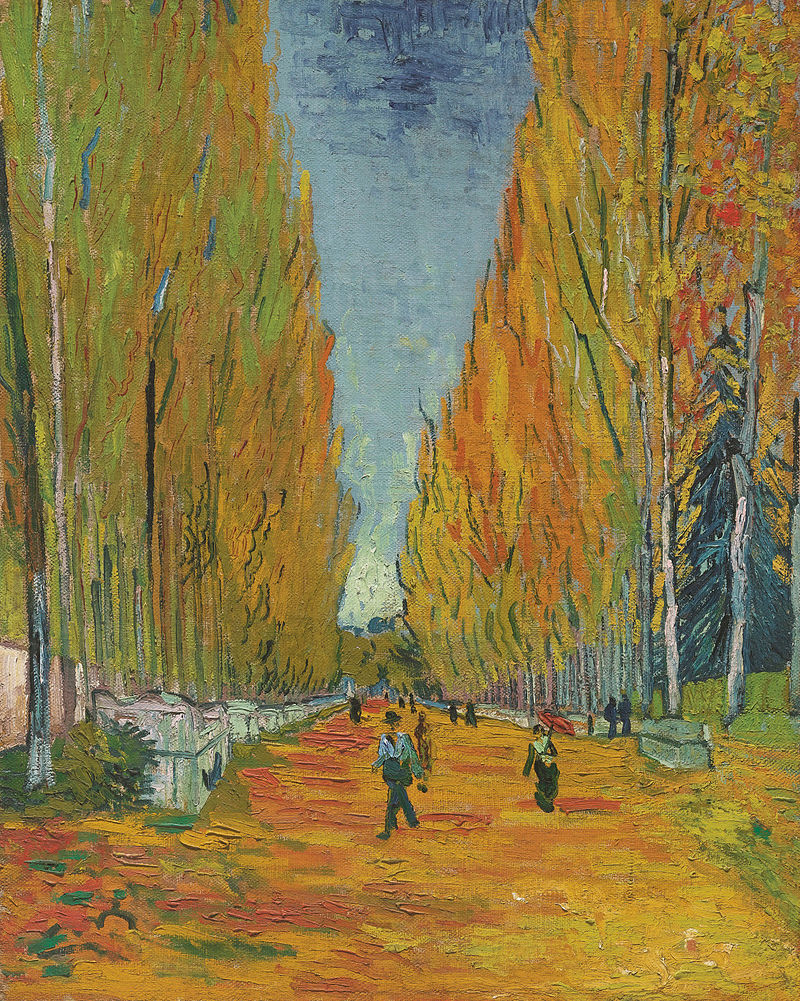
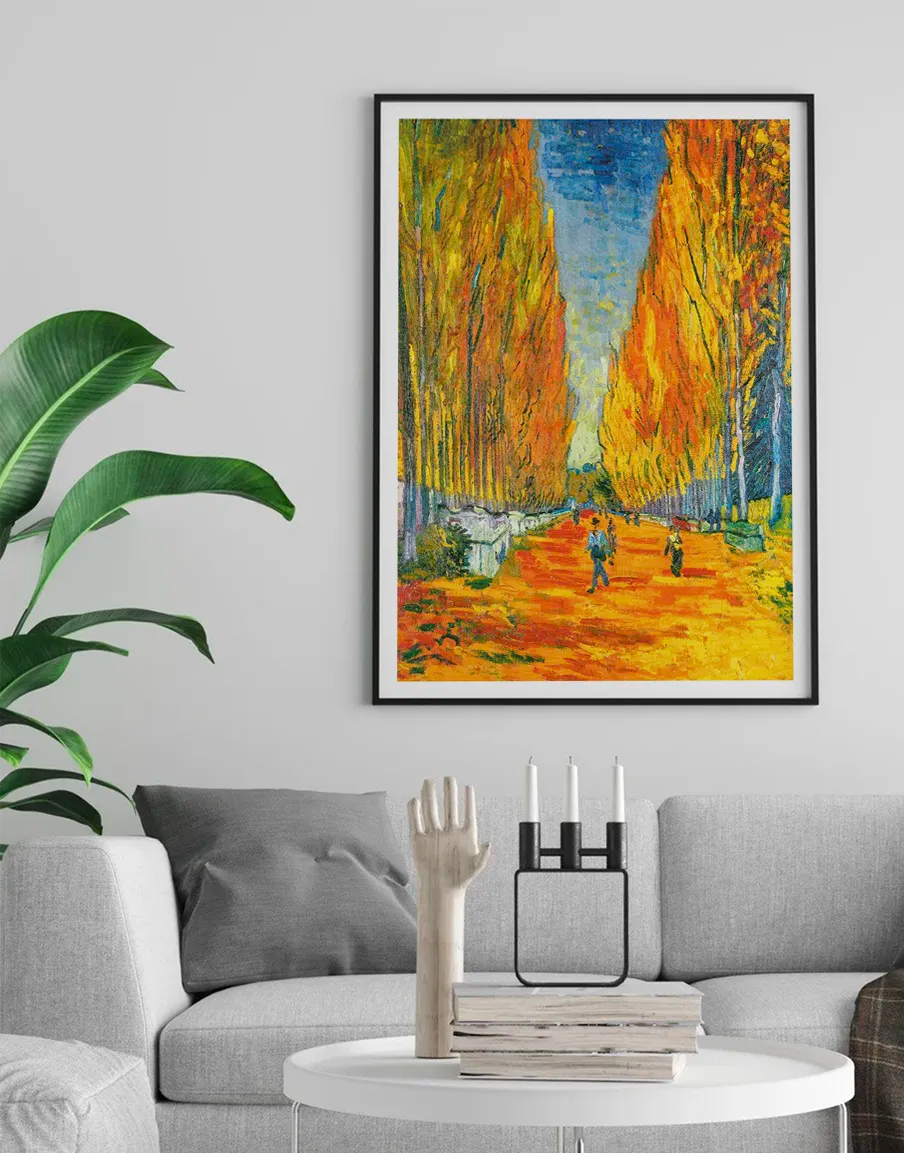
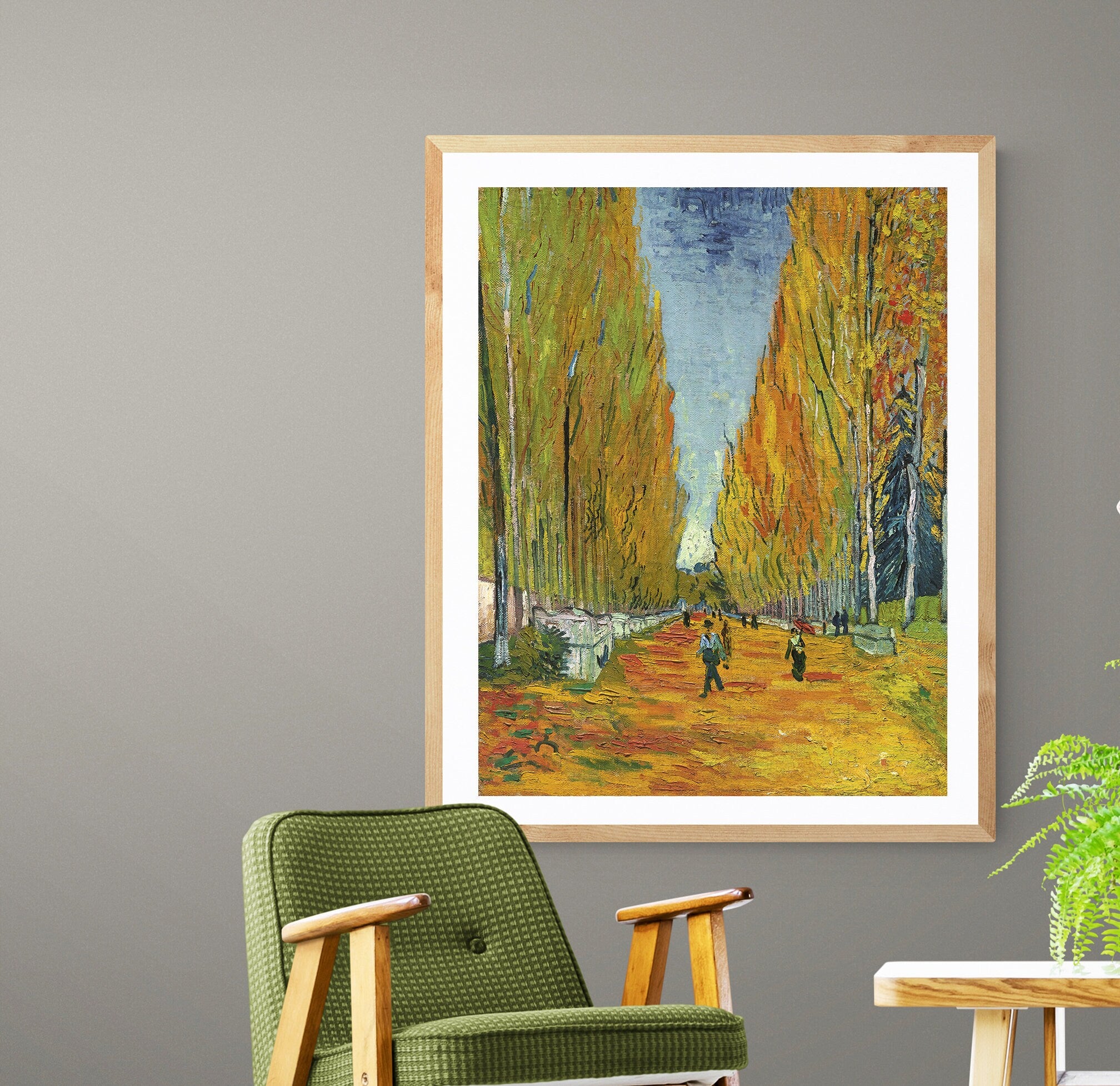
The painting depicts a broad, tree-lined avenue at the Alyscamps, receding in perspective toward a luminous horizon. Two passersby walk through the foreground, separated from each other but connected by the direction of the path, while several smaller figures are scattered toward the vanishing point. Dense rows of tall trees rise on either side, their greens, yellows, oranges and ochres forming a leafy corridor. Low, pale structures appear beside the left edge, integrated into the vegetation and evoking funerary remains. On the right, a dark, conical tree adds a deep vertical note against the autumn foliage. In the distance, bluish forms of far-off terrain unfold beneath a wide sky.
The Alyscamps is an ancient necropolis in Arles, in southern France, used as a burial ground over long periods and associated with burials and sarcophagi. Vincent van Gogh depicted this place during his time in Arles, transforming a site associated with the memory of the dead into a landscape traversed by everyday life. The avenue is not presented as a closed or motionless space: passersby walk along its paths, creating a direct connection between the viewer and the ancient burial ground. The scene thus brings history, landscape and urban experience together in a single, open view.
The structures along the left side lend the path a memorial resonance, while the presence of the passersby restores a human scale to an environment marked by the passage of time. The autumn foliage intensifies this relationship: its yellows, oranges and ochres speak of change and decay, but also of abundant vitality. Light filtering through the treetops and gathering on the horizon balances the funerary associations with a sense of continuity and openness. The ancient cemetery thus appears as a place of passage, where memory is inseparable from the movement of the visible world.
The composition is organized around a very strong central perspective. The path leads the eye from the lower edge to the luminous area in the distance, while the two rows of trees act as parallel lines that narrow the field of vision and emphasize depth. The human figures, small against the height of the trunks, provide a concrete sense of the landscape’s scale. Van Gogh articulates the surface with visible, energetic brushstrokes: the ground combines warm, broken strokes, the foliage vibrates with patches of color, and the sky stretches across the canvas in horizontal, grayish-blue strokes. The contrast between the earthy tones of the path, the gold of the leaves, and the blues of the sky keeps the eye moving constantly.
In The Alyscamps, Vincent van Gogh transforms a funerary avenue into an experience of landscape, passage, and memory. The artist’s characteristic treatment—intense color, expressive brushwork, and the contrast between warm hues and blues—allows the scene to retain both its specific reference and an immediate sensory force. Notice how the path and figures lead the eye toward the brightness of the horizon, while the trees and remnants along the sides keep the site’s historical depth present. The work finds its most compelling tension in this balance: a place associated with death becomes vibrant through light, autumn, and the passing of people.
Have questions about our oil painting reproductions? See our frequently asked questions.