

Description
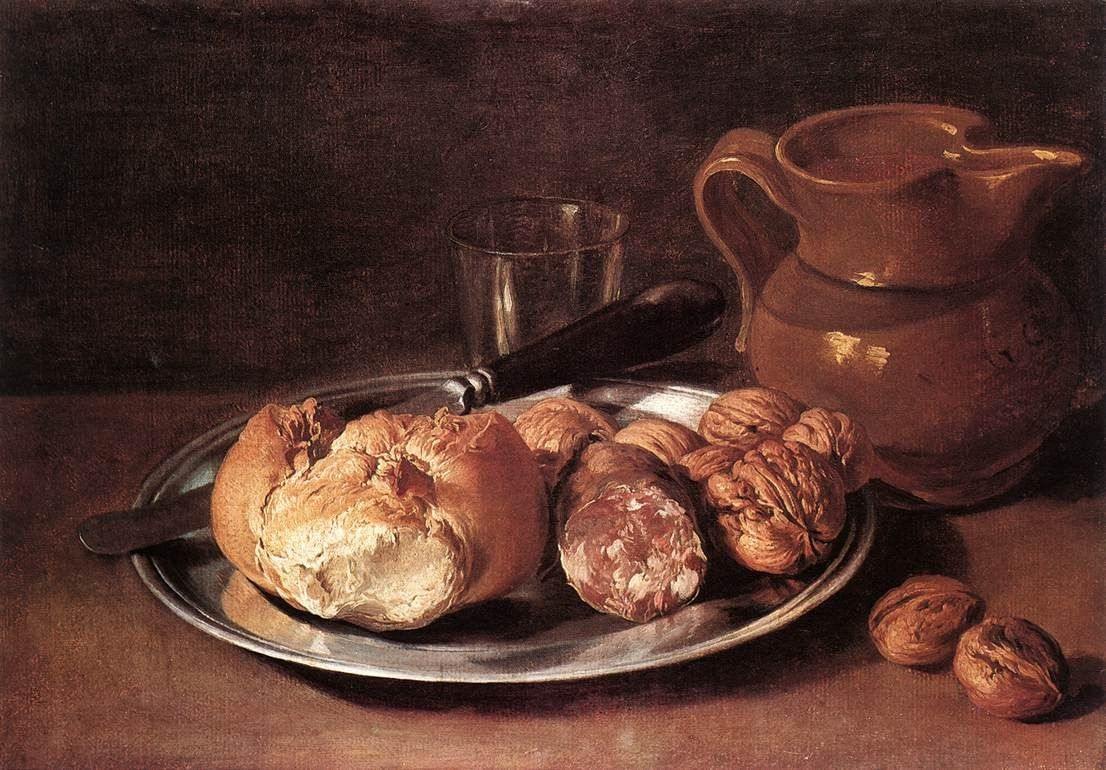
The painting depicts a still life of pomegranates, walnuts and utensils arranged on a table. In the foreground, an oval metal dish holds two opened pomegranates: one with yellow-orange skin and the other a deeper reddish hue, their pale interiors breaking up the continuity of the rinds. Beside them is a cluster of rough-textured walnuts, while two separate ones rest on the wood in the lower-right corner. Behind the dish are a cylindrical glass, a dark-handled knife and a large brown ceramic jug. The arrangement is horizontal and stable, yet each object retains a distinct presence, as if the table were displaying a small inventory of materials, weights and surfaces.
As a genre, the still life turns food, vessels and utensils into the independent subject of a painting. No figurative narrative unfolds here: the focus is on contemplating everyday objects and on how their relationships create visual balance. This tradition makes it possible to study texture, material, reflections and lighting through simple elements. In the work associated with Giacomo Ceruti, the domestic scene takes on a serene gravity: the pomegranates, walnuts, metal, glass and ceramic cease to be mere accessories and become the focus of close observation.
The opened pomegranates lend visual abundance and create an especially eloquent contrast between their compact, opaque outer skin and their lighter, more complex exposed interiors. Their volume and cracks introduce a tension between containment and openness. The walnuts, by contrast, draw attention with their irregular, broken shells; their tactile surface provides a counterpoint to the reflective smoothness of the plate and the transparency of the glass. The jug and dark background anchor the scene with an earthy, deep mass, while the knife adds a horizontal line that discreetly crosses the rear area. The composition can thus be read as a visual meditation on the differences between hard and fragile, rough and polished, closed and open.
The side lighting focuses attention on the fruit and walnuts, allowing the objects in the background to emerge gradually. The metal plate acts as a luminous plane in the lower part of the composition, able to catch faint reflections and set the food apart from the brown table. The glass is identifiable by its transparent vertical highlights, while the ceramic absorbs the light and retains a more solid presence. The palette, dominated by dark browns, ochres, muted oranges, beige, and black, avoids chromatic dispersion and reinforces the unity of the composition. Depth is built through layering: the plate and walnuts occupy the foreground, the glass and knife define the middle ground, and the jug visually closes off the space at the back.
The value of this Still Life lies in transforming a gathering of everyday objects into a focused study of matter and light. The restrained palette does not diminish the variety; on the contrary, it allows the sheen of the metal, the transparency of the glass, the porosity of the ceramic, and the broken food shells to be perceived more intensely. The composition retains a domestic stillness, while the lighting introduces a rhythm of accents that guides the eye from the pale pomegranate to the reddish fruit, the nuts, and finally the jug. It is worth observing how each surface responds differently to the same half-light: here lies the key to the work, in the transformation of the ordinary into a sustained experience of presence, texture, and contemplation.
Have questions about our oil painting reproductions? See our frequently asked questions.