

Description
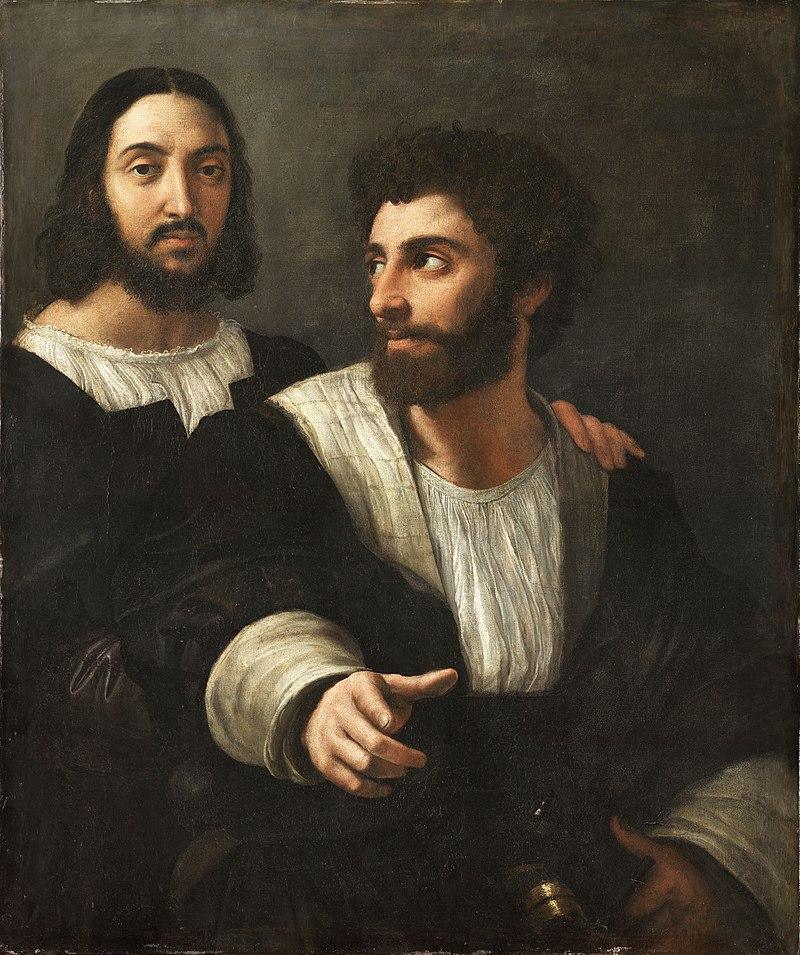
In Portrait of a Man with a Friend , the painting depicts two bearded men in a composition showing them from the bust and waist up, tightly framed against an almost black-brown background. The figure on the left, set slightly back, looks straight ahead with a serene expression; beside him is the second man, placed in the foreground with his head turned to the left. Both wear dark garments that set off their broad, pleated white collars. One hand rests on the foreground figure’s shoulder, while another reaches out into the viewer’s space, reinforcing the physical closeness between the two.
As a genre, the self-portrait turns the artist’s presence into an assertion of identity. Here, that representation is shared with a friend or close companion, so the work brings individuality and personal connection together within the same pictorial space. Double portraits have traditionally served to express friendship, kinship, collaboration or social alliance; in this painting, the figures’ proximity makes their relationship as important as their identities. The frontal gaze establishes immediate contact, while the companion’s posture introduces a second focus of attention.
Gestures underpin much of the visual interpretation. The hand resting on the shoulder conveys familiarity and trust, and serves as a bridge between the overlapping bodies. The hand extended towards the foreground projects that relationship beyond the picture’s boundaries and draws the viewer into a space of contact suggested by the gesture. The contrast of the white collars against the dark garments draws attention to the faces, hands and transition between the two figures. The direct gaze asserts one figure’s presence, while the other’s turned head creates a dynamic relationship between the figure looking out at the public and the one facing sideways.
The formal structure reinforces this intimacy. The vertical, tightly framed composition leaves little empty space, compresses the figures, and makes their bodies visually intertwine. The uniform background, in shades of brown and black, removes environmental references and makes tonal contrast the main means of creating depth. The light is concentrated on the faces, hands, and light folds of the collars; the dark areas of the garments act as a frame, directing attention to these illuminated points. The diagonals formed by the outstretched hand, the turn of the head, and the touch on the shoulder introduce movement into a stable structure.
In relation to Raphael, the work can be linked to a tradition of compositional clarity, elegant drawing, and harmonious balance between the figures. This arrangement gives each gesture weight and allows emotion to emerge from visible relationships, without relying on an elaborate narrative setting. The painting’s appeal lies in transforming a shared self-portrait into a scene of trust and presence. The frontal gaze, the hand on the shoulder, and the hand reaching outward form a visual sequence of identity, closeness, and contact, turning the portrait into a carefully constructed image of friendship.
Have questions about our oil painting reproductions? See our frequently asked questions.