

Description
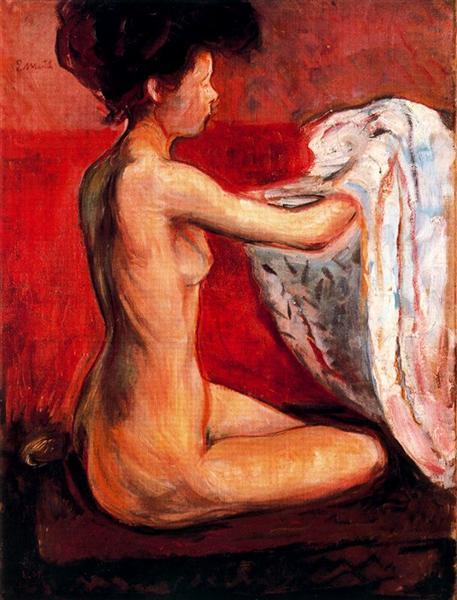
The painting shows a nude human figure seated in profile, with the torso upright and the legs bent on a dark surface. The figure occupies the center and left side of the composition; the head, crowned by a thick mass of dark hair, faces right while the arms extend toward a large, light-colored cloth. The fabric falls in vertical folds and features gray, blue, and reddish marks that enrich its surface. In the background, a field of crimson and dark reds envelops the scene and establishes an intense contrast between the body, the cloth, and the pictorial space.
The work belongs to the genre of figure study and presents an intimate scene, removed from any historical, religious, or mythological narrative. Attention centers on the physical presence, the posture, and the immediate relationship between the figure and the fabric spread out in front of it. The nude is not accompanied by attributes that point to a specific narrative identity, but is presented as a body observed in a moment of concentration. This choice connects the scene with a modern tradition that uses the human figure to explore tension, isolation, and sensitivity. The reference to Paris belongs to the title and provides a cultural context without making the depicted background a recognizable location.
The body concentrates the work’s expressive force. The back, neck, and legs form a continuous silhouette, while the curve of the pose conveys stability alongside restrained effort. Opposite it, the light-colored cloth introduces a counterpoint of texture, volume, and luminosity. Its folds visually extend the direction of the arms and turn an everyday action into an exchange between skin and material. The dominant red surrounds the figure, absorbs the surrounding space, and makes the cloth open up a breathing space within the scene. Set against the chromatic density of the background, the nude concentrates a sense of vulnerability and physical strength, while the cloth creates visual distance that heightens the intimacy of the composition.
Formally, the composition is organized around two main directions. The verticality of the body and the folds of the cloth intersects with the horizontal line traced by the arms, creating a tension that keeps the eye moving. The head and torso form a curved diagonal that leads toward the hands and, from there, toward the cloth’s luminous expanse. The red background functions as an enveloping pictorial field, with variations in density and dark areas that heighten the contrast. The whites, grays, and blues of the cloth interrupt the continuity of the red and establish the composition’s secondary focal point. The patches of color and simplified contours make the volume emerge through both drawing and the opposition between areas of color.
In this sense, the work is consistent with traits widely associated with Edvard Munch: intense color, simplified forms, and a composition designed to create psychological tension. The scene transforms an everyday study of the body into an image of great intensity, in which the enveloping red and the light-colored fabric set against the body create an intimate and dramatic visual experience. The figure’s gaze, the outstretched arms, and the draping of the cloth form a chain of attention linking body, material, and space. This relationship between nudity, color contrast, and expressive simplification is the visual key to Nude, Paris.
Have questions about our oil painting reproductions? See our frequently asked questions.