

Description
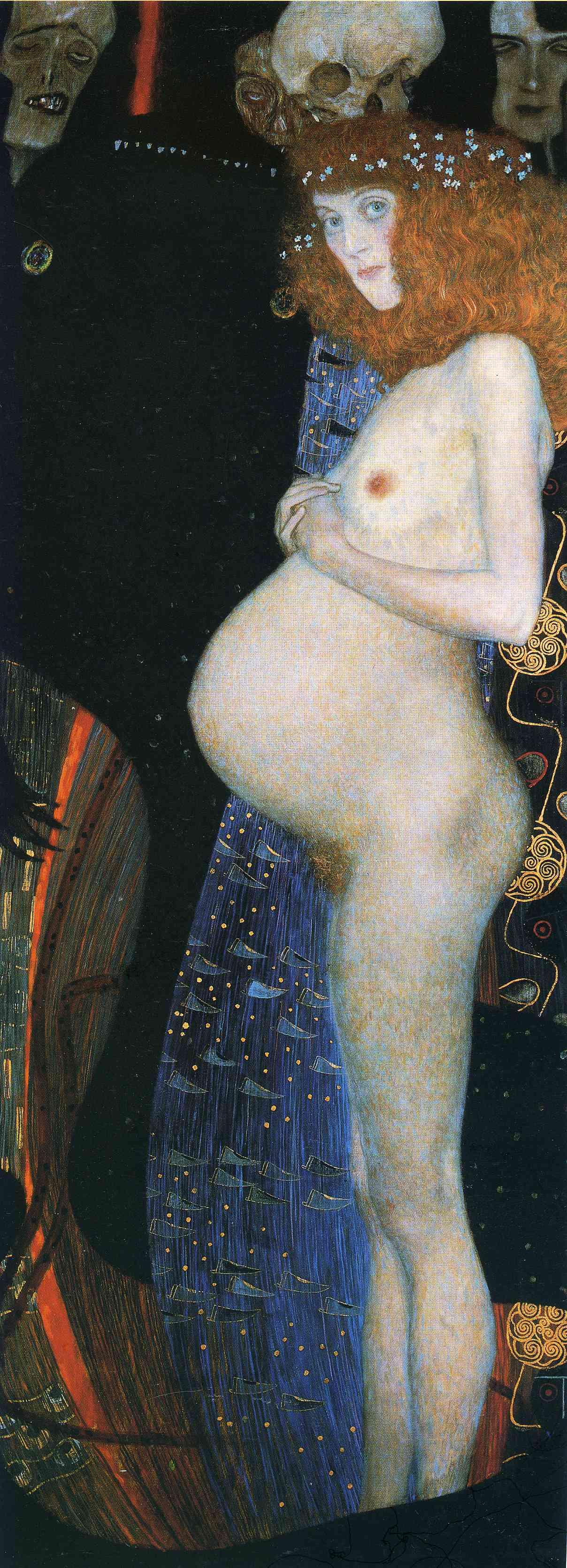
The painting presents a pregnant nude woman as the central figure, seated or leaning against a densely ornamented black background. Her prominent belly and pale body occupy the foreground, while her long reddish hair falls around her face and is adorned with small white flowers. A blue fabric patterned with vertical lines, golden dots and curved motifs is arranged behind and beneath the figure. Behind the woman, a dark figure draped in black, several fragmentary faces and a pale skull peering out above her head come together. At the right edge, spirals, circles and golden lines complete the visual field.
The title Hope I focuses the interpretation on motherhood as a promise of continuity and renewal. In the Western symbolic tradition, pregnancy is associated with fertility and the persistence of life; here, this association takes on particular intensity because the pregnant figure appears surrounded by shadows and unsettling presences. The skull introduces the motif of vanitas, associated with mortality and the transient nature of existence. The scene does not depict a specific episode, but instead constructs an allegory in which birth and death remain inseparably linked.
The symbolic power comes from this direct confrontation. The pregnant body serves as an emblem of life, vulnerability and transformation, while the skeletal head acts as a silent counterpoint against the dark background. The white flowers reinforce associations with renewal and fleeting fragility. The partial faces and the black figure surround the woman as presences of vigilance, threat or fate, without displacing her from the center. The blue fabric and golden ornaments turn the setting into a decorative field where the organic, the bodily and the mortal are integrated into a single symbolic language.
The vertical composition guides the eye from the red hair and face down to the belly, the true center of visual gravity. The contrast between the pale skin and black background sharply defines the silhouette, while the orange-red hair introduces a chromatic energy echoed in the textiles below. In contrast to the woman’s frontal stillness, the lines, dots, spirals, and circles create an enveloping rhythm. Depth is compressed: the heads in the background, the skull, and the dark figure are integrated into a continuous ornamental surface. This combination of frontal presentation, pattern, and contrast draws the eye back to the central body again and again.
In Hope I, Gustav Klimt employs an ornamental, Symbolist visual language based on dense surfaces, flat patterns, expressive gilding, and the contrast between a naturalistic body and a decorative setting. The figure’s sensuality is not presented in isolation: it is permeated by an awareness of death and the fragility of every promise of life. The belly, the skull, and the golden motifs form a triangle of focus that encapsulates the work: life asserts itself at the center, under the constant shadow of its limits.
Have questions about our oil painting reproductions? See our frequently asked questions.