

Description
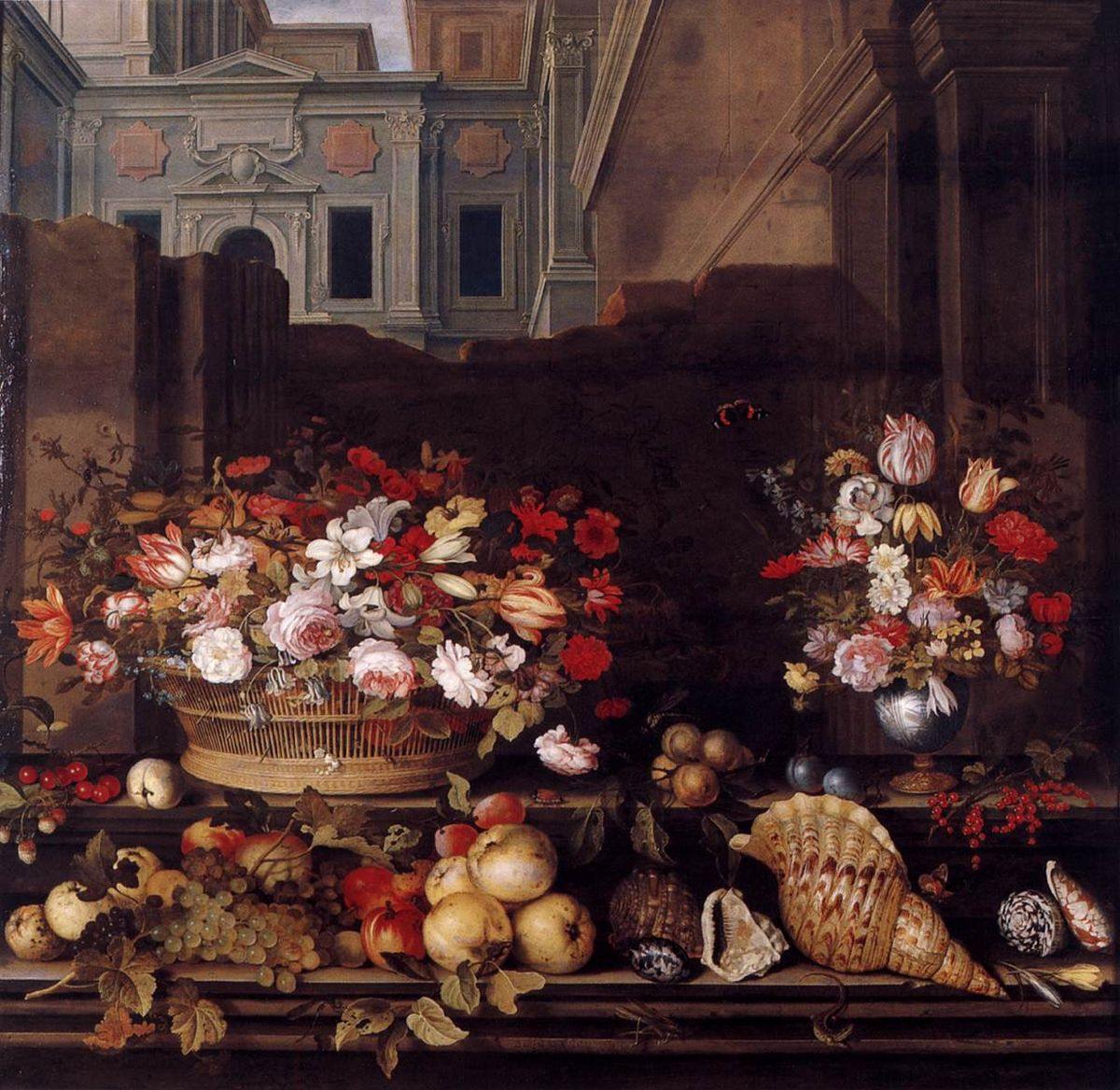
The painting presents a still life of flowers, fruit and shells arranged on a series of dark shelves. Two large floral arrangements dominate the foreground: one rises beside a low wicker basket on the left, while the other is grouped on the right, forming a lush mass of white, pink, red, yellow and orange petals. Leaves and stems intertwine among the flowers, while clusters of grapes, apples, pears and other fruit fill the lower levels. At the far right, several conical, ribbed, fan-shaped and spiral shells introduce an array of marine forms. In the background, a shadowy classical architectural setting, with columns, mouldings, dark openings and a sloping structure, enhances the scene’s sense of depth.
As a still life, the painting does not depend on a specific historical or religious narrative, but instead invites contemplation of an orderly arrangement of carefully assembled objects. The genre turns flowers, fruit and natural elements into independent subjects, drawing attention to their colours, textures, volumes and spatial relationships. Here, the variety of species and materials creates a visual celebration of abundance: plants, fruit and marine life coexist as a collection of natural wonders. The classical architecture expands the scope of the composition and gives it a theatrical appearance, as though the objects were arranged on a monumental stage.
The cut flowers convey a dual meaning: they are signs of abundance while also recalling the limited lifespan of beauty. The fruit and clusters of grapes reinforce the idea of nature’s bounty and add a sensory dimension through their ripe forms and varied surfaces. The shells serve as a counterpoint of rarity and curiosity, with their spirals, ridges and bands, enriching the ensemble with a texture distinct from that of the plants. A small winged insect near the center introduces a traditional allusion to the transience of life. The dark architecture heightens this reading by setting off the luminous fragility of the flowers and fruit.
The composition is arranged in a stepped, horizontal structure that guides the eye from one grouping to the next. The basket and the arrangement on the left establish an initial focal point, while the arrangement on the right balances its visual weight and closes the scene. Between them, the fruit and shells form a transitional band linking the different levels. Warm lighting is concentrated on the objects in the foreground, bringing out ivory whites, reds, yellows and pinks against a range of browns, muted greens and dark browns. By contrast, the columns, moldings and openings remain immersed in shadow, creating depth and a stage-like effect. The accumulation of petals, leaves, fruit and marine surfaces creates a dense rhythm, contained by the orderly arrangement of the shelves.
The work is consistent with Balthasar Van Der Ast’s specialization in still lifes of flowers, fruit, and shells, characterized by meticulous attention to natural forms, rich textures, and the concentration of objects against dark backgrounds. Its appeal lies in transforming abundance into a theater of nature: each flower, fruit, and shell contributes to a composition in which beauty appears vivid, detailed, and fleeting. The shadowy architecture frames the illuminated objects, while the ledges turn a scattered collection into a carefully balanced scene. The result brings together splendor and silence, material variety, and a visual meditation on transience.
Have questions about our oil painting reproductions? See our frequently asked questions.