


Description
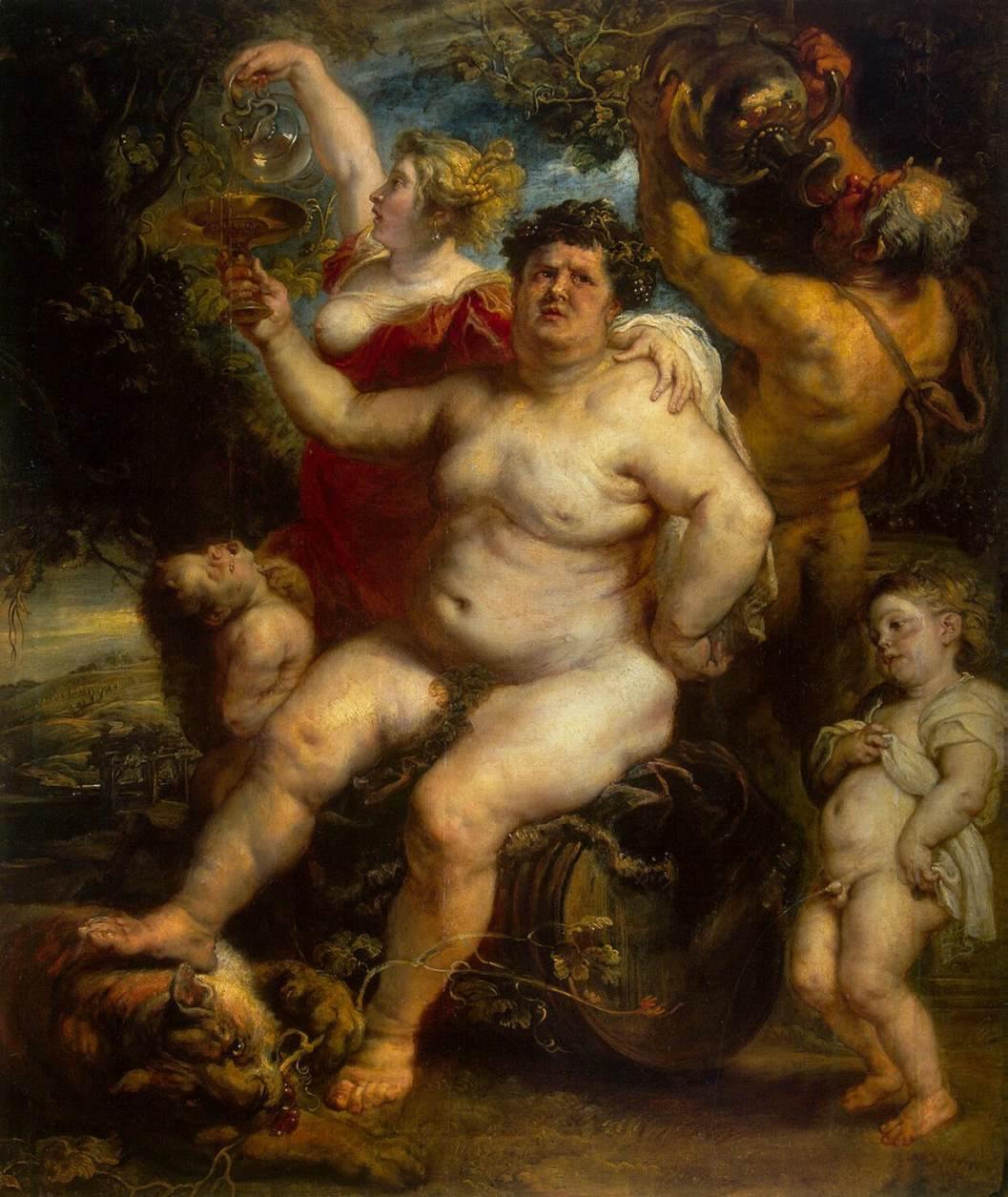
The painting shows Bacchus at the heart of an exuberant celebration in a woodland landscape. The corpulent, semi-nude male figure occupies the center and dominates the foreground, surrounded by vines, leaves and clusters of grapes. Behind him, a woman in a red dress raises one arm beside a small vessel, while a muscular figure with animal features rises in the upper-right area. Two child figures complete the group below, beside a large dark barrel and a goat-like animal reclining between the protagonist’s legs. The blue sky, visible between the masses of foliage, opens the scene onto a luminous natural space.
Bacchus is the Roman deity associated with wine, the vine and celebration, equivalent to Dionysus in Greek mythology. In classical tradition and later painting, his surroundings bring together abundant vegetation, drinking, sensuality and companions of a wild nature. The scene gathers these elements around a large-scale central presence: the god appears as part of a festive procession in which the bodies, vessel and plants form an image of physical and vital abundance. The grouping of adults, child figures and an animal-like figure gives the composition a communal, theatrical and mythological character.
The vines and grape clusters serve as recognizable attributes of Bacchus and shape the entire composition, enveloping the figures like a network of fertility and excess. The large vessel and the small vessel evoke wine and shared celebration, while the animal-like figure can be read as a satyr or a member of Bacchus’s retinue. The animal’s proximity and the wild vegetation heighten this pastoral, untamed quality. The woman in red provides an intense visual accent, and her raised gesture draws attention to the upper part of the group, where the celebration seems to continue beyond the foreground.
Rubens constructs the scene through a vertical, densely interwoven grouping. The central body establishes a stable axis, while the arms, legs, folds, and vine tendrils create diagonals that keep the eye moving. The illuminated bodies stand out against the dark forest, and the deep red of the dress introduces a focal point of color that balances the flesh, ochre, olive-green, and brown tones. The contrast between the open sky and the dense foliage creates depth, while the overlapping figures and objects make the foreground feel almost tangible, full of rhythm and physical contact.
The work is consistent with widely recognized features of Peter Paul Rubens’s style: monumental bodies, dynamic composition, sensuality, and a warm palette enriched with reds, ochres, and flesh tones. In Rubens’s hands, the myth of Bacchus becomes a physical, theatrical celebration in which the god, the vine, and his animal-like retinue merge into a single visual flow. The energy of the scene arises from the balance between abundance and structure: the leaves guide the eye toward the center, while Bacchus’s body transforms the vegetation, vessels, and gathered figures into an image organized around vitality and excess.
Have questions about our oil painting reproductions? See our frequently asked questions.