




Description
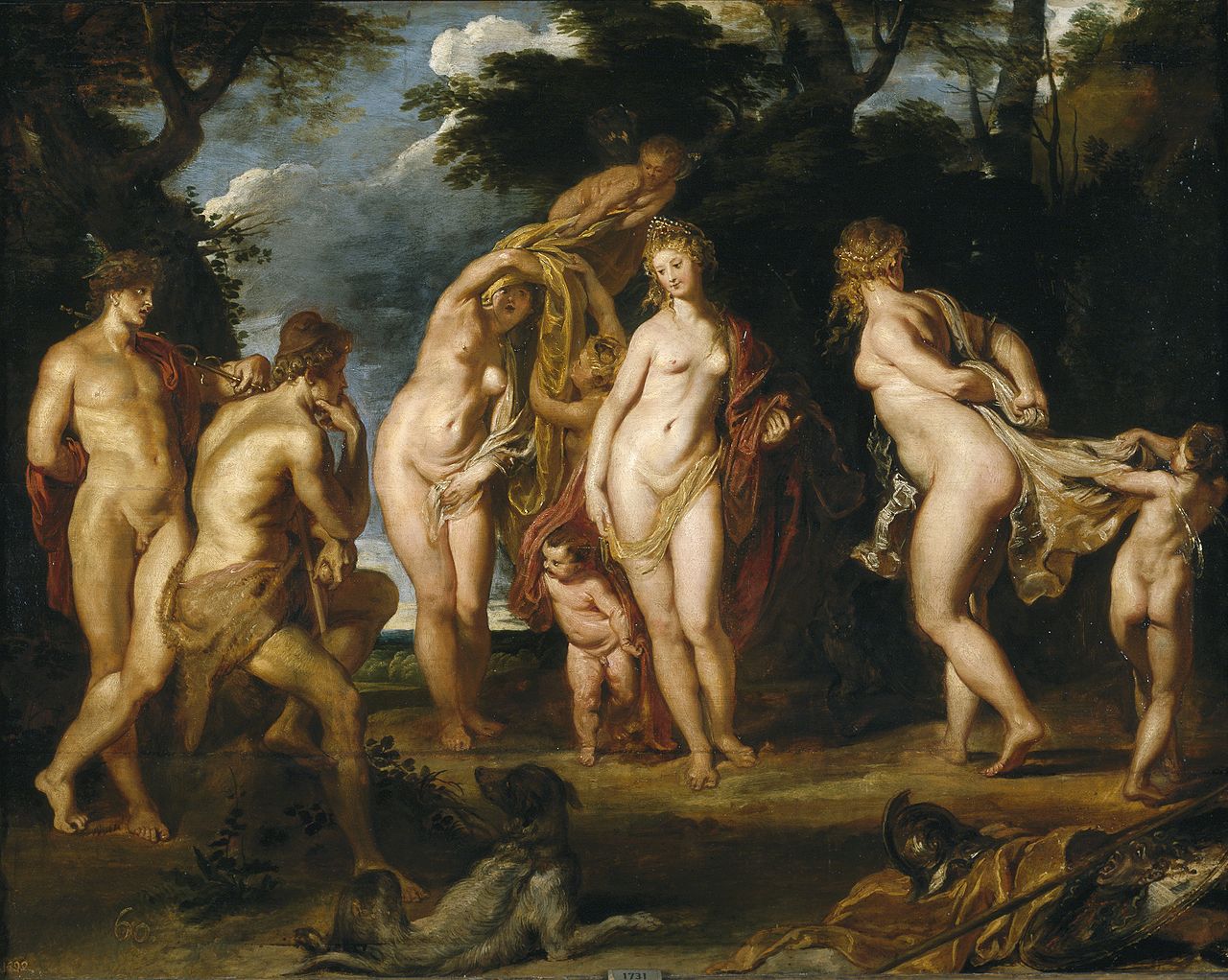
The painting depicts the Judgement of Paris as a group scene unfolding in a woodland clearing. Several nude figures, or figures partially covered with fabrics, gather around a central woman, standing upright and facing forward. Her ornate hair and golden-red drapery make her the main focal point. Around her are adult figures and children: on the left, a man stands beside another who is crouching; at the center, a female figure bends beneath a light-colored drape; on the right, a woman seen from behind holds a fabric that trails toward another small figure. Dark trees frame the scene, while the blue sky and clouds open up a bright space above the branches. In the lower section, vegetation and some animal forms complete the scene’s natural character.
The episode belongs to classical mythology and depicts Paris, prince of Troy, facing the famous beauty contest between Hera, Athena and Aphrodite. Each goddess offers him a different reward: power and sovereignty, glory and wisdom, or the love of the most beautiful woman. Paris chooses Aphrodite, a decision that tradition links to Helen and to the chain of events leading to the Trojan War. The painting concentrates this narrative conflict in a sensual, theatrical encounter, where the choice is expressed through the proximity of the bodies, the display of the female figures and the group’s focused attention.
The fabrics play an essential role in interpreting the work. The large golden cloth crossing the central area visually links the figures and adds a touch of splendor, while the white, reddish and brown fabrics accentuate the folds and poses. The male figure at the far left can be read as Paris within the narrative structure, facing the group of goddesses and attendants. The wooded landscape serves as an idealized setting for the mythological episode: its trunks and branches separate the scene from the open sky, while the low vegetation extends the sense of abundance and earthly life.
The horizontal composition organizes movement along diagonals. The drapery leads the eye from the upper center to the right side, while the bodies form a flowing rhythm that contrasts with the verticality of the trees. The lighting is concentrated on the flesh tones and fabrics, which stand out in warm hues against the dark green, browns and grayish blue of the background. The contrast between the compact group and the patches of sky between the branches creates depth without distracting from the main focus. The woman facing forward acts as a visual axis, while the figures at the sides open up the scene and make the episode seem to extend beyond its boundaries.
These features are consistent with characteristics widely associated with Peter Paul Rubens: monumental, sensual bodies, warm coloring, abundant fabrics and a dynamic staging within a lush landscape. In The Judgement of Paris III, mythology thus becomes a spectacle of movement, desire and color. It is worth observing how the fabrics do more than simply cover the bodies: they connect the figures and establish a visual hierarchy. Around this interplay, the light transforms Paris’s decision into an image of tension, beauty and abundance.
Have questions about our oil painting reproductions? See our frequently asked questions.