



Description
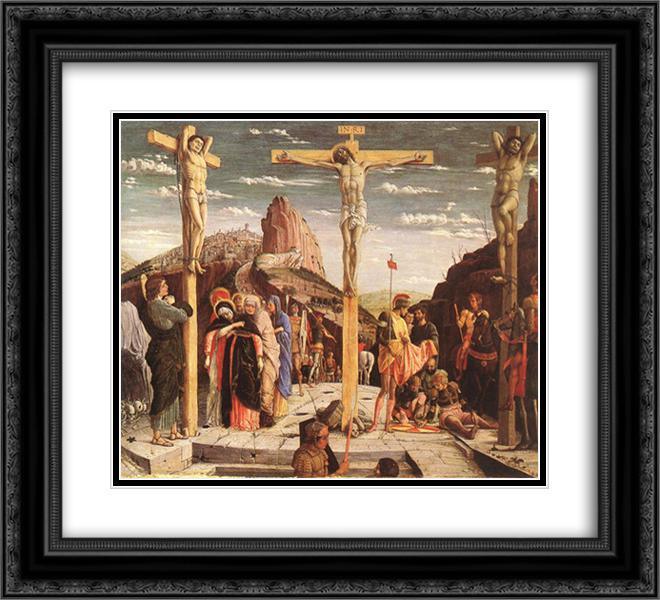
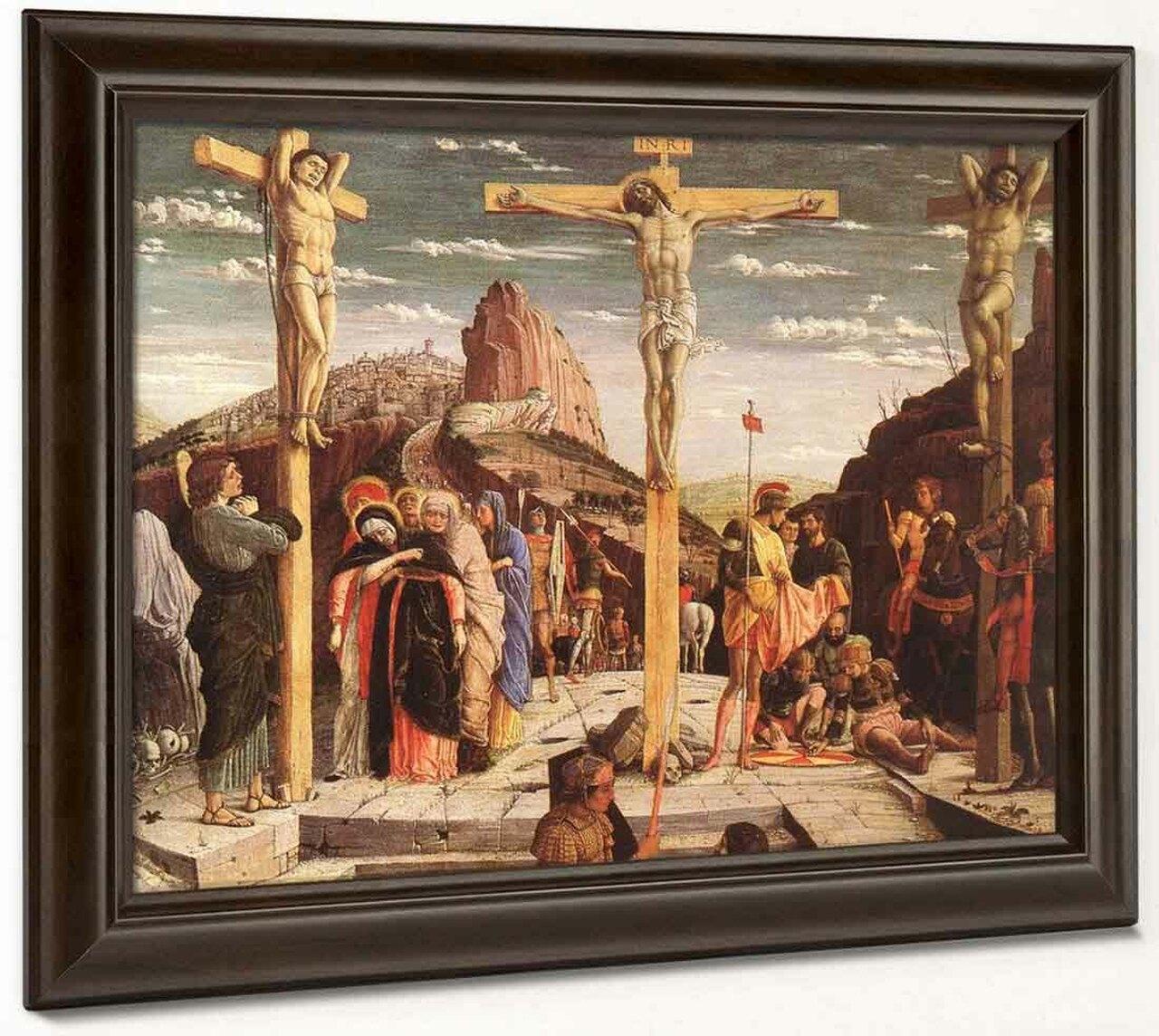
The painting depicts the Crucifixion of Christ in an open, panoramic setting. Jesus occupies the central cross, which is higher and more prominent, with the tablet bearing the inscription INRI above his head; on either side rise the crosses of the other two condemned men. A varied crowd gathers below: women and attendants wrapped in tunics, cloaks and veils, soldiers wearing helmets and armor and carrying spears and swords, as well as two horses visible among the foreground figures. In the lower-left corner, the skulls and bones beside the foot of the cross heighten the association with Calvary. The large paving stones lead the eye toward a settlement on a hill, amid rocky cliffs and a mountainous horizon.
The work depicts the central episode of the Christian Passion: the death of Jesus on the cross between two condemned men. The inscription INRI, placed above the main cross, identifies Christ within the narrative and guides the reading of the entire composition. The grieving figures remain gathered at the foot of the crosses, while the soldiers, their weapons and the horses introduce a worldly dimension of authority, vigilance and tension. The rocky landscape places the event in the traditional setting of Golgotha, or Calvary, while the distant city keeps in view the inhabited world that continues beyond the drama.
The iconography is shaped by contrasts. The three crosses establish a clear narrative structure, while the skulls and bones allude to Calvary, mortality and the redemptive nature of the scene. The group of women embodies grief and contemplation, in contrast to the active presence of the soldiers, who carry weapons and cluster beside the animals. The fabrics spread across the ground, the red flag and the variety of objects and garments add vivid details of human activity. In this way, the painting brings together grief, ritual, violence and anticipation around an immobile, monumental central figure.
The composition is constructed with almost architectural precision. Christ’s cross divides and orders the space, while the lateral crosses balance the width of the format and create a visual rhythm of verticals. The lines of the paving and the road guide the eye from the foreground figures toward the center, the rocky formation, and the horizon. The luminous blue of the sky contrasts with the ochres, reddish browns, blacks, and grays of the rocks, armor, and garments. The scale gradually diminishes toward the settlement and the mountains, creating depth without diminishing the human groups’ presence.
In relation to Andrea Mantegna, the work is recognizable for its precise drawing, sculptural figures, and rigorous spatial construction—qualities widely associated with his artistic style. The integration of the landscape with the religious narrative transforms The Crucifixion into a broad, almost architectural setting, where the geometry of the crosses engages with the cliffs and stone slabs. When viewing it, follow the path that begins at the skulls and mourners, passes through the throng of soldiers and animals, and finally rises to the central cross. This visual journey reveals how human grief and the event’s monumental solemnity sustain one another.
Have questions about our oil painting reproductions? See our frequently asked questions.