

Description
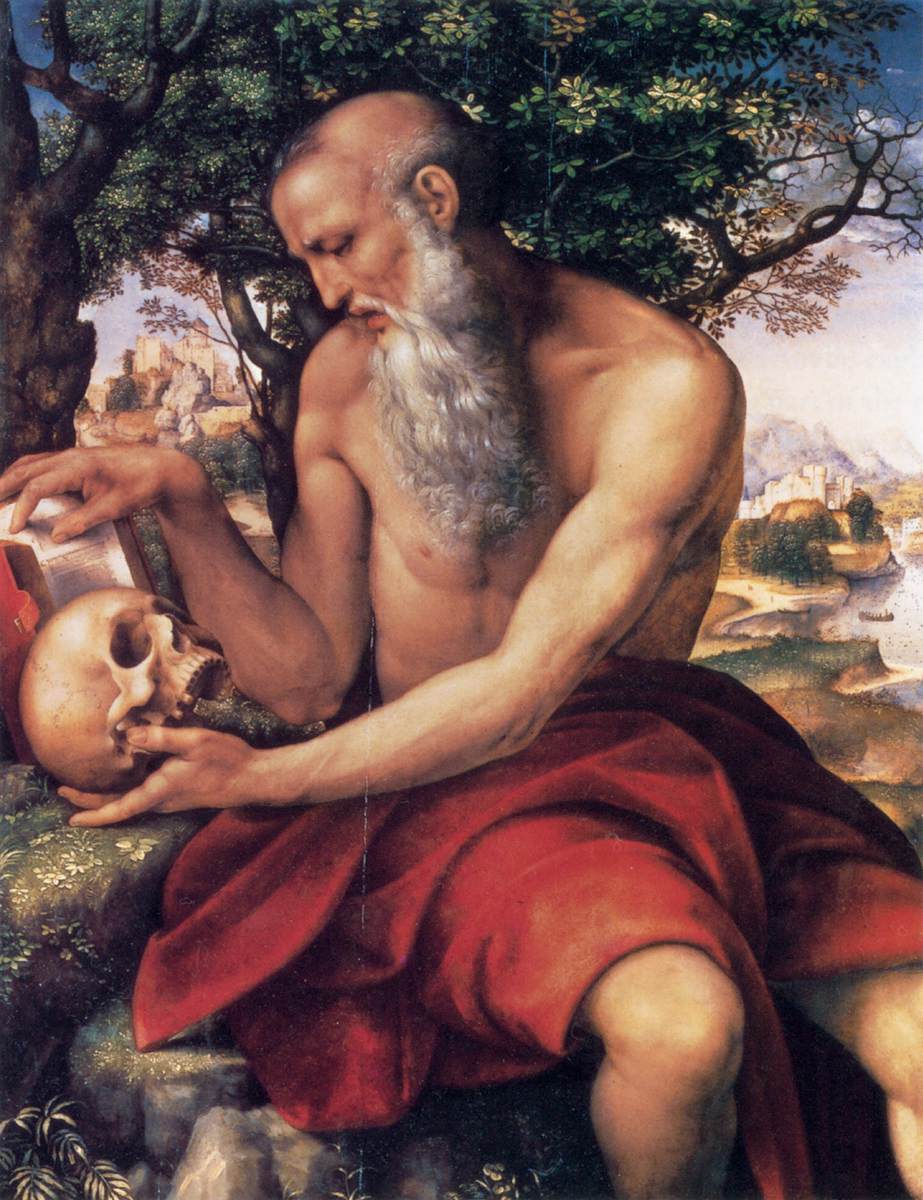
The painting depicts Saint Jerome seated beneath a grove, his torso bare, his head bowed and his long beard outlined against the brightness of the landscape. He holds an ivory skull in his hands, positioned in the lower-left area, while a dark red cloth covers his legs and extends across the foreground as a band of color. Beside it, an open book introduces a second reference to the saint’s intellectual life. The trunks and leafy canopies frame the figure like a natural refuge; beyond them, a landscape of roads, water, hills and fortified buildings opens out towards a habitable horizon.
Saint Jerome is one of the central figures in the Western Christian tradition and one of its great scholar-saints. He is often depicted in iconography withdrawn into a rugged setting, devoted to penance, prayer and contemplation. His presence thus combines two complementary dimensions: the hermit’s renunciation of the body and his dedication to the study of Scripture. The composition brings together both aspects without resorting to a complex narrative: the exposed body and secluded landscape evoke ascetic retreat, while the book and his concentrated pose connect the saint with reflection and religious knowledge.
The skull serves as the symbolic center of the scene. Held carefully and gazed at in silence, it evokes meditation on death and the transience of earthly things, an idea traditionally associated with Saint Jerome. The crimson cloth introduces a note of intensity amid the greens, browns, and earthy tones, and can be read as a visual counterpoint to the penitent’s austerity. The book brings spiritual experience and intellectual discipline together in one place. In the background, the fortress-like buildings and distant water contrast with the isolation of the foreground: the world continues there, but the saint’s attention remains focused on an inner truth.
The vertical structure guides the eye from the upper branches to the bowed face, the arms, and finally the skull. The body forms a gentle diagonal that leads the eye, while the red cloth anchors the lower part and acts as a focal point of color. The trees, with their dark trunks and dense foliage, create a kind of natural architectural frame; in contrast to this leafy gloom, the landscape on the right opens up with greater light and depth. The small buildings, winding paths, and stretches of water introduce successive scales, making the monumental figure seem close and physically present. The contrast between mass and openness, shadow and light, silence and expansiveness turns contemplation into a spatial experience.
In this work by Cesare Da Sesto, Saint Jerome’s identity is expressed through a clearly defined composition: his penitent body occupies the threshold between the dark shelter of the trees and the luminous landscape of the world. The image does not separate knowledge from renunciation; instead, it brings them together around the skull and the open book. Notice how the diagonal line of his arms draws the eye toward these attributes, while the red cloth visually unifies the foreground. Here lies the key to the painting: a figure withdrawn from everyday life yet visually connected to it through the horizon, which transforms meditation on mortality into a broad reflection on spiritual life.
Have questions about our oil painting reproductions? See our frequently asked questions.