

Description
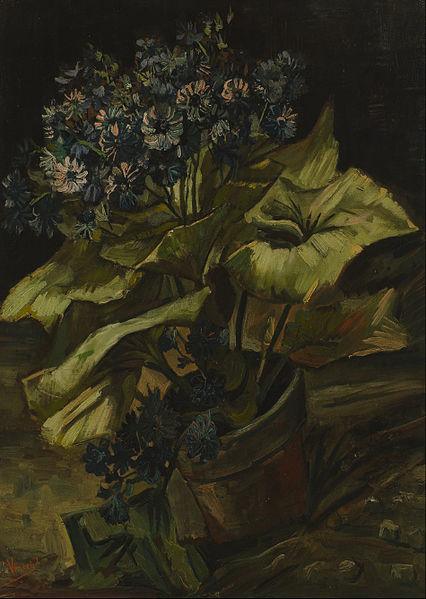
The painting Cineraria presents a flowering plant as the undisputed focal point of the composition. From an earthy container barely visible in the shadows, dark, branching stems rise, supporting large, broad, overlapping green leaves. Several clusters of small flowers gather at the top and toward the left, while the foliage spreads sideways to fill almost the entire vertical format. The nearly black background removes any secondary spatial references and focuses the viewer’s gaze on the plant’s structure. The plant is not presented as a decorative detail, but as a compact, expansive and silent presence emerging from the darkness.
As a botanical still life, the work turns an ornamental plant into an independent subject for contemplation. The cineraria is known for its clustered flowers and abundant foliage, qualities translated here into a carefully articulated structure of stems, leaves and flower clusters. The container provides an anchor at the bottom, but most of its form is absorbed by the vegetation, so the viewer’s attention quickly rises toward the flowers. The whole presents a concentrated vision of plant life: not an open garden or a landscape, but a self-contained presence, observed up close and isolated from any narrative setting.
The clusters of flowers function as small points of light within the mass of greenery. Their cream, bluish, and greenish tones interrupt the continuity of the leaves and create a delicate rhythm against the dark background. The overlapping foliage reinforces a sense of abundance and expansive growth, while the curved stems act as connecting lines between the different parts of the plant. The shadow enveloping the container and the lower leaves introduces a sense of intimacy: the flowers become visible by contrast, as if each cluster preserved its luminosity amid the deeper mass of vegetation.
The vertical composition guides the eye from bottom to top. The container and lower leaves form a dense base; from there, the stems lead the eye toward the upper clusters, which balance the visual weight of the large leaves opening out to the right. Visible brushstrokes construct the forms without completely separating them: veins, irregular edges, and folds partially merge into patches of olive green, ochre, grayish blue, and earthy brown. The light is not distributed evenly but picks out specific areas of the foliage and flowers, creating depth through the alternation of illuminated surfaces and areas absorbed by shadow.
In this Cineraria, Vincent van Gogh transforms a simple botanical subject into a surface of intense pictorial presence. The color contrast, expressive brushwork, and expressive rendering of the leaves are consistent with traits widely associated with his way of turning natural subjects into fields of color and energy. The essence of the work comes through in the way the plant gradually emerges from the background: the flowers first draw the eye, but the stems, shadows, and overlapping leaves are what hold the composition together. The work derives its strength from this tension between floral fragility and organic density.
Have questions about our oil painting reproductions? See our frequently asked questions.