



Description
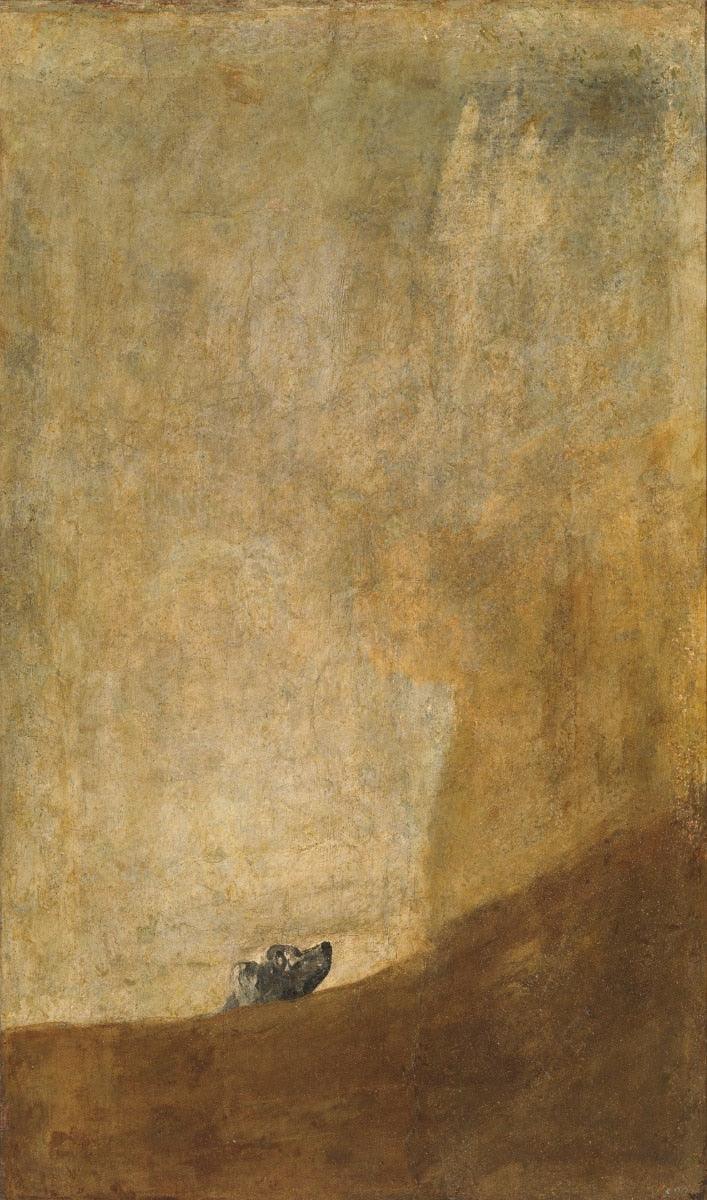
The painting shows a dark dog peering over a hill, its muzzle turned to the right and part of its body concealed by the terrain. The animal figure occupies a small area near the lower center, while an extensive expanse of ochre, beige, greenish-gray, and amber tones opens up above it. The ridge of earth crosses the composition on an ascending diagonal, from the lower-left edge toward the right, creating a clear separation between the animal and the atmospheric space. There are no human figures or anecdotal details to distract the viewer: everything is reduced to the silent presence of the dog, the earth, and a broad, irregular, earthy background.
The Drowning Dog is part of the group known as Francisco Goya’s Black Paintings, painted on the walls of the Quinta del Sordo. Rather than developing a conventional narrative, the work presents a minimal apparition: an animal’s head emerges partially from behind a mass of earth, without offering an explanatory context or a clearly defined action. This narrative economy is essential to its power. The subject needs no recognizable episode to create unease; the relationship between the small creature and the bare landscape is enough to suggest an experience of isolation and suspension.
The dog’s small scale against the breadth of the upper field heightens its vulnerability and loneliness. The hill functions simultaneously as shelter, boundary, and obstacle: it protects the animal from complete exposure, but also visually imprisons it. Its head, isolated against the background, draws the viewer’s gaze and transforms an everyday presence into an image charged with gravity. The nearly empty expanse creates a space of uncertainty, while the contrast between the lighter background and the dark terrain intensifies the sense of separation. The scene offers no conclusion; its tension arises precisely from this incomplete appearance.
The vertical composition reserves most of its surface for an atmospheric field of mottled texture, with patches and variations that keep the background from being completely uniform. Against this expanse, the hill forms a compact, dark mass whose curved edge guides the eye toward the dog’s head. The eye first follows the diagonal of the ground, then comes to rest on the animal’s snout, ears, and profile. The visible texture retains an irregular, earthy character, suited to a scene in which depth is created more through tonal layers than descriptive detail. The light is diffuse and subdued; rather than depicting a dramatic moment, it sustains a sense of restrained tension across the entire surface.
In this work, Francisco Goya transforms a simple subject into an image of extraordinary psychological intensity. The dark, earthy palette, austere space, and ambiguity of the scene are characteristic of his late period, associated with the Black Paintings. Its power comes from making a minimal presence monumental: a partially hidden dog, a strip of earth, and an emptiness that seems to extend beyond the painting. When viewing it, follow the diagonal of the hill to the point where the head appears; there, the balance between presence and concealment, between the animal’s vulnerability and the silent immensity of its surroundings, is concentrated.
Have questions about our oil painting reproductions? See our frequently asked questions.