








Description
A masterpiece of the early modern period, Gustav Klimt’s The Kiss is a deceptively simple portrait of lust and love. But beyond that brilliant gold leaf, the work is full of fascinating facts.
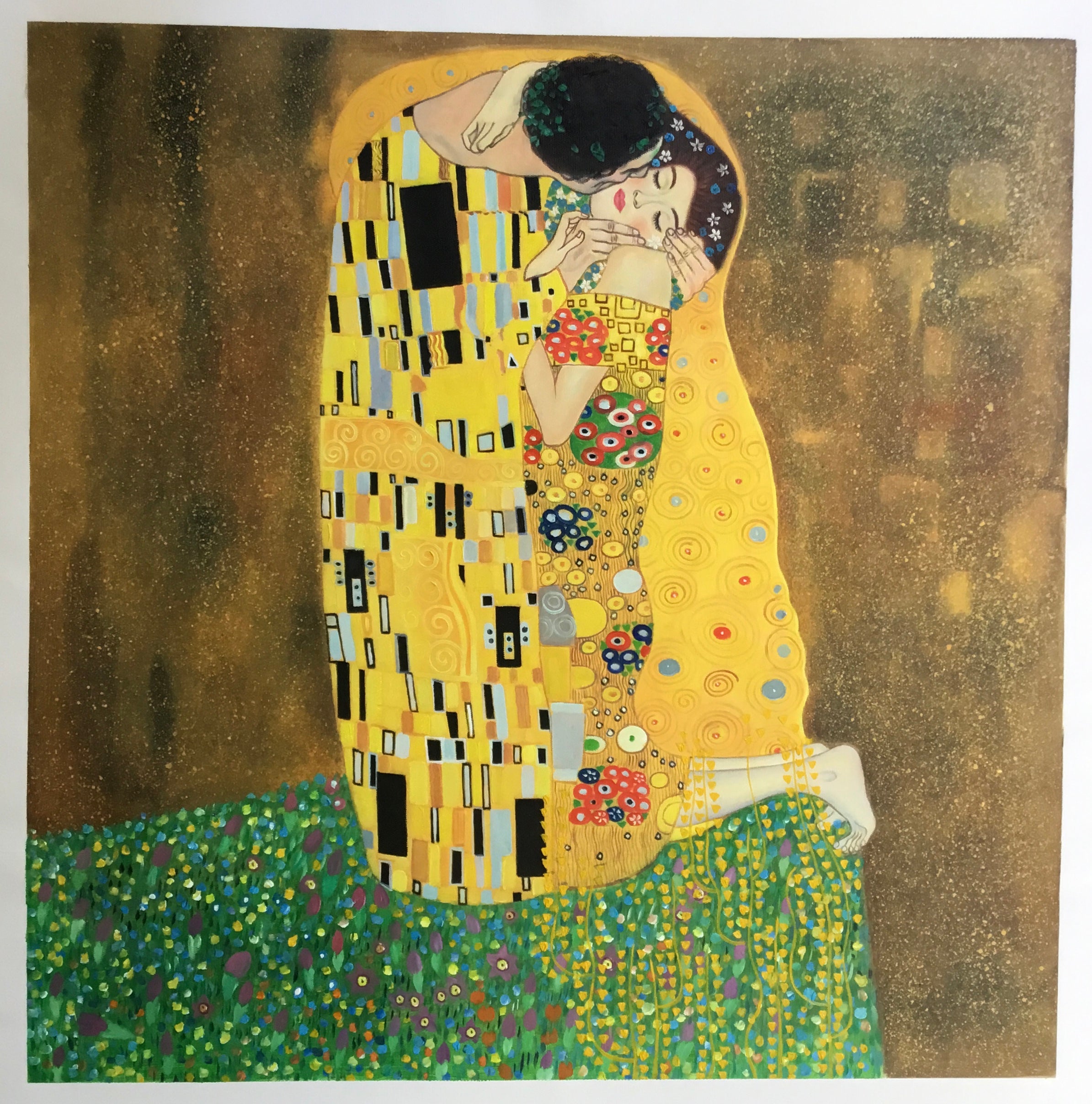
The Kiss, Klimt’s most famous painting, was created between 1907 and 1908, the height of Klimt’s Golden Period, when he painted several works in a similar gilded style.
His Golden Phase was presumably inspired by a visit to Ravenna during his travels in Italy in 1903, which introduced him to the world of Byzantine mosaics. For Klimt, the mosaics’ flatness and lack of perspective and depth only enhanced their golden brilliance, and he began making unprecedented use of gold and silver leaf in his own studio.
The Kiss is housed at the Austrian Gallery in the Upper Belvedere Palace in Vienna.
The painting shows a couple embracing in a field of flowers. The man leans over the woman, who, holding him tightly, awaits his kiss. In terms of ornamentation, the male figure is characterized by square and rectangular shapes, while soft lines and floral motifs dominate the female figure.
Klimt depicts the couple enclosed in intimacy, while the rest of the painting dissolves into an extravagant, brilliant, flat pattern.
The pattern has clear links to Art Nouveau and the organic forms of the Arts and Crafts movement. At the same time, the background evokes the conflict between two-dimensionality and three-dimensionality inherent in the work of Degas and other modernists.
Paintings such as The Kiss were visual expressions of the fin-de-siècle spirit because they capture a sense of decadence conveyed through opulent, sensual imagery. The use of gold leaf recalls “golden” medieval paintings and illuminated manuscripts, as well as earlier mosaics, while the spiral patterns on the clothing evoke Bronze Age art and the decorative tendrils found in Western art since before the Classical era.
There have been numerous attempts to identify the woman depicted in The Kiss. Those suggested include Klimt’s lifelong partner, Emilie Flöge, as well as Adele Bloch-Bauer. The subject’s well-proportioned facial features bear a resemblance to many of the women Klimt portrayed, but ultimately cannot be attributed unequivocally to any particular person.
The Kiss ranks No. 5 on the list of famous paintings