

Description
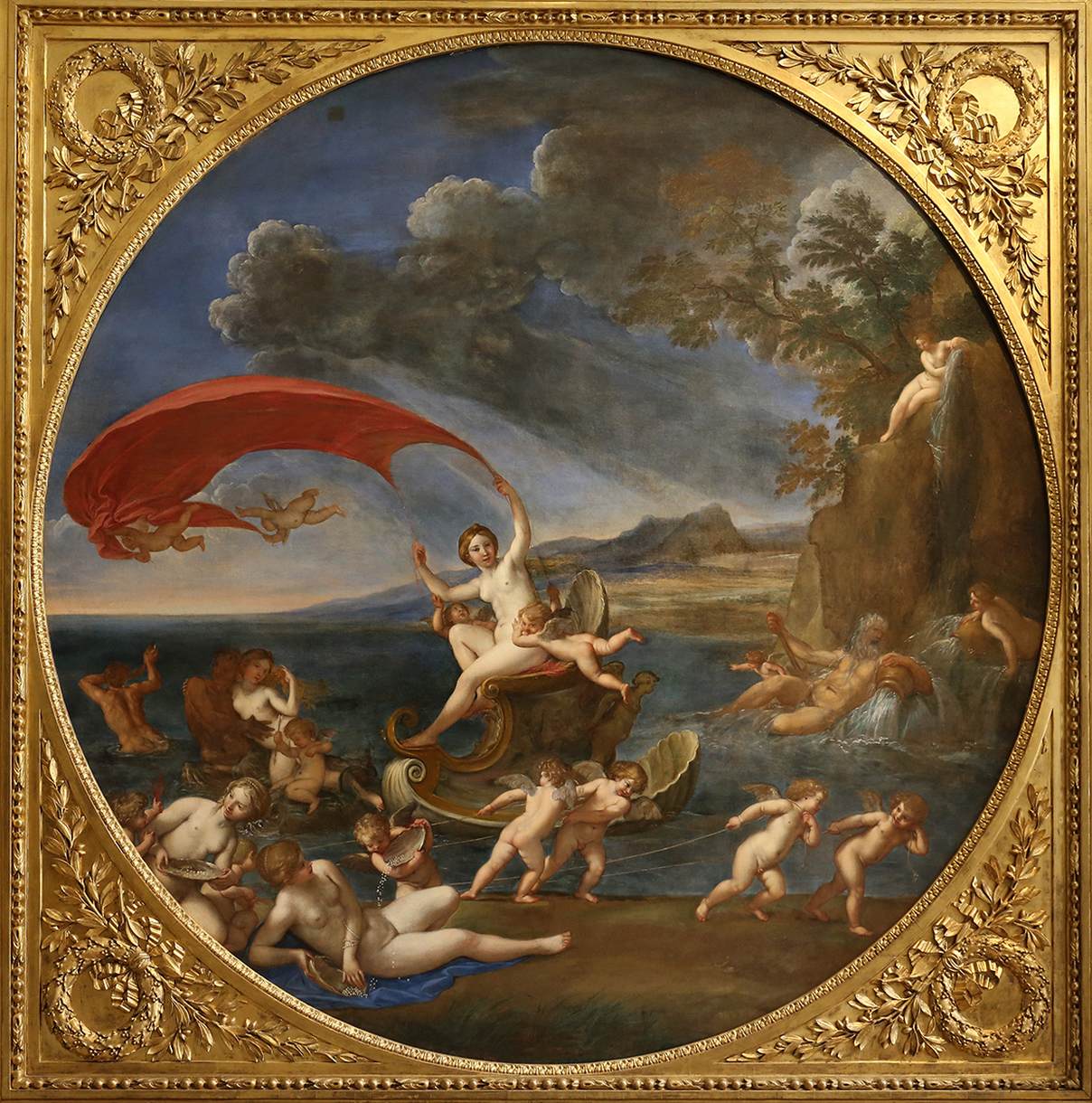
The painting depicts an allegory of Water conceived as a mythological and ornamental spectacle. At the center, a nude woman rises above a golden vessel or shell, one arm raised and surrounded by numerous winged children. Other nude adult figures rest or submerge themselves among the water, rocks and vegetation. A waterfall cascades on the right, while the aquatic horizon opens onto mountains and rock formations. In the upper left, a large red drapery sweeps across the scene, adding a theatrical flourish to the composition.
The title, The Four Elements: Water, places the work within a Western tradition that personifies earth, water, air and fire through human figures, natural attributes and recognizable settings. Here, the water element is not presented as a simple landscape, but as a populated, festive world. The waterfalls, shells, vessel and figures gathered in the water form a mythological allegory, closer to a poetic vision than a literal narrative. The small winged beings, reminiscent of the putti in European allegorical painting, enliven the composition and accompany the central personification.
The iconography is built around a direct association between water and its attributes: flowing movement, shells, the waterfall and the marine horizon. The central woman serves as the focal point of the allegory, while her youthful entourage lends lightness, rhythm and a playful tone. The red drapery creates a striking counterpoint to the grayish blues, dark greens and golden hues. Dense clouds and bands of light add drama to the sky, so that the scene combines abundance and celebration with shifting natural energy. The gilded frame, covered with garlands, crowns and vegetal reliefs, extends the work’s ceremonial character and visually connects it to a decorative cycle.
The composition is arranged along a vertical axis dominated by the female figure and the golden vessel. From this center, the bodies form a broad curve that guides the eye toward the foreground, where the winged children, shells, and undulating forms concentrate the activity. The diagonal of the red drapery balances the weight of the trees, rocks, and waterfall on the right. The contrast between the stormy sky and the warm-toned bodies of the central group creates depth and separates the different planes. The abundance of figures creates an almost musical rhythm, while the gold of the frame and vessel catches the light and holds the scene together.
The work is consistent with the Bolognese classicist tradition associated with Francesco Albani: idealized figures, nudes with an elegant rhythm, poetic landscape, and mythology treated with ornamental lightness. Rather than isolating the personification, Albani—understood here within that stylistic context—integrates it into a universe of water, vegetation, clouds, and winged creatures. Notice how the golden center first draws the eye, but the red drapery then shifts it to the left, and the waterfall leads it back to the landscape. This journey reveals the painting’s essential idea: Water is not merely a natural element, but a living, theatrical, collective scene.
Have questions about our oil painting reproductions? See our frequently asked questions.