

Description
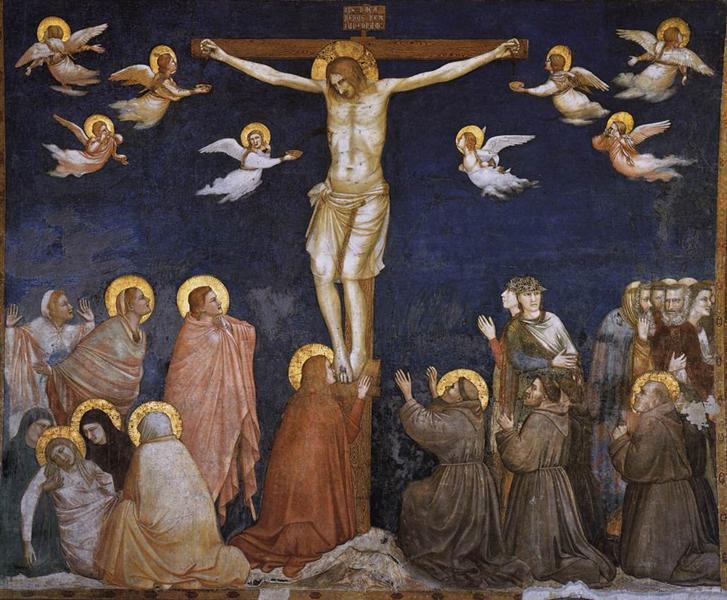
The painting shows Christ crucified at the center of a vertical composition, raised on a wooden cross that dominates the space. His bare torso and the light-colored cloth around his waist stand out against the dark blue background, while a small plaque sits at the top of the upright. Six winged figures float around the crossbeam, turning their bodies, arms and gazes toward the central figure. Below, a crowd of haloed figures gathers on rocky ground: some stand, others kneel or bow their heads, and many raise their hands in gestures of grief, prayer and veneration.
The scene depicts the crucifixion of Jesus Christ, a central episode in the Christian Passion. Christ is shown raised on the cross as the angelic beings and figures gathered below express the gravity of his death. The cross serves not merely as a support for the figure: in the Christian tradition, it embodies the meaning of the Passion, death and redemption. The halos identify the figures as sacred or connected to the spiritual dimension of the event, transforming the gathering below into a community of devout witnesses to the sacrifice.
The work transforms the Crucifixion into a visual structure of mourning and veneration. The arc formed by the angels introduces a heavenly response to the earthly tragedy, as though the entire space were turning toward Christ. In the lower area, raised hands and bowed bodies form a chain of gestures that conveys grief and prayer. The brown, red, cream and greenish-gray robes distinguish the figures without disrupting the unity of the scene. The concentration of golden halos around their heads reinforces the spiritual hierarchy and establishes a luminous rhythm among the crowd.
The composition is organized with almost geometric clarity. The cross’s vertical shaft divides and orders the field, while its crossbeam establishes a horizontal axis that balances the winged figures on either side. Christ, positioned in the upper half, immediately draws attention through his scale, elevated position, and the contrast between his pale body and the deep blue. From there, the gaze descends toward the compact group of mourners, guided by the diagonals formed by arms, cloaks, and overlapping bodies. The rocky ground anchors the scene in a specific space, while the dark background eliminates distractions and makes the halos and light-colored garments function as points of light.
In relation to Giotto di Bondone, the work is associated with a narrative and devotional approach based on figures with a pronounced physical presence, expressive gestures, and a clear organization of the sacred story. The emotion does not depend on a single face, but on the interplay between Christ, the angels, and the crowd responding to his death. Hierarchical scale, symmetry, and chromatic contrast make the episode accessible and deeply focused. It is worth observing how the cross’s verticality is echoed in the response of the hands and gazes: the entire scene rises toward Christ and, at the same time, directs his gravity back toward the community gathered below.
Have questions about our oil painting reproductions? See our frequently asked questions.