

Description
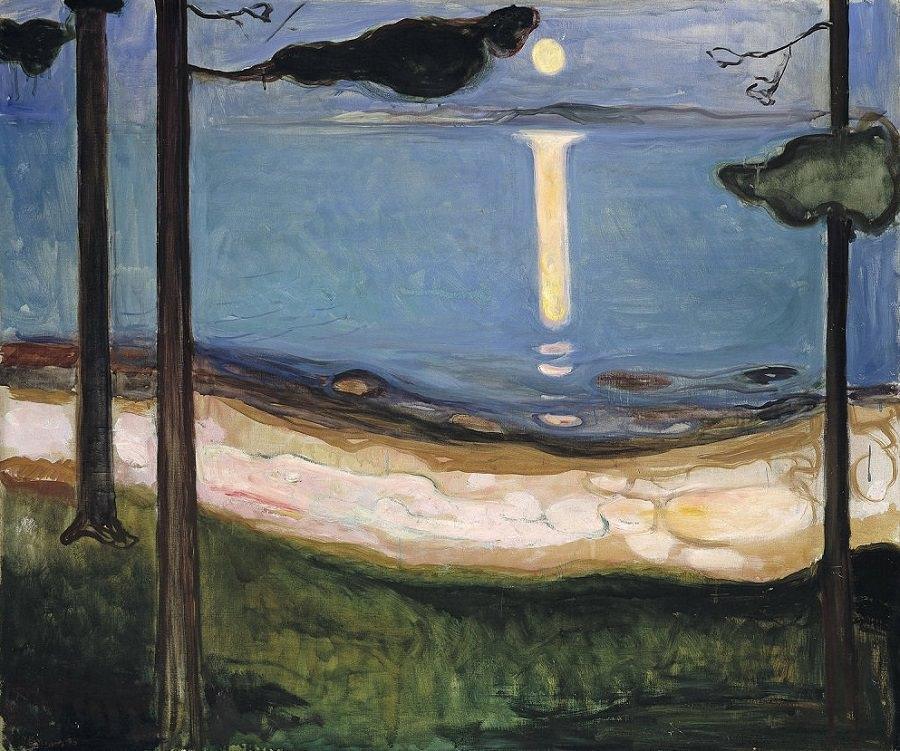
The painting shows a nighttime landscape built around a bright moon and its vertical reflection on the water. The lunar disk occupies the upper central area, slightly offset to the right, and casts a luminous column down across the water’s surface. The lake or pond stretches horizontally across the center, with blue bands and ripples breaking up and fragmenting the light. Farther down, a shore in cream, pink, and ochre tones separates the water from a band of dark vegetation. Trunks and branches frame the scene from the sides, while foliage gathers in the foreground, reinforcing the impression of looking into a secluded place.
As a landscape, Moonlight does not rely on a narrative episode or characters to sustain its presence. Its subject is the contemplative experience of nature at night: the sky, water, and vegetation form a silent setting in which moonlight shapes perception. The work thus belongs to a landscape tradition that turns a natural environment into an emotional experience, focusing more on the intensity of the moment than on the topographical description of a specific place. The title encapsulates this interpretation and directs the eye to the relationship between the light source in the sky and its extension across the water.
The moon and its reflection establish an axis of light within an environment dominated by shadows. The duplication of this celestial form transforms the water into a resonant surface, as though the landscape were structured between a distant presence and its nearby imprint. The dark trees at the edges serve as a visual frame, compressing the illuminated space and emphasizing its isolation. Against the vastness of the sky, the vegetation introduces density, boundaries, and a sense of enclosure. The contrast between the band of light and the green, black, and blue masses does more than separate the planes: it also creates tension between openness and confinement, between the stillness of the horizon and the enveloping closeness of the forest.
The composition is arranged in clearly defined horizontal layers: sky, water, shoreline, and foreground vegetation. Superimposed on this stable structure are the vertical lines of the tree trunks and the moon’s reflection, which guide the eye from top to bottom. The horizontal brushstrokes in the sky and water suggest a gently moving surface, even as the scene retains a profound stillness. Cool colors—grayish blues, muted greens, and blacks—concentrate the sense of night, while creams, pale yellows, and ochres reserve the greatest luminosity for the moon, its reflection, and the shoreline. This distribution of color creates depth without relying on architectural perspective: the framing vegetation draws close to the viewer, while the water opens up an intermediate space leading toward the horizon.
In keeping with the sensibility widely associated with Edvard Munch, the painting transforms the landscape into a structure of psychological intensity through simplified forms and expressive use of color. The scene does more than depict a night by the water; it reveals how minimal illumination can reorganize the entire visual field. Particular attention should be paid to the path between the moon and its reflection: this luminous axis crosses the sky, the water, and the shore, while the branches and foliage frame it from the edges. The strength of Moonlight, where the landscape’s apparent serenity becomes an experience of concentration and inner depth.
Have questions about our oil painting reproductions? See our frequently asked questions.