

Description
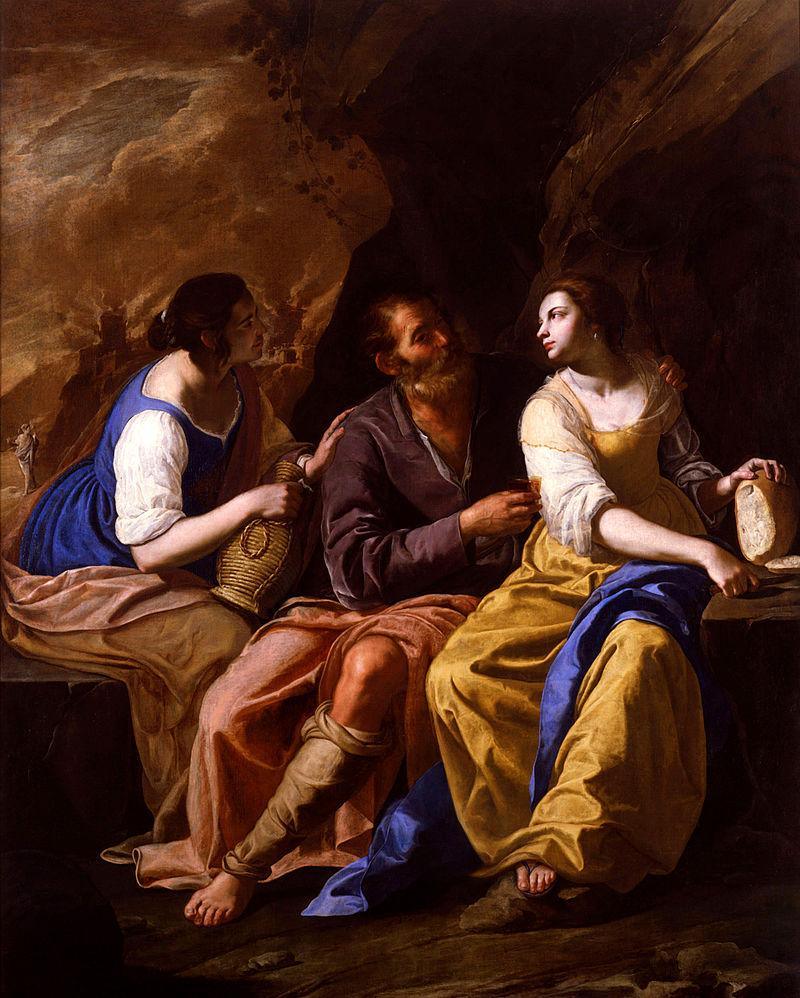
The painting shows Lot and his daughters gathered in a dark, rocky, enclosed space. The bearded man occupies the center of the composition, dressed in a purple tunic and a pink cloth over his legs, as he turns his face toward the woman seated on the right. His daughters sit on either side: the figure on the left holds a wicker basket and wears blue and white; the one on the right, wrapped in yellow, blue, and light-colored fabrics, extends an arm toward a rounded, luminous object at the edge of the scene. The three figures form a compact group, connected by their gazes, gestures, and physical closeness.
The episode comes from the Book of Genesis, following the destruction of Sodom and Gomorrah. Lot flees with his daughters and finds refuge in a cave, isolated from the world left behind. There, in their confinement, his daughters get him drunk so they can conceive children with him and ensure the continuation of his line. The painting concentrates the tension of this family and moral episode: it does not depict an overt action, but rather an encounter charged with intimacy, dependence, and conflict within a precarious refuge.
The cave functions as more than a backdrop: it turns the episode into an experience of isolation and confinement. The richly colored fabrics and the basket introduce a domestic dimension that contrasts with the gravity of the story. The exchanged glances shape the emotional reading of the scene: Lot appears between his daughters, connected to both and positioned at the center of a relationship marked by vulnerability and power. The tactile richness of the fabrics heightens the ambiguity between refuge, intimacy, and moral threat, while the light-colored object on the right adds a visual focal point without shifting the composition’s human focus.
The triangular composition leads the eye from the woman on the left to Lot’s face, then to the figure on the right. The brown and black background absorbs the secondary contours, while the light falls on the faces, hands, and folds of the garments. Blue, yellow, pink, and purple stand out against the gloom as rhythmic accents of color. Depth is created by the overlapping bodies and fabrics rather than by a spacious setting; in this way, the viewer senses the physical confines of the cave and the psychological closeness of the figures.
The work is consistent with widely recognized features of Artemisia Gentileschi’s style: drama, intense chiaroscuro, expressive gestures, and the prominence of female figures in biblical narratives. Here, the theatricality arises not from violent movement but from the restrained tension among the three figures. The light models the hands and faces before guiding the eye toward the fabrics, transforming a biblical scene into a complex study of relationships, vulnerability, and power. The cavernous refuge also becomes an inner stage, where each gaze carries as much weight as the events being depicted.
Have questions about our oil painting reproductions? See our frequently asked questions.