

Description
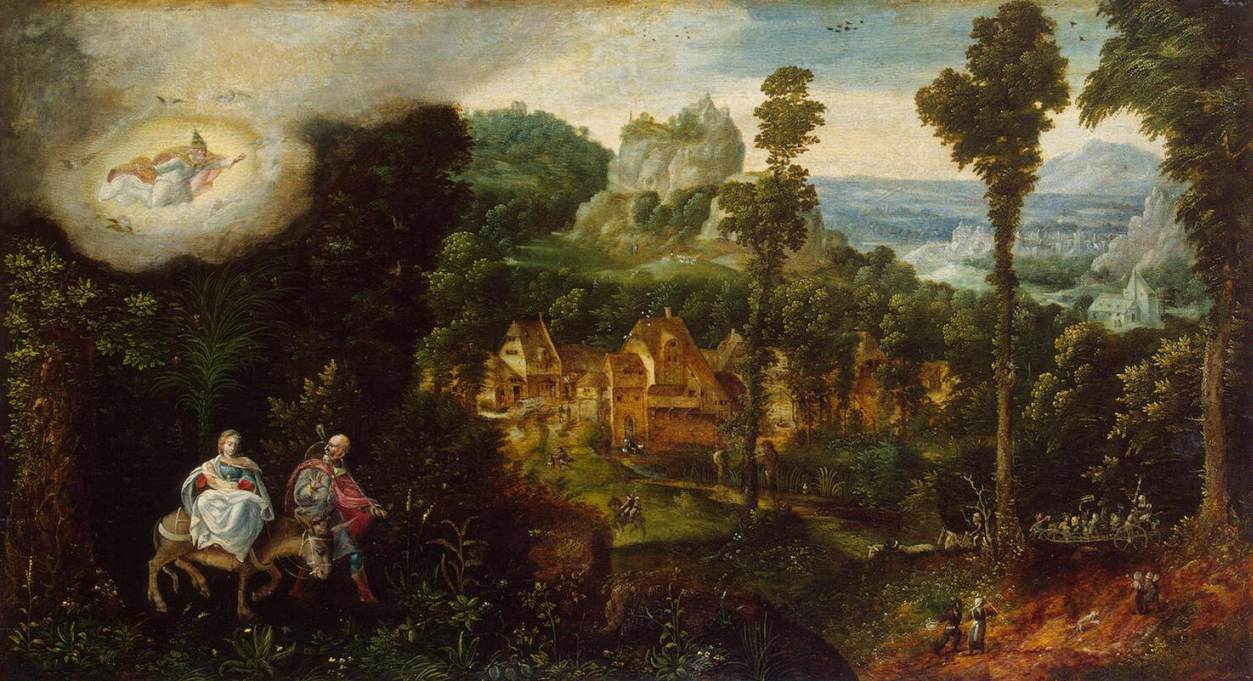
The painting depicts the Flight into Egypt as a journey unfolding within a vast woodland landscape. In the lower-left foreground, Mary sits on a pack animal, accompanied by Joseph, who bends beside her. The dirt road begins in this nearby area and winds through trees, small figures and vegetation before reaching a village of ochre houses with sloping roofs. Beyond, pale cliffs, blue mountains and a luminous expanse open up the depth of the scene. In the upper-left sky, a circular radiance gathers tiny luminous figures, while several birds cross the bright expanse.
The scene refers to the Gospel account in which Joseph leads Mary and the infant Jesus to Egypt to protect him from the threat posed by Herod. Here, the episode is not focused on a close depiction of the Holy Family, but expands into an experience of passage through a natural landscape. The presence of other travelers and animals along the path visually extends the idea of a journey, as though the sacred story were part of a broader route. The village at the center offers a point of refuge and everyday life, contrasting with the protagonists’ itinerant existence.
The road serves as the composition’s main narrative motif: it connects the foreground with the community and leads the eye toward an increasingly open horizon. Above this earthly route, the celestial radiance introduces a spiritual dimension and evokes an angelic presence associated with divine protection. The contrast between the dark forest and the sky’s golden light heightens the episode’s themes of danger, shelter and hope. The small scattered figures give the landscape a human scale and keep nature from seeming like a mere backdrop; each group takes part in a scene of pilgrimage and the search for safety.
Formally, the work is structured around a deep, tiered perspective. The tall trees on either side act as a vertical frame, compressing the foreground and directing the eye toward the center, where the village and the road establish the narrative focus. The forest’s dark greens, olive tones, and browns contrast with the ochres of the buildings, the blue-gray hues of the horizon, and the sky’s creamy yellow. The alternation of masses of vegetation, clearings, crags, and tiny figures creates a measured yet continuous rhythm. Reduced in scale against the vast natural setting, the central group is protected yet vulnerable within a scene where depth makes the journey the true measure of the story.
The work belongs to the tradition of Flemish panoramic landscapes associated with Herri met de Bles, recognizable by their integration of miniature narratives into wooded settings, bluish backgrounds, and carefully graduated contrasts of light. Here, the landscape does not passively accompany the Flight into Egypt: it absorbs and extends it, giving it a contemplative dimension. Follow the path from the pack animal to the horizon, then return to the glow above; this visual journey reveals how the painting brings together family protection, human passage, and spiritual openness in a single landscape structure.
Have questions about our oil painting reproductions? See our frequently asked questions.