

Description
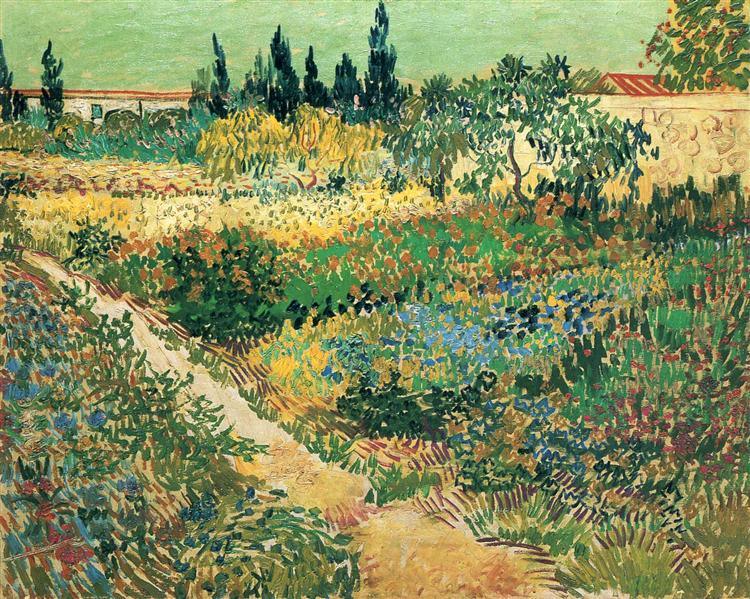
The painting shows a lush, cultivated garden crossed by dirt paths that begin in the foreground and lead the eye toward the center of the composition. The paths run through densely flowered beds, where patches of yellow, blue, violet, red, pink, and white alternate. Dark green shrubs fill the edges and the foreground, while a group of tall, slender trees rises in the central background. Beyond the vegetation, a light-colored wall encloses the space, accompanied by low structures with reddish lines beneath a pale green sky.
The subject belongs to the garden landscape genre, understood as a space shaped by human intervention yet filled with natural vitality. It is not an open, boundless landscape, but an enclosed setting composed of paths, flower beds, trees, and a constructed horizon. This combination places the scene between nature and architecture: the garden functions as a tended, habitable, enclosed place, although its abundant vegetation overflows any impression of rigidity. In the context of Vincent van Gogh’s work, this kind of subject offers a view of everyday life in his surroundings through a painting in which color and vegetation take center stage.
The profusion of flowers reinforces a sense of abundance, vitality, and renewal. Each band of color helps make the garden seem to be in constant growth, as though the plants were organizing the space through their own energy. The paths introduce a sense of movement: they not only divide the flower beds but also guide the eye into the distance, turning contemplation into an experience of moving forward. The line of trees and the enclosure establish a serene boundary, making the garden a secluded space protected by its own vegetal structure.
The horizontal composition is animated by clear diagonals. The main path rises from the lower edge toward the center-left, while another section crosses the left side and creates a spatial counterpoint. Along this network of paths, the flowers are arranged in irregular bands that create an almost musical rhythm: yellow and ochre contrast with blues and violets, while red and pink accents interrupt the continuity of the foliage. The trees in the background add depth and verticality, balancing the low expanse of the flower beds. Daylight and the even sky unify the scene without dampening its contrasts; on the contrary, they allow each area of color to retain its intensity.
The association with Vincent van Gogh places the work in a landscape tradition characterized by expressive use of color, vivid contrasts, and a rhythmic arrangement of vegetation. Here, these qualities emerge in the alternation of flower-filled bands, masses of trees, and paths that articulate the space like living architecture. Notice how the eye moves from the flowers’ chromatic details to the trees’ vertical stability, then returns to the path crossing the foreground. This movement is where the force of Garden with Flowers: an everyday landscape transformed into an experience of visual abundance and serene movement.
Have questions about our oil painting reproductions? See our frequently asked questions.