

Description
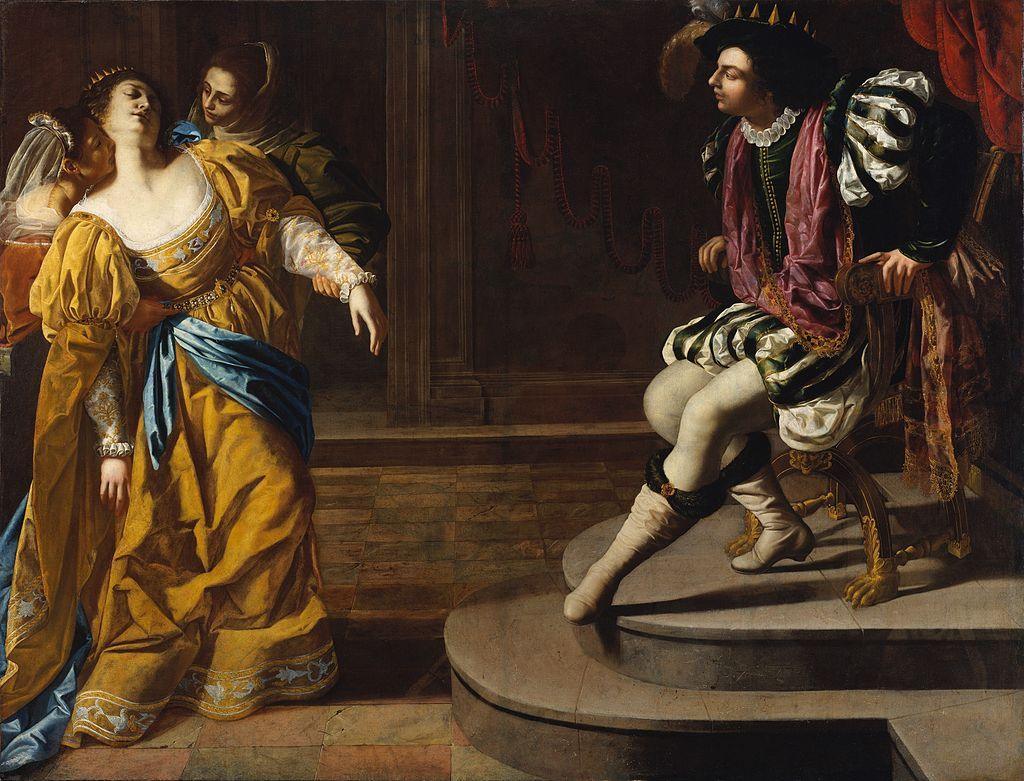
The painting shows Esther before Ahasuerus inside a palace setting, transformed into the scene of a tense audience. On the left, the protagonist wears a voluminous golden dress with blue details and leans backward, while a second figure supports her from behind. Opposite her, on the right, a seated man occupies a raised platform. His dark attire, pointed hat, ruffled white collar and puffed sleeves emphasize his courtly rank. The vertical panels, staircase, tiled floor and red drapery create a ceremonial setting that separates the two groups of figures while also bringing them together.
The episode comes from the biblical story of Esther, a Jewish woman who becomes queen of Persia. Before King Ahasuerus, Esther intercedes to protect her people, and the scene captures this moment of extreme vulnerability before royal authority. The protagonist’s leaning posture, supported by her companion, is linked to the visual tradition of depicting her weakened or fainting before the monarch. The encounter is not presented as an everyday conversation, but as a solemn plea in which each position in the space expresses a power relationship: Esther remains below and in motion, while Ahasuerus dominates the scene from a ceremonial height.
The iconography is built around the contrast between vulnerability and authority. The golden dress sets Esther apart from the dark background and makes her inclined body the composition’s main emotional focus. The figure supporting her conveys both care and urgency, reinforcing the impression that the protagonist is at the end of her strength. By contrast, the stability of the seated king and the raised structure beside him convey hierarchical distance. The textiles, moldings, and red drapery serve more than a decorative purpose: they heighten the theatricality of the audience and envelop the episode in an atmosphere of power, wealth, and restrained danger.
The horizontal composition is arranged around 2 clearly distinct focal groups. On the left, the bodies form a dynamic diagonal: the dress, the outstretched arm, and the tilt of the head guide the eye toward the center. On the right, the lines of the platform and steps steady the male figure and create a geometric counterpoint to that movement. The darker central space acts as a visual pause between supplication and authority. The palette of blacks, browns, and deep reds allows the gold, cream, and light blue tones of the figures to stand out intensely. Warm lighting focuses attention on the faces, hands, and fabrics, while the vertical panels add depth and a sense of solemn enclosure.
The work is consistent with traits widely associated with Artemisia Gentileschi: dramatic lighting, strong contrasts between luminous areas and dark backgrounds, theatrical composition, and particular attention to the expressive power of female figures. Here, that sensibility turns a biblical episode into a visual drama of power and vulnerability, without sacrificing the material richness of the courtly setting. Esther’s golden adornment does not present her simply as a sumptuous figure, but as the fragile, luminous center of the scene; opposite her, Ahasuerus’s elevated position and the palace architecture organize the space into a visible hierarchy. The meaning of the painting arises from this tension between movement and stillness, supplication and authority, and is concentrated in the contrast between Esther’s illuminated figure and the raised throne facing her.
Have questions about our oil painting reproductions? See our frequently asked questions.