

Description
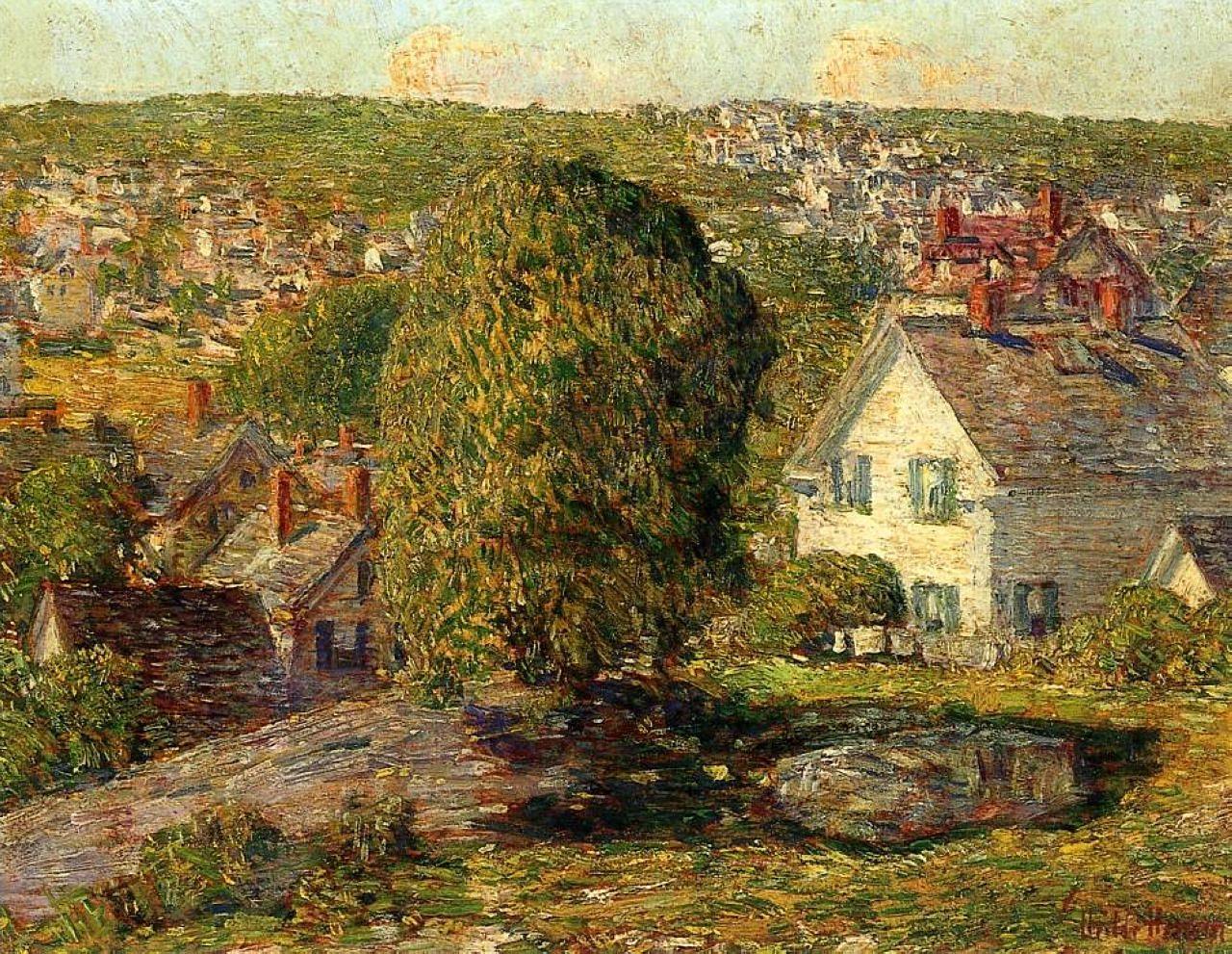
The painting depicts the outskirts of East Gloucester as an open rural landscape, extending across a hillside covered with homes and vegetation. A large, irregularly crowned tree stands at the center, rising from the foreground into the middle distance and partially obscuring the houses clustered behind it. Around it are paths or patches of bare earth, shrubs, and gardens, while the sloping rooftops and numerous brick chimneys form a line of habitation in the background. Pale façades, gray and reddish rooftops, and a light sky create a tranquil, luminous scene in which the settlement gradually merges with the terrain.
As a landscape, Outskirts of East Gloucester stands at the threshold between the countryside and the built community. It does not present a monumental view or an isolated piece of architecture, but rather a residential area seen from an open space, with homes gathered along the hillside. Its interest lies in the coexistence of the natural and the inhabited: the tree, low vegetation, and path belong to the rural world, while the chimneys and concentration of rooftops suggest an ongoing domestic life. The scene turns an everyday setting into a pictorial subject that rewards unhurried observation.
The large tree serves as a visual intermediary between the viewer and the village. Its foliage interrupts a direct view of the houses, creates depth, and allows the settlement to emerge in fragments: a triangular façade, a dark roof, a row of chimneys, or a dense cluster in the background. This partial concealment adds rhythm and suggests that the community extends beyond what the eye can take in. The path and open terrain reinforce the sense of gradual approach, guiding the viewer’s attention from the breadth of the foreground toward the intimacy of the homes.
The composition is arranged in horizontal bands—the sky, the built-up hillside, and the vegetated ground—crossed by the vertical axis of the central tree. This structure guides the viewer’s attention without making it rigid: first, the mass of foliage catches the eye; then the houses come into view; finally, the details in the foreground draw the gaze. Olive and dark greens mingle with ochres and golden yellows, while slate gray, brick red, and cream white distinguish the architecture. The visible brushwork and dense chromatic texture prevent the surfaces from appearing uniform; each area shimmers with subtle variations that make the diffuse light palpable.
The work reflects Childe Hassam’s association with American Impressionism, particularly in its attention to atmospheric light, vibrant color, and evident brushwork applied to urban and landscape scenes. Here, that sensibility is focused on an outlying area where built life disperses among trees, roads, and gardens. The tree organizes both the form and the meaning: it divides without isolating, conceals without erasing, and connects the open ground with the pattern of rooftops in East Gloucester. The painting thus transforms an everyday view into an experience of rhythm, proximity, and light, guided by the contrast between the central mass of vegetation and the inhabited continuity of the hillside.
Have questions about our oil painting reproductions? See our frequently asked questions.