

Description
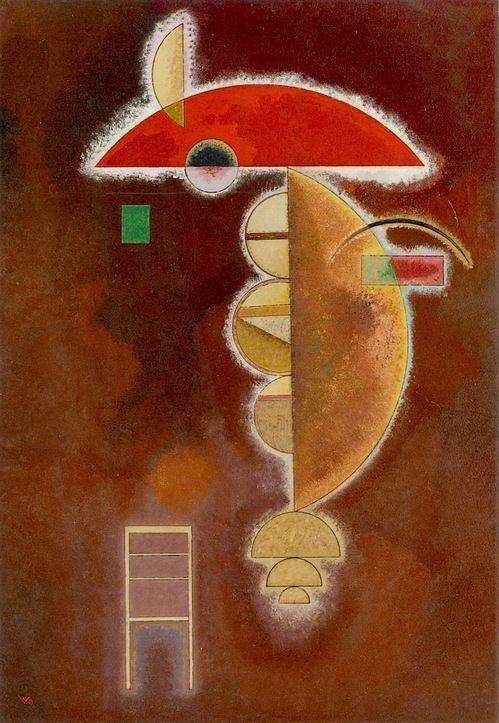
The painting shows a dense, carefully balanced vertical abstract composition against a reddish-brown background. A large red semicircle dominates the upper section, crossed by a curved yellow form rising over its left side and accompanied by a small grayish-yellow circle. On the right, a large semicircular mass in ochre, orange, and yellow occupies much of the space, while a column of yellow circles and semicircles descends through the center, partially covered by that larger form. Green, red, and yellow rectangles are integrated into the structure, along with an elongated rectangular motif in the lower-left area and a series of small yellow arches toward the bottom.
As an abstract work by Wassily Kandinsky, “Depressed” presents no narrative scene, recognizable figures, or historical episode to decipher. Its subject is built through relationships between color, geometry, and space. The title directs the viewer’s attention toward a state of dejection or withdrawal, expressed not through a face or bodily gesture but through the concentration of overlapping forms and an arrangement that seems to contain its own movements. The painting thus transforms an emotional experience into a visual architecture, in which every circle, arch, and block of color contributes to a compact system.
The weight of the upper red semicircle and the large ochre curve on the right reinforces an impression of pressure and density. The repeated, partially concealed central forms create a restrained rhythm, as if the composition were advancing in layers without finding an open exit. The whitish halos surrounding several outlines separate the figures from the dark background and heighten their isolation: each element becomes clearly visible, yet remains confined within its own boundary. The small colored rectangles introduce lively interruptions into this enclosed field, acting as accents that add tension to the overall austerity.
The formal structure guides the eye from the broad red figure at the top toward the central axis and then to the curved mass on the right and the lower yellow arches. The composition is asymmetrical, yet maintains a dynamic balance between the concentrated weight on the right and the rectangles that counterbalance the left side. The dark lines define the silhouettes precisely, while the variations and mottling in the reddish-brown background create a less stable surface that contrasts with the geometric clarity of the figures. The result combines order and friction: the circles and semicircles suggest continuity, but the overlapping forms interrupt their course.
The work is connected to Wassily Kandinsky’s exploration of abstraction through geometric forms, chromatic contrasts, and rhythmic relationships between color and structure, without relying on figurative representation. In “Depressed,” this exploration takes on an earthy, introspective tone. Notice how the red area at the top and the ochre arch on the right seem to compress the central space, while the white halos keep the elements of the composition apart. The title draws its power from the tension between a carefully organized system and a persistent sense of confinement: the emotion is not illustrated, but constructed through the way the forms cluster, overlap, and leave only small intervals in which to breathe.
Have questions about our oil painting reproductions? See our frequently asked questions.