

Description
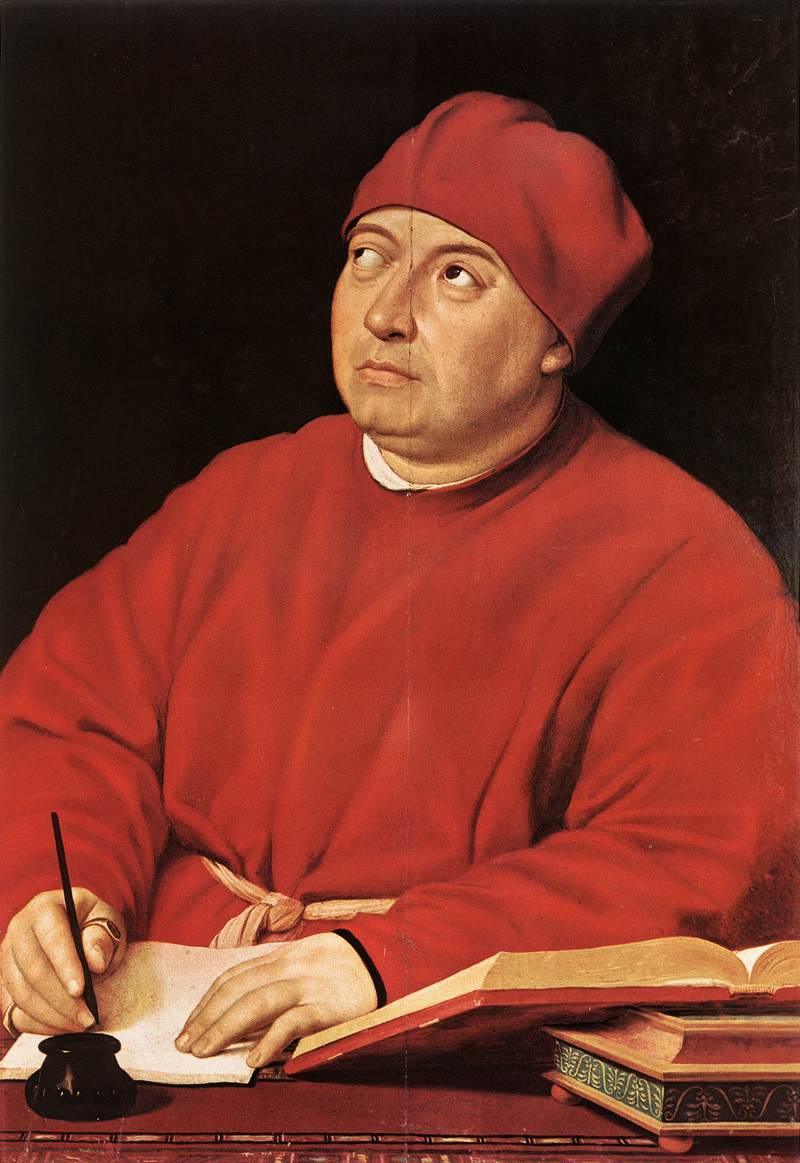
The painting depicts Tommaso Inghirami seated at a writing desk, shown from the waist up and dominating the entire composition. He wears a voluminous red robe topped with a cap of the same color, with a white collar and a light-colored cord tied around his waist visible beneath it. His right hand holds a quill, while his left rests on the papers spread out before him. A dark inkwell occupies the lower-left corner; beside the manuscripts, a large open book and another partly closed volume complete the reddish surface of the table. His gaze, directed upward and to the left, introduces a reflective pause into this writing scene.
The portrait places Inghirami within the world of Renaissance humanism, presenting him as a man of letters associated with the papal court and the literary and intellectual life of his time. The table serves not merely as a surface for objects: it characterizes the subject through his relationship with study. The books, papers, ink and quill present written culture as a visible part of his identity. In this way, the portrait combines personal recognition with social representation: it depicts a specific individual, while also embodying the prestige of the scholar in the intellectual life of the Renaissance.
The writing implements serve as attributes of knowledge and concentration. The inkwell and quill directly connect the figure with literary production, while the open book makes the mental world of study visible and turns the table into an extension of his thought. The red robe reinforces the sitter’s visual authority and creates a striking contrast with the black background. This isolation focuses attention on his face, hands and working tools. His gaze, directed away from the frontal axis, adds an introspective dimension: the subject seems to pause in his writing for a moment to attend to an idea, a presence or a reflection.
The vertical, centered composition organizes the scene around a monumental figure. The head occupies the upper area, while the hands and objects form a densely articulated band below, drawing the viewer’s attention from the face down to the intellectual activity. The red of the garment dominates the surface and visually connects the figure to the table, while the creamy whites of the pages introduce luminous pauses among the dark masses. The uniform background eliminates any spatial distractions and gives each object on the table added weight. Clear contours, a stable pose, and chromatic contrast create an image that is restrained, resolute, and psychologically intense.
In Raphael’s work, this portrait’s construction brings together clarity of drawing, balanced dignity, and a characterization that goes beyond physical likeness. The figure retains a serene, monumental presence, while the books and manuscripts place him in a world of thought, writing, and memory. The result is a portrait in which identity is articulated through the body and its attributes: red makes authority visible, the black background heightens concentration, and the table reveals the activity that defines the sitter. Notice how the gaze and hands connect two distinct areas of the painting: above, reflective awareness; below, the concrete work of the written word.
Have questions about our oil painting reproductions? See our frequently asked questions.