

Description
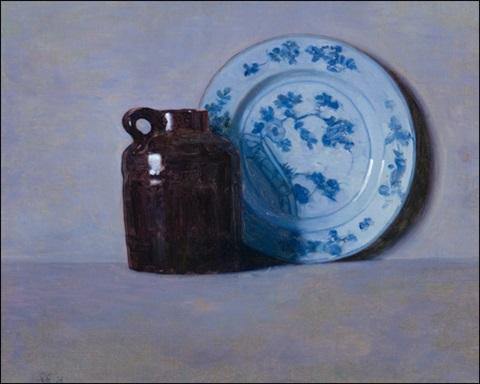
The painting depicts a still life composed of two household objects arranged on a bluish-gray surface: a dark pitcher occupies the foreground, slightly offset to the left, while a round plate decorated with blue flowers and leaves rises behind it. The pitcher has a broad body with a softly rounded rectangular outline, a narrow mouth, and a curved handle silhouetted against the background. The plate, partly obscured by the vessel, introduces a lighter, more ornamental presence. The arrangement stands out against a plain background in lavender-gray and bluish-gray tones, with no incidental elements to distract from the relationship between the two pieces.
As a genre, still life turns everyday objects into the subjects of a concentrated, quiet scene. Here, the pitcher and plate do not form a narrative episode but a small domestic architecture based on proximity, overlapping forms, and contrast. The simplicity of the subject allows the eye to focus on the shapes, decorative rhythms, and the way light organizes the space. The scene thus takes on an intimate character: set apart from any narrative context, the objects hold the viewer’s attention in their own right and establish a tranquil relationship on the table.
The plate’s blue floral decoration serves as the work’s main ornamental focus. Its leaves and flowers introduce a delicate rhythm that contrasts with the pitcher’s chromatic and geometric austerity. The proximity of the two objects encourages a reading centered on materiality and domestic use: the pitcher carries the visual weight, while the plate adds lightness, circularity, and a decorative accent. The shadows cast beneath the pitcher and to the right reinforce the sense of contact with the surface and make the lighting an expressive element. The object does not float; it is anchored in a specific, intimate, unhurried space.
Formally, the work rests on a static, balanced composition. The pitcher concentrates the mass in the left foreground, while the plate counterbalances it with a circular shape positioned behind it and to the right. The overlapping forms create depth without recourse to a complex setting: the stepped arrangement of the surface, pitcher, and plate establishes distinct planes. The cool palette of the background and base enhances the sense of stillness, while the vessel’s dark brown serves as a warm, weighty counterpoint. The lateral shadows extend the silhouettes and guide the eye from the body of the pitcher to the plate’s decorated rim.
In the context of Newell Convers Wyeth’s work, this painting presents itself as an exercise in visual clarity and a focus on the objects’ force, without turning the subject into an explicit narrative. The title, Still Life with Plate and Pitcher, sums up this economy: two objects, a surface, and a carefully measured arrangement. Interest centers on the interplay of weight and lightness, darkness and brightness, volume and ornament. The pitcher partly conceals the plate while, at the same time, making its floral decoration stand out more vividly; within this simple tension lie the painting’s structure and intimate character.
Have questions about our oil painting reproductions? See our frequently asked questions.