

Description
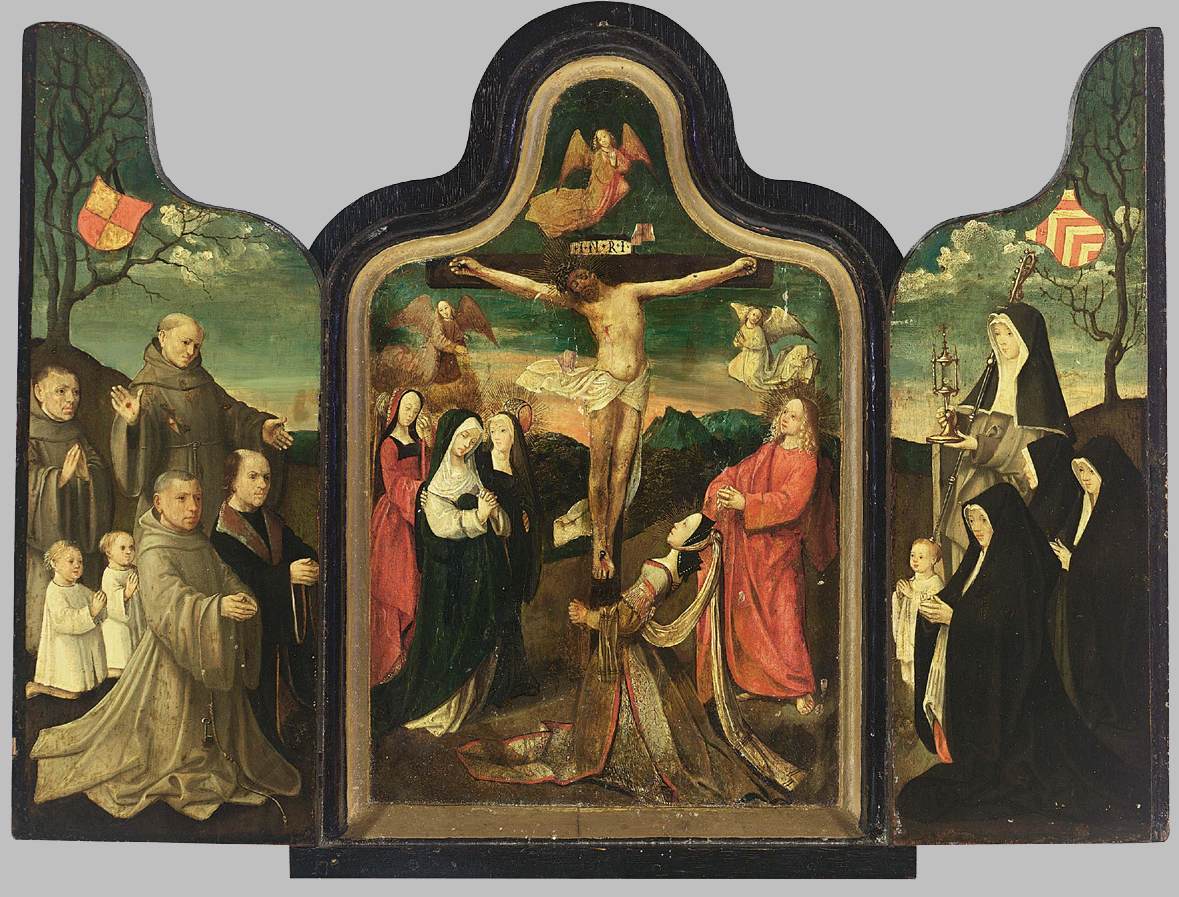
The painting depicts the Crucifixion of Christ, arranged as a triptych with a vertical structure and pronounced symmetry. In the central panel, the crucified figure rises above a wooden cross, beneath a small inscription, while several figures gather at its foot in attitudes of prayer and mourning. Women in veils and dark garments cluster beside figures dressed in red and gold; a kneeling figure, covered in ornate clothing, occupies the foreground. Two winged figures flank the scene, and another appears at the top, within an arched opening. The side panels expand on the episode with groups of religious men, women in habits and several children, all set within landscapes of trees, hills and a greenish sky.
The Crucifixion is the central narrative of the Passion of Christ: the depiction of his death on the cross, an event that Christian tradition associates with sacrifice, redemption and salvation. The triptych format allows this episode to be focused in the center, with a space for communal prayer extending around it. The figures on the sides can be viewed as witnesses and devotional participants, gathered before the sacred event rather than forming a merely decorative crowd. The presence of religious men, women and children also lends the scene a collective dimension, as though the image brings biblical history together with the experience of those who contemplate it.
The cross dominates not only through its position but also through its verticality, which connects the earth with the winged figure above the scene. The wings near the crossbeam reinforce the episode’s celestial dimension, while the gestures of clasped hands and bowed bodies visually convey prayer, compassion, and mourning. The red of some garments draws the eye and creates an emotional counterpoint to the blacks, greens, and browns of the composition. At the sides, the trees with dark branches act as a natural frame that separates the devotional communities from the open landscape while also connecting them to it. The shields or emblems among the branches add heraldic accents to the altarpiece’s visual architecture.
The composition guides the eye through a succession of vertical axes: the cross at the center, the arches framing it, and the upright figures in the side panels. Against this stability, the kneeling, bowed, or gesturing bodies introduce a more human and changing rhythm. The landscape of hills opens up depth behind the central group, while the black moldings and fine gold lines keep the scene contained, almost like a ceremonial space. The muted palette of greens, ochres, and browns sustains the gravity of the subject, while the reds, creamy whites, and golden reflections highlight faces, hands, and attributes. The viewer’s attention thus shifts between Christ’s body and the silent responses of those around him.
In the context of Jacob Cornelisz van Oostsanen’s work, the ensemble can broadly be situated within the devotional tradition of early 16th-century Netherlandish painting, recognizable here in the meticulous arrangement of the groups, the vivid colors, and the integration of the landscape into the religious narrative. The work’s appeal lies in turning the Crucifixion into a collective image of prayer: the cross provides the axis, the winged figures open up a supernatural dimension, and the communities in the side panels extend contemplation toward the edges. It is worth noting how each gesture and each block of color draws the eye back to the center, making the triptych’s architecture an active part of the scene’s spiritual meaning.
Have questions about our oil painting reproductions? See our frequently asked questions.