

Description
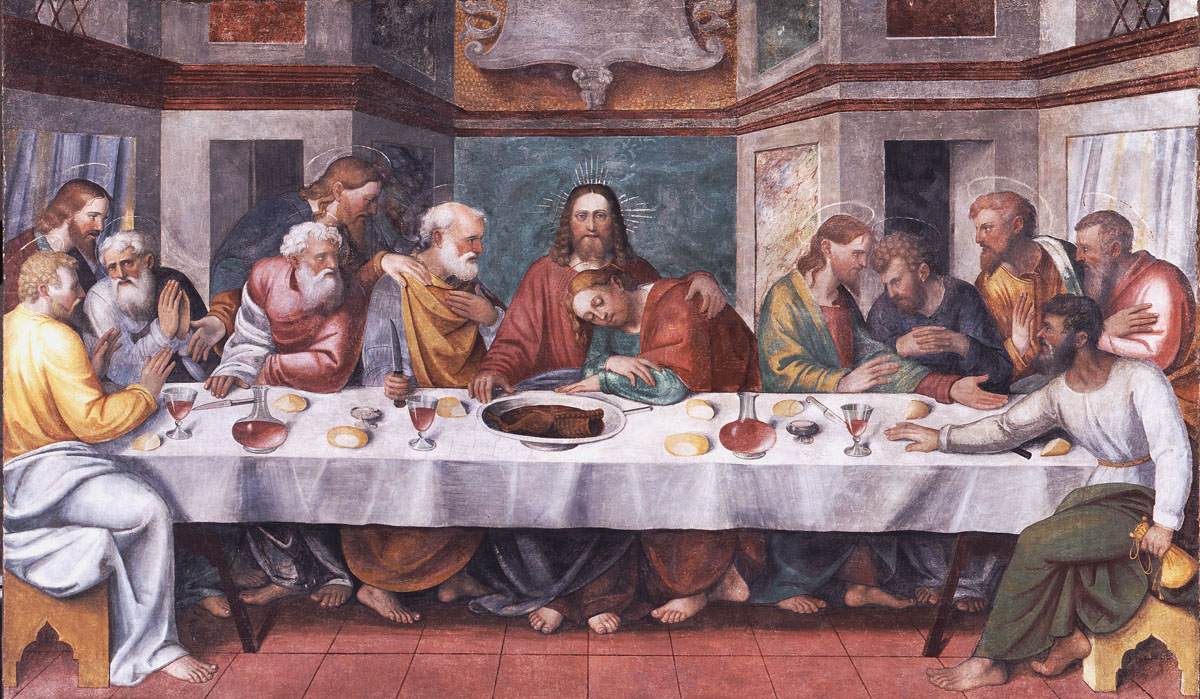
The painting depicts The Last Supper as a group scene unfolding around a long table. Thirteen male figures occupy both sides and the ends of the white tablecloth, while Christ, bearded and dressed in red, sits at the center, distinguished visually from the group by a radial halo. The apostles react in a wide variety of poses: some lean toward their neighbors, others raise their hands, point or converse, and one figure rests his head on Christ’s shoulder. Bread, goblets, plates, bowls and an oval platter bearing roasted food are arranged across the table. The gathering takes place in an interior defined by side windows, light-colored curtains, decorative panels, dark moldings and a reddish tiled floor.
In Christian tradition, the Last Supper is Jesus’ final meal with his twelve apostles before the Passion. The episode brings together the intimacy of a shared meal and the revelation of an impending betrayal, turning the table into both a gathering place and a setting for narrative tension. The bread and wine connect the scene with the institution of the Eucharist, while Christ’s presence on the central axis arranges the disciples around him. The composition thus preserves two inseparable dimensions: the human event, marked by the participants’ reactions, and its sacramental significance within the Passion cycle.
The radiant halo serves as Christ’s primary iconographic attribute, drawing the eye before it moves on to the apostles. The table, covered with a luminous cloth, provides a shared surface on which the bread and cups take on particular significance. The arrangement of objects is not merely decorative: it reinforces the ritual meaning of the meal and establishes a visual rhythm that runs throughout the scene. The gestures and inclinations, in turn, create a chain of responses around the center. Raised hands, leaning bodies, and glances directed toward those nearby turn the gathering into an image of collective conversation, surprise, and anticipation.
Formally, the work is built around a horizontal, almost symmetrical structure. The table acts as a dominant line crossing the foreground, while the architectural moldings and floor tiles extend the sense of order and depth. Against this geometric stability, the figures introduce diagonals, curves, and shifts in scale through their arms, leaning torsos, and turned heads. The red of the central robe stands out against the grayish blues, ochres, muted greens, pinks, and whites of the garments. Soft frontal lighting unifies the scene, while the light-colored tablecloth and the halo create two luminous focal points that guide the eye from the material space of the table toward the figure of Christ.
In this work by Paolo da Caylina the Younger, solemnity does not depend on absolute stillness, but on the contrast between the stable architecture and the participants’ expressive agitation. The scene feels theatrical because each figure contributes a distinct posture and gesture, while all remain connected by the table and the central axis. It is worth observing how the tablecloth, vessels, and hands form a band of activity that balances Christ’s serene presence. The result is an interpretation of The Last Supper in which the religious event is constructed simultaneously as ceremony, conversation, and shared tension.
Have questions about our oil painting reproductions? See our frequently asked questions.