

Description
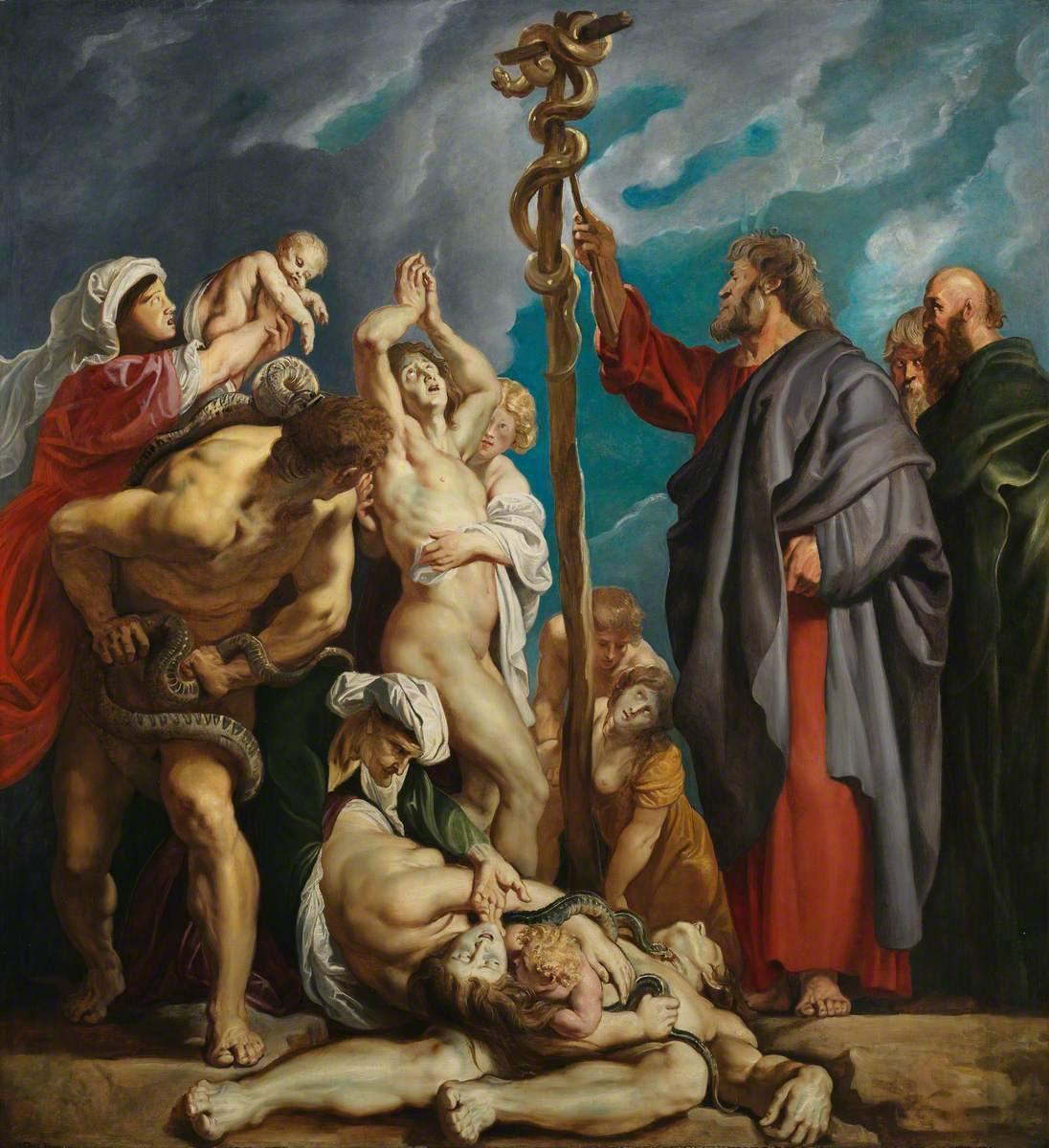
The painting depicts Moses and the brazen serpent in a collective scene of danger, supplication, and hope. On the right, the bearded figure holds a vertical staff, its upper end encircled by two intertwined serpents. A group of figures crowds around him: a veiled woman holds a baby on the left; a muscular man bends among serpents coiling around his body; in the center, a nude figure raises their arms and clasps their hands. Below, several figures appear kneeling, reclining, or lying among fabrics, bodies, and reptiles. The turbulent blue-gray sky opens onto a dramatic backdrop behind this compact group, while a strip of brown ground supports the scene.
The episode comes from the Book of Numbers and takes place during the Israelites’ journey through the wilderness. According to the biblical account, the community is punished with venomous snakes, and, in response to their suffering, God instructs Moses to raise a bronze serpent on a staff. Those who have been bitten must look toward it to be healed. The painting brings together, in a single moment, the community’s affliction and the promise of relief: the wounded or stricken figures occupy the foreground, while Moses rises above them as the visible mediator of a saving response.
The staff organizes the meaning and structure of the work. Its vertical line cuts through the tumult of bodies and leads the eye to the elevated symbol, a counterpoint to the serpents coiling around the man on the left and crossing the foreground. The reptiles make tangible the threat afflicting the group; the raised serpent, by contrast, transforms that same motif into a sign of healing. Raised arms, clasped hands, and faces turned upward form a collective response of pain and trust. The nudity of several figures heightens their vulnerability, while the reddish, white, and violet draperies introduce points of intensity amid the general agitation.
Formally, the composition rests on a powerful tension between verticality and diagonals. The staff serves as the central axis, but the inclined poses, overlapping bodies, and sinuous lines of the serpents extend the movement toward the edges. The lower group forms an irregular, weighty base from which the eye rises to Moses and the ornamentation above. The contrast between the open sky, rendered in bluish grays and turquoise, and the dense bodies in the foreground heightens the sense of urgency. Carmine reds, golden ochres, dark greens, and creamy whites visually distinguish the figures and create a chromatic rhythm that guides the eye from one gesture to the next.
The work is associated with traits widely linked to Peter Paul Rubens: vigorous anatomy, intense gestures, a profusion of figures, and a dynamic construction of the religious narrative. The Baroque energy depends not only on the number of figures, but also on how each body takes part in a chain of movements leading toward Moses’ staff. It is especially worth noting the contrast between the serpents invading the ground and the raised sign that dominates the composition: this dialogue encapsulates the transformation of punishment into the possibility of healing. Thus, the chaos of bodies, fabrics, and reptiles is ordered by a single upward line of faith and hope.
Have questions about our oil painting reproductions? See our frequently asked questions.