

Description
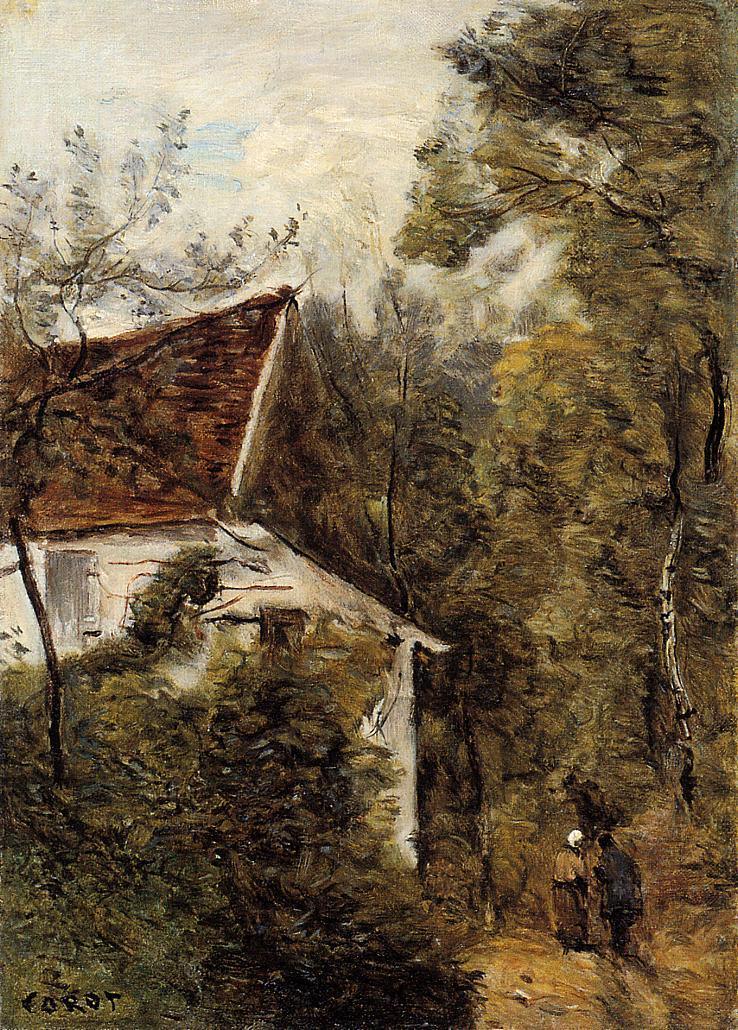
The painting depicts a rural landscape in Luzancy, organized around a path that runs through a grove beside a house. Partially hidden by vegetation, the building occupies the left half of the composition and is recognizable by its large, sloping dark reddish roof and pale walls. From the center, a bright strip descends toward the foreground, leading the eye between shrubs, grasses and tree trunks. In the lower right, a small human figure follows the path, lending the setting an intimate scale. Tall trees, spreading branches and dense foliage enclose the space without completely isolating it: a pale sky opens above the grove, letting in soft light.
The work’s interest lies not in a historical or religious narrative, but in the experience of a place that is inhabited and traversed. The house anchors the landscape in everyday reality, while the path establishes a direct relationship between the architecture, the forest and the viewer. Luzancy thus appears as a rural setting where human presence coexists with abundant nature, suggested more by masses of vegetation and shifts in light than described with topographic precision. The small figure does not take part in any specific action; it serves as a silent companion to the landscape, making the wooded expanse feel traversable, intimate and contemplative.
The path forms the principal axis of visual meaning. Its lightness sets it apart from the surrounding greens and browns, turning it into a guide leading into the grove while also connecting the shadowy background with the viewer’s foreground. The partially hidden house suggests a balanced coexistence between domestic life and nature, without imposing on it. The tiny figure introduces an everyday, contemplative dimension: against the vastness of the trees, the human presence seems integrated into the rhythm of the place. The contrast between the sky’s luminous openness and the dense darkness of the foliage reinforces a sense of seclusion, as if the landscape alternated between areas of exposure and shelter.
The vertical, asymmetrical composition distributes visual weight with great effectiveness. The house and the finer branches occupy the left side, while the large tree on the right acts as a natural frame enclosing the scene. Between the two sides, the light band creates depth and establishes a path through the scene, preventing the vegetation from appearing as a solid mass. The palette of olive and dark greens, ochres, browns, bluish greys, and creams maintains a restrained harmony, interrupted by the reddish hue of the roof. The diffuse light softens the contours and makes the space take shape through tonal transitions: the eye moves from the pale sky to the treetops, from the treetops to the shrubs, and from there to the sunlit path. The result is a tranquil depth that is more atmospheric than geometric.
This work by Camille Corot reflects a landscape approach grounded in atmosphere, filtered light, and restrained tonal harmonies. The artist transforms an apparently simple subject—a house beside a wooded path—into a highly concentrated spatial experience, in which each mass of foliage contributes to the overall balance. As you look at it, follow the path of the band of light and observe how the small figure, the architecture, and the large tree define the distances. This journey reveals that the landscape is not merely a rural setting: it is an invitation to contemplation, in which human presence is measured against the quiet expansiveness of the forest.
Have questions about our oil painting reproductions? See our frequently asked questions.