

Description
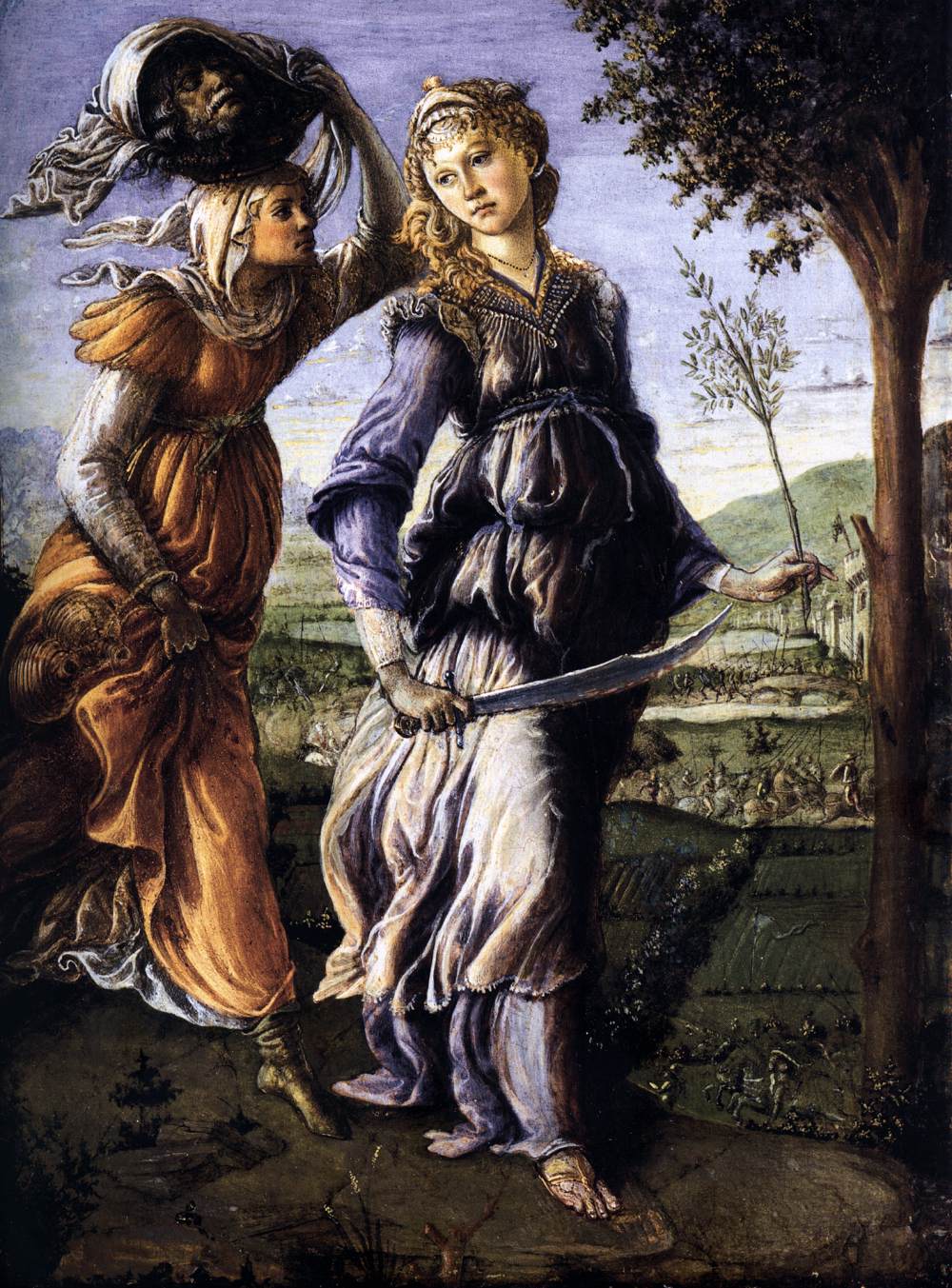
The painting shows Judith as she returns to Bethulia, accompanied by her servant through a rural landscape. The heroine stands at the center of the composition, wearing a dark dress with wide sleeves and a light overskirt; she holds a curved-blade sword in her hands, its blade crossing the lower part of the scene diagonally. Her companion, dressed in ochre and with a light cloth around her head, raises a large dark fabric above herself. To the right, a tree with a dense canopy frames the scene, while a sapling rises beside Judith’s outstretched hand. Fields, hills, and small buildings draw the eye toward a luminous horizon.
The episode comes from the biblical Book of Judith. After defeating Holofernes, commander of the Assyrian army, Judith returns to Bethulia with her servant. Her deed is traditionally understood as the liberation of the threatened city and as a victory achieved through courage, intelligence, and determination. The scene does not depict the most violent moment in the story, but its aftermath: the two women’s passage through a land once again under the protection of its community.
The sword is Judith’s most immediate attribute, concentrating in a single object the memory of the confrontation and the heroine’s authority. The second figure introduces a sense of cooperation and companionship, moving the interpretation away from a wholly individual triumph. The dark cloth, raised above the servant’s head, adds a dramatic accent and creates a silhouette that contrasts with the lilac sky. Beside them, the young tree reinforces an image of renewal: its growth accompanies the return of an ordered life after the threat. The cultivated landscape extends the episode’s meaning beyond a personal feat to encompass the security of an inhabited land.
The visual composition is built around a tension between vertical and diagonal lines. The central figure, the young tree, and the trunk of the larger tree establish an upward rhythm, while the sword introduces an oblique line that activates the lower area and guides the eye toward the background. The clearly defined outlines of the figures distinguish their bodies from the landscape, while the recurring greens, ochres, browns, and violets maintain a chromatic connection between the foreground and the horizon. Light is concentrated on the faces and light-colored garments, bringing the expressions and gestures into relief against the dark vegetation. The hills and terraced fields create depth without competing with the main narrative.
In relation to Sandro Botticelli’s work, this painting reflects a sensibility characterized by elegant, linear figures, precise outlines, and expressive gestures, in which religious narrative is combined with a lyrical landscape. The delicacy of the silhouettes does not diminish the gravity of the episode; instead, it transforms it into an image of contained tension. The sword evokes the recent battle, while Judith’s outstretched hand gestures toward the young tree and the open space. Between these two gestures—defense and continuity—the painting turns the return to Bethulia into a visual meditation on survival and renewal.
Have questions about our oil painting reproductions? See our frequently asked questions.