

Description
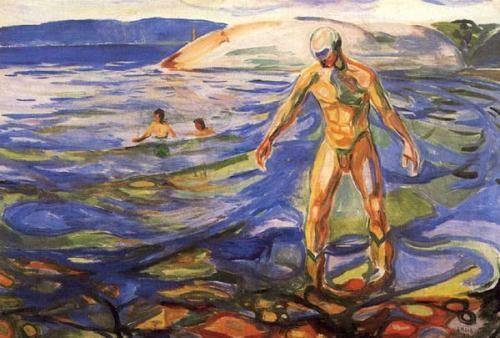
The painting shows men bathing in open water, with a central standing figure who immediately becomes the focal point of the composition. The bather is in the water, his arms relaxed at his sides and his head slightly inclined, while two partially submerged figures occupy the middle ground. A broad expanse of water stretches around them, crossed by ripples and reflections in blue, violet, green, white, and ochre. The coastal horizon and bright sky open the scene into the distance; in the foreground, intensely colored rocky and earthy forms surround the feet of the main figure and reinforce his physical presence.
The subject is an outdoor scene of men bathing. The work does not develop a complex narrative action, but instead focuses attention on the relationship between the body, the water, and the landscape. The three bathers share an open space in which an everyday activity takes on a broader pictorial dimension: the human body is integrated into the rhythm of the waves and the luminous expanse of its surroundings. In Edvard Munch’s artistic development, this focus on intense color, visible brushwork, and expressive simplification places the scene close to the emergence of modern Expressionism.
The upright figure serves as a steady human presence against the horizontal movement of the water. His verticality guides the eye and creates a contrast between the body, which rises from the surface, and the undulating bands extending around it. The two background figures broaden the scene’s collective interpretation of bathing: this is not an individual in isolation, but a shared observation of the body and outdoor life. The open horizon connects the bathers to the landscape, while the masses of color in the foreground provide an almost tactile visual foundation, as if the land and water shared the same chromatic pulse.
The formal composition relies on the tension between horizontal lines and a dominant vertical axis. Water occupies much of the surface and is rendered with broad, visible, shifting brushstrokes that create a sense of continuous movement. Blues and violets intertwine with greens, whites, ochres, and oranges, so that the reflections do not simply describe a surface but turn the aquatic space into a structure of color. The lighter sky brightens the upper area, while the dark forms of the horizon and the intense tones in the foreground balance the weight of the central figure. Depth emerges from the succession of planes and the diminishing size of the figures, rather than from rigid perspective.
In Bathing Men, Edvard Munch transforms an everyday scene into a dynamic composition of bodies, water, and landscape. His expressive treatment simplifies the forms without diminishing their physical force: each figure is identifiable by its posture and its relationship to the water’s surface. The work’s appeal lies in observing how the central bather organizes a visual field dominated by color and brushwork, while the secondary figures and the horizon extend that rhythm into the background. The scene invites the viewer to move through it from bottom to top: from the masses of land in the foreground to the ripples, the bodies, and finally the luminous expanse of sky.
Have questions about our oil painting reproductions? See our frequently asked questions.